How to Choose a Philadelphia SEO Company: 12 Key Questions
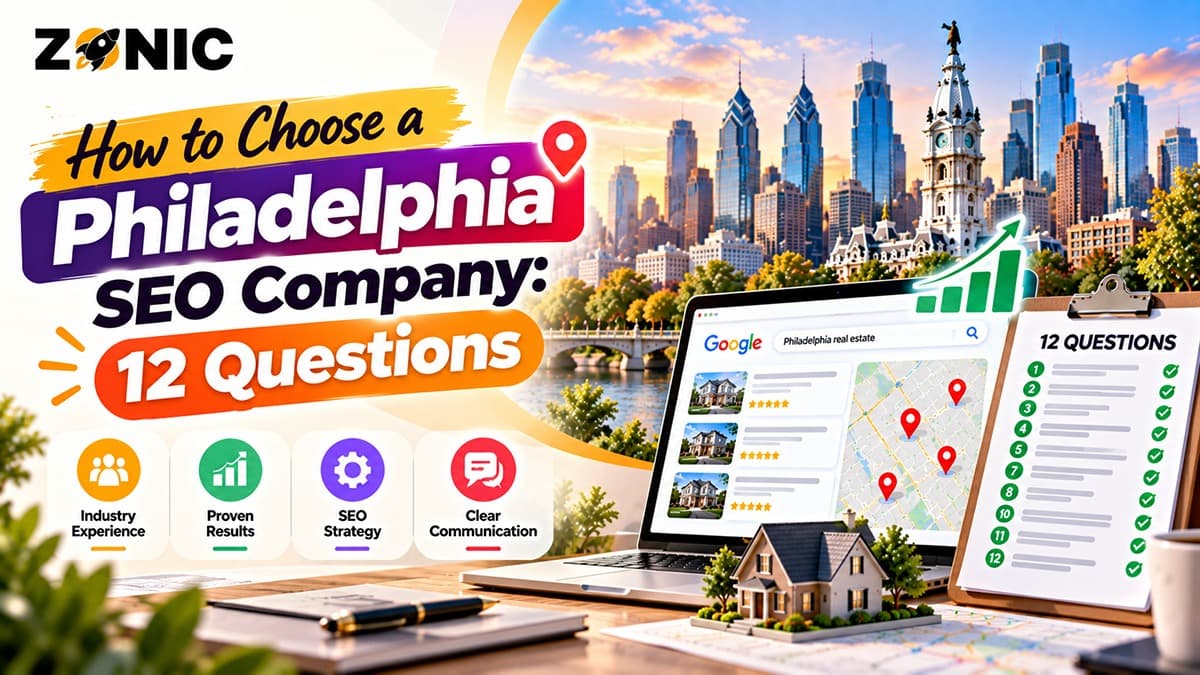
The right Philadelphia SEO agency should be able to answer these 12 questions clearly.
That matters because choosing an SEO company is not simply about rankings. You are choosing a partner that may influence your website, Google Business Profile, content, analytics, local visibility, conversion paths, and the way potential customers find your business online.
Plenty of agencies can show keyword reports. Plenty can promise more traffic. What matters is whether they can explain what your Philadelphia business actually needs, why those priorities matter, and how their work connects to qualified leads.
The best SEO company Philadelphia businesses can hire should be practical and transparent. It should understand the difference between organic SEO and local SEO, know how to evaluate competitors, identify which pages need attention, understand Google Maps visibility, create useful content, and explain how results will be measured.
A strong strategy should also reflect the type of business being promoted.
A law firm competing in Center City will not have the same search priorities as a roofer serving Philadelphia and surrounding suburbs. A dentist, med spa, HVAC company, real estate firm, restaurant, auto repair shop, or B2B company may each require a different approach.
This guide covers 12 questions to ask before hiring a Philadelphia SEO company, along with the warning signs that can help you avoid the wrong provider.
Why Local Experience Matters
An SEO company does not have to sit on the same Philadelphia block as your business to understand local search.
What it does need is the ability to understand how geography, competition, customer behavior, and search intent change from one market to another.
A business targeting Fishtown may face a different local search environment from one focused on Center City, South Philadelphia, University City, Manayunk, King of Prussia, Cherry Hill, or the Main Line.
A service-area company may need visibility across several communities. A storefront may care more about nearby searches, Maps visibility, customer reviews, and people looking for directions.
Local experience matters because Philadelphia SEO is not simply about adding the city name to a page.
It requires understanding where customers search, what they search for, and which competitors already hold strong positions.
Philadelphia SEO Should Connect Organic and Local Search
A good agency should understand both website SEO and local search visibility.
Your website needs useful pages, clear structure, strong internal links, relevant content, and a good mobile experience. Your Google Business Profile should accurately represent the business and support the same services and locations shown on your website.
Google describes local rankings in terms of relevance, distance, and prominence.
A good agency should therefore understand how accurate categories, services, website content, reviews, links, reputation, and broader business information contribute to local visibility.
It should also understand that distance places real limits on local rankings. A business cannot simply add more service areas and expect equal Maps visibility everywhere.
If an agency only talks about publishing blogs and ignores local search, reviews, business information, and Google Business Profile, it may not be the right fit for a local Philadelphia campaign.
Question 1: What Philadelphia Searches Can We Realistically Win?
Before an agency promises rankings, ask which searches it believes your business can realistically compete for.
A professional SEO company should review your current visibility, website strength, competitors, services, target locations, existing content, and business goals before making that judgment.
Some keywords may be highly competitive.
A newer law firm may not immediately outrank established firms for “personal injury lawyer Philadelphia.” A new roofing company may have difficulty competing for the broadest citywide terms.
That does not mean SEO has no opportunity.
There may be stronger opportunities around specific services, customer problems, geographic areas, longer search phrases, and high-intent local searches.
The Answer Should Include Search Intent
Keyword research should explain what the searcher is trying to accomplish.
Someone searching “what is SEO” is mainly looking for information.
Someone searching “how much does SEO cost in Philadelphia” is researching a possible purchase.
Someone searching “Philadelphia SEO company” is much closer to choosing a provider.
A good SEO agency should know the difference.
Search volume matters, but intent matters just as much. A smaller keyword that attracts the right customer may be more valuable than a high-volume phrase that rarely produces inquiries.
Question 2: How Will You Audit Our Website?
An SEO strategy should begin with diagnosis.
If an agency recommends a large package without first understanding your website, ask how it reached that conclusion.
A website review may include technical SEO, indexability, site structure, titles, headings, internal links, content quality, page performance, mobile experience, analytics, Search Console data, conversion paths, and competitor gaps.
The agency should also review whether important service pages already exist and whether those pages are strong enough to compete.
A Real Audit Should Prioritize Problems
A long list of SEO issues is not the same thing as a useful audit.
Some problems matter much more than others.
A missing high-value service page may deserve attention before a minor metadata adjustment.
A contact form that does not work may be more important than publishing another blog.
Poor site architecture may need to be addressed before adding dozens of new pages.
The audit should result in a priority list based on business impact, not simply a software export containing hundreds of warnings.
Question 3: How Will You Handle Google Business Profile?
For many local businesses, Google Business Profile can become an important source of visibility and customer actions.
Ask whether the agency will review your business name, primary category, additional categories, address configuration, service areas, hours, services, photos, reviews, website link, and possible duplicate profiles.
A Philadelphia SEO agency should also understand that Google Business Profile work needs to be handled carefully.
Keyword-stuffed names, fake locations, unsupported addresses, duplicate city profiles, and aggressive category changes can create unnecessary risk.
GBP Work Should Be Safe and Accurate
The purpose of Google Business Profile optimization should be to represent the real business accurately.
If your company operates as a service-area business, the agency should understand Google's eligibility and address-display requirements. When customers do not visit a business at its location, the address may need to be hidden from public view.
For a storefront or customer-facing office, the profile should accurately reflect the real-world location.
If your business has multiple locations, the agency should confirm that each location is legitimate and eligible rather than creating extra profiles simply to target more cities.
Accurate setup should come before ranking tactics.
Question 4: What Will You Do in the First 90 Days?
An agency should be able to explain what the early stage of the campaign will look like.
The first 90 days should not be a mystery.
Early work often includes audits, analytics review, Search Console review, tracking setup, competitor research, keyword mapping, Google Business Profile review, and priority planning.
The following stages may include technical improvements, important page updates, internal linking, local SEO work, content development, and conversion improvements.
The exact sequence depends on the site.
The First 90 Days Should Build the Foundation
SEO does not need to produce a number-one ranking within 90 days for the work to be meaningful.
But you should be able to see what is happening.
Important issues should be identified.
Priority pages should start improving.
Tracking should become clearer.
Technical problems should be addressed according to importance.
The agency should also be able to explain what it completed and what it plans to do next.
If the first 90 days are described only as “ongoing optimization,” ask for more detail.
Question 5: How Will You Measure Leads, Not Just Rankings?
Rankings are useful, but they are not the final goal for most businesses.
A company generally wants calls, forms, appointments, quote requests, bookings, purchases, or other meaningful customer actions.
Ask how the agency plans to connect SEO work with those outcomes.
A Philadelphia SEO campaign may track website form submissions, phone calls, booking requests, consultation requests, quote forms, ecommerce actions, and relevant Google Business Profile interactions.
Reporting Should Show Business Impact
A useful report should help you understand what changed.
It may include organic traffic, ranking movement, landing page performance, conversions, calls, forms, Google Business Profile activity, completed work, and priorities for the next period.
The exact metrics depend on the business.
What matters is interpretation.
A report full of charts without explaining what the numbers mean is not especially helpful.
The agency should tell you whether performance is improving, where problems remain, and what it plans to do next.
Question 6: What Content Will You Create and Why?
Content should not exist simply because an agency promises four blog posts every month.
Every page should have a reason to exist.
Ask what type of content the agency believes your business needs.
That may include service pages, location pages, comparison pages, pricing guides, FAQs, case studies, blog content, or resources that answer common customer questions.
The type of content should reflect real search demand and the customer's stage in the buying process.
Local Content Should Not Be Generic
Philadelphia content should provide more than a city name inserted into a generic template.
A useful local page may reflect actual service needs, geographic considerations, customer questions, competitive conditions, or differences between the areas the business serves.
That does not mean every paragraph needs a neighborhood reference.
It means the content should have a genuine reason to target Philadelphia.
If an agency produces nearly identical location pages for every city and simply swaps place names, ask how those pages provide unique value.
Question 7: How Will You Improve Existing Pages?
New content is not always the first priority.
Your existing homepage, service pages, location pages, pricing pages, and contact paths may already have rankings, backlinks, or useful history.
Improving those pages can sometimes make more sense than immediately publishing new articles.
Ask whether the agency plans to review existing pages before creating additional content.
High-Value Conversion Pages Should Come First
A high-value conversion page is designed to turn relevant traffic into an inquiry or sale.
Depending on the business, that may include a service page, location page, pricing page, consultation page, quote page, or booking page.
These pages should explain the service clearly and make the next step easy.
If they are thin, outdated, slow, confusing, or difficult to contact from, additional traffic may not create many new leads.
A strong SEO strategy should improve visibility and conversion together.
Question 8: How Do You Approach Local Citations and NAP Consistency?
NAP refers to your business name, address, and phone number.
Local citations are mentions of business information on directories, industry platforms, review sites, social profiles, and other online sources.
Ask whether the agency will review important citations and correct major inconsistencies.
Old addresses, outdated phone numbers, duplicate listings, and incorrect business names can confuse customers and create an inconsistent online presence.
Citation Work Should Focus on Important Sources
A business does not need to appear on every directory ever created.
Citation work should prioritize sources that matter.
That may include your website, Google Business Profile, major business directories, important review platforms, industry-specific listings, professional profiles, and relevant local platforms.
The purpose is business consistency and clarity.
It should not become endless directory submission work with no clear benefit.
Question 9: What Is Included in the Price?
SEO proposals can look similar until you compare the details.
Ask what the monthly price actually includes.
Does the agency write content?
Does it implement technical fixes?
Does it edit the website?
Does it manage or review Google Business Profile?
Does it handle citation corrections?
Are call tracking, landing pages, development, reporting, and strategy calls included?
Some services may be priced separately, and that is not automatically a problem.
The problem is discovering those costs after signing.
Compare Scope, Not Just Price
A cheaper SEO proposal is not necessarily better value.
A more expensive proposal is not automatically better either.
Compare what each company is actually promising to do.
A lower-priced plan with an unclear scope may provide less value than a higher-priced plan with clearly defined priorities and deliverables.
Ask for plain-English explanations instead of vague package labels such as “advanced optimization” or “authority growth.”
Question 10: What Contract Terms Should We Know?
SEO contracts vary.
Some companies operate month to month. Others use fixed commitments. Some require cancellation notice periods or setup fees.
Before signing, understand the length of the agreement, cancellation terms, deliverables, communication schedule, reporting, account access, and what happens when the relationship ends.
You Should Control Your Assets
Your business should control its website and domain.
It should also retain appropriate owner or administrator access to important platforms such as Google Business Profile, Google Analytics, and Search Console.
Your company should retain access to content, landing pages, conversion data, and other first-party business information created as part of the campaign.
An agency can manage those assets without taking control away from the client.
Be cautious if a provider refuses to give you appropriate access to your own business accounts.
Question 11: What Red Flags Should We Watch For?
A trustworthy SEO company should be comfortable explaining what is realistic and what is not.
Be cautious of guaranteed rankings, instant-result promises, fake reviews, fake locations, keyword stuffing, manipulative link schemes, copied content, unclear deliverables, no account access, or reporting that never explains what work was completed.
Also be careful if an agency claims it can pay Google to improve your organic local ranking.
Paid advertising and organic local rankings are separate.
Good SEO Does Not Need Tricks
SEO should make your website, business information, content, and customer experience stronger.
A strategy built around shortcuts may create unnecessary risk.
The agency should be able to explain why it recommends an action and what that action is intended to accomplish.
If every answer depends on a “secret system,” ask more questions.
Question 12: Why Should We Choose You Over Another Philadelphia SEO Agency?
This question forces the agency to explain its actual value.
A useful answer should go beyond “we get results.”
The company should explain how it works, what it prioritizes, how it communicates, how it reports, what experience it brings, and why its approach fits your particular business.
A strong agency should also be willing to say when a client is not a good fit.
The Best Answer Should Be Specific
A weak answer sounds like:
“We are the best Philadelphia SEO company and we guarantee results.”
A stronger answer sounds more like:
“Based on your website, your biggest opportunities appear to be improving your main service pages, correcting Google Business Profile issues, strengthening conversion tracking, and building content around high-intent Philadelphia searches. Here is how we would prioritize those areas during the first 90 days.”
Specificity is valuable because it shows the agency has actually looked at your business.
Philadelphia SEO Company Comparison Checklist
Use this checklist when comparing providers:
Area | What to Look For |
Local SEO knowledge | Understands Google Business Profile, local search, reviews, business information, and geographic limitations |
Website SEO skill | Can improve crawlability, structure, content, internal links, and technical issues |
Philadelphia strategy | Understands local search intent and differences between citywide, neighborhood, and service-area competition |
Clear first 90 days | Explains early priorities and expected work |
Content quality | Creates useful pages instead of generic filler |
Reporting | Tracks leads and conversions, not rankings alone |
Pricing clarity | Explains what is included and what costs extra |
Contract transparency | Clearly explains terms and cancellation requirements |
Account control | Your business retains appropriate owner and administrator access |
Communication | Explains recommendations without unnecessary jargon |
Risk awareness | Avoids fake locations, fake reviews, keyword stuffing, and manipulative tactics |
Business focus | Connects SEO activity to inquiries, sales, and growth |
The goal is not to find an agency that checks boxes mechanically.
It is to find one that can explain why its proposed work makes sense for your business.
How Zonic Helps Philadelphia Businesses With SEO
Zonic helps Philadelphia businesses build SEO strategies around visibility, qualified leads, and measurable business outcomes.
The process starts with a review of the website, local search presence, Google Business Profile where relevant, competitors, existing content, technical SEO, citations, reviews, and conversion paths.
From there, Zonic identifies the areas most likely to matter.
For one business, that may mean improving core service pages.
For another, it may involve Google Business Profile cleanup, stronger local pages, better tracking, or technical improvements that need to be fixed before additional content is created.
The goal is to prioritize the work rather than fill a monthly checklist.
Zonic focuses on clear strategy, safe local SEO, useful content, transparent reporting, and recommendations tied to business goals.
Conclusion
Choosing a Philadelphia SEO company is a business decision, not simply a marketing purchase.
The right agency should understand your market, website, customers, competitors, local visibility, and business goals.
It should be able to explain which searches are realistic, what needs to be improved first, how it plans to measure results, and what work will happen during the early stages of the campaign.
Before signing, ask the 12 questions in this guide.
Look for specific answers.
Compare scope instead of price alone.
Understand the contract.
Retain control of your important accounts and assets.
And be cautious of guarantees, vague promises, or strategies built around shortcuts.
A strong SEO partner should make the plan easier to understand.
If you want to see where your Philadelphia website, Google Business Profile, and organic visibility currently stand, Zonic can review the main opportunities and identify the areas worth prioritizing.
Call Zonic Media at (302) 726-9736 or visit 8 The Green, Suite B, Dover, DE 19901 Request a free audit through Zonic's Philadelphia SEO Company page to see where your business may be missing qualified search opportunities.