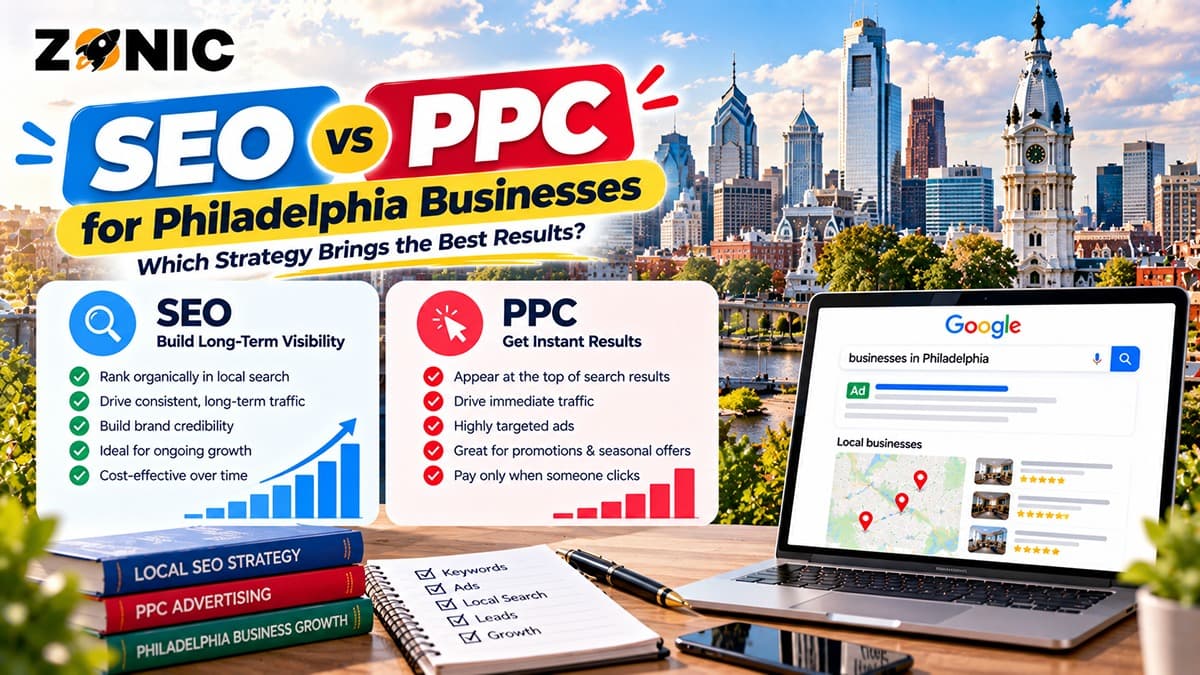
PPC can create search visibility sooner. SEO usually takes longer but can strengthen your website's organic visibility over time.
For most Philadelphia businesses, the real question is not whether one channel is universally better. It is where the next marketing dollar is most likely to produce useful results.
A roofing company trying to generate emergency repair calls has different priorities from a law firm building long-term search visibility. A newly opened restaurant in Fishtown may want immediate awareness, while an established dental practice in Center City may already have pages and a Google Business Profile that can be improved organically.
Both search engine optimization and pay-per-click advertising help businesses appear when customers use search engines. They differ in how quickly visibility can begin, how businesses pay for that visibility, how much control they have, and what happens when the investment changes.
PPC provides paid search exposure while campaigns are active and eligible to show. SEO improves organic visibility through stronger website pages, technical improvements, useful content, and local search work.
For Philadelphia businesses, choosing where to invest first depends on current visibility, competition, available budget, customer value, and how urgently the company needs additional inquiries.
This guide compares SEO vs PPC Philadelphia businesses can use to evaluate speed, cost, control, lead potential, and when coordinating both channels makes sense.
How SEO Works for Philadelphia Businesses
Search engine optimization improves a website's ability to compete in unpaid search results.
Businesses do not pay Google each time someone clicks a normal organic listing. Instead, they invest in the website, content, technical performance, local visibility, measurement, and ongoing optimization needed to compete for relevant searches.
SEO may involve keyword research, website structure, technical improvements, service pages, location pages, internal linking, content development, and conversion improvements.
For businesses serving local customers, it can also include Google Business Profile, reviews, accurate business information, and pages that support the services and locations the company genuinely serves.
Organic SEO Builds Visibility Around Customer Searches
A Philadelphia HVAC company may build strong pages around air conditioning repair, furnace installation, heat pump services, and other services customers actively research.
A law firm may strengthen individual practice-area pages instead of trying to rank one general page for every legal service.
A roofing contractor may focus on roof repairs, replacements, inspections, flat roofing, and storm-related services.
These pages answer different customer needs while giving search engines clearer information about the business.
Once a useful page earns organic visibility, it can continue attracting visitors without a direct advertising charge for each click.
That does not make the ranking permanent.
Google states that search positions are dynamic, and website improvements can take anywhere from days to several months to show an effect. Competition, changing search systems, new content, and declining page quality can all affect future performance.
Local SEO Connects Businesses With Nearby Customers
Local SEO focuses on searches influenced by geography.
Google says local results are mainly determined by relevance, distance, and prominence. Businesses can improve factors within their control by maintaining accurate information, strengthening their website, earning legitimate reviews, and building a credible presence.
For Philadelphia businesses, that means working around genuine locations and realistic service areas rather than creating pages or profiles for places the company does not actually serve.
A dentist receiving patients in Center City operates differently from an electrician traveling throughout Philadelphia and surrounding suburbs.
Both can benefit from local visibility, but the website and Google Business Profile should accurately reflect how customers interact with each business.
How PPC Works and Why It Can Produce Faster Visibility
Pay-per-click advertising allows businesses to compete for paid placements in search results.
With Google Ads, advertisers can choose geographic targeting, campaign goals, budgets, keywords or other targeting methods, bidding strategies, ad messaging, and landing pages.
When an advertiser becomes eligible for a search, Google runs an auction.
Google says Ad Rank considers several factors, including the bid, auction-time ad quality, Ad Rank thresholds, competition, the context of the person's search, and the expected impact of ad assets and formats. Ad and landing-page quality can influence both eligibility and placement.
Unlike SEO, paid visibility does not require a website to first earn an organic ranking.
A properly configured campaign can begin receiving eligible impressions and clicks after approval and activation. Producing consistent qualified leads, however, can still require testing and optimization.
PPC Targets People Searching for Specific Services
Consider a plumbing company offering emergency repairs in Philadelphia.
A paid search campaign can target relevant high-intent queries and direct users to a page focused specifically on emergency plumbing.
That landing page might contain the service details, coverage area, trust information, and an obvious phone or booking option.
The same principle can work for dental consultations, roofing, HVAC, legal services, pest control, remodeling, and other services where customers actively search before contacting a provider.
Paid search is particularly useful when search intent is strongly connected to an immediate action.
PPC Performance Depends on More Than Clicks
Clicks alone do not make an advertising campaign successful.
Broad targeting, irrelevant searches, weak ads, poor landing pages, unreliable conversion tracking, and inefficient bidding can all consume budget without generating enough qualified customers.
A strong campaign needs regular review of search terms, negative keywords where appropriate, ad relevance, landing pages, conversion data, targeting, and bidding performance.
Google's own advertising guidance emphasizes that the usefulness and relevance of both ads and landing pages contribute to ad quality and Ad Rank.
The objective is not simply to purchase traffic.
It is to generate useful customer actions at a sustainable acquisition cost.
SEO vs PPC: Speed, Cost, and Long-Term Value
The main difference between SEO and PPC is how businesses acquire visibility.
PPC can generally create eligible paid exposure sooner because businesses are entering an advertising auction.
SEO usually develops more gradually because organic pages need to be discovered, indexed, evaluated, and competitive enough to appear prominently.
Neither channel guarantees leads, customers, or revenue.
Factor | SEO | PPC |
Visibility | Usually develops gradually | Paid exposure can begin once campaigns are eligible and active |
Main expense | SEO strategy, content, technical work, implementation, and management | Advertising spend plus campaign management |
Cost per click | No direct charge for ordinary organic clicks | Advertiser pays for chargeable ad interactions |
Ongoing value | Useful pages may continue attracting organic traffic | Paid exposure depends on active campaign participation and budget |
Control | Limited control over rankings | Greater control over targeting, bidding, budgets, and campaign settings |
Best use | Developing organic visibility and stronger website assets | Capturing current search demand and testing campaigns |
Main challenge | Time, competition, and uncertain rankings | Acquisition cost and inefficient spending |
The comparison shows why the correct choice depends on the business rather than the channel alone.
SEO Requires Investment Even Without Per-Click Charges
Organic traffic is not free simply because Google does not charge for normal organic clicks.
Businesses may pay for technical work, content, website improvements, analytics, local SEO, strategy, implementation, and ongoing optimization.
The investment strengthens assets the business controls, particularly its website and original content.
A strong Philadelphia service page may continue generating organic visits for a long period if it remains useful and competitive.
But there is no guarantee that a page will hold the same ranking indefinitely.
Organic visibility requires monitoring because competitors, search behavior, and search systems continue changing.
PPC Offers Greater Budget and Targeting Control
Paid search gives businesses more direct control over campaign budgets and targeting.
Spending can be adjusted based on seasonality, lead volume, location, campaign performance, and available capacity.
A roofing contractor may increase investment during a period of storm-related demand.
A restaurant may advertise a particular event or dining offer.
A medical practice may concentrate budget on services with available appointments.
This flexibility is one of PPC's advantages.
But spending more does not guarantee better performance. Google Ads still evaluates bids, ad and landing-page quality, auction competition, search context, and other Ad Rank factors.
When Philadelphia Businesses Should Start With PPC
PPC can make sense when a business needs additional visibility sooner than a new organic SEO program is likely to provide.
This may apply to new businesses, urgent services, seasonal campaigns, launches, short-term offers, or businesses entering highly competitive markets.
The important distinction is that faster visibility does not automatically mean faster profitable leads.
New Businesses Need Immediate Market Exposure
A newly opened Philadelphia business may have little organic history, few links, limited content, and minimal brand recognition.
SEO can begin immediately, but meaningful organic visibility may take time to develop.
PPC provides a way to test real search demand while the site's organic presence develops.
A new dental practice, restaurant, med spa, or home service company can test which searches, services, locations, and messages produce useful customer actions.
That information may also help guide future website and SEO priorities.
High-Intent Services Benefit From Paid Search
Urgent searches can be well suited to paid search because the customer may be close to taking action.
Examples include emergency plumbing, urgent HVAC repairs, water damage services, and other time-sensitive needs.
A paid campaign can place an eligible business in front of those searchers without requiring the company to already hold a strong organic position.
The business still needs to evaluate profitability.
Advertising cost, qualified lead rate, conversion rate, customer value, and cost per acquired customer matter more than raw click totals.
When Philadelphia Businesses Should Start With SEO
SEO may deserve greater priority when a company wants to improve the discoverability and usefulness of its own website over time.
It can be particularly valuable for established businesses that already have pages receiving impressions, organic traffic, or some rankings but are not converting those opportunities effectively.
Existing Websites May Have Untapped Opportunities
A Philadelphia business may already appear for relevant searches without ranking prominently enough to generate consistent inquiries.
Improving existing pages can sometimes create a stronger opportunity than publishing large amounts of new content.
A contractor may already have service pages that need clearer copy, better internal linking, stronger titles, improved mobile experience, or more obvious contact options.
An SEO review can identify those opportunities and help prioritize the pages closest to producing business value.
Businesses With Tight Advertising Budgets Need Focused Foundations
A limited marketing budget should be allocated carefully.
Spreading a small paid budget across too many campaigns can make it difficult to collect enough data or compete effectively.
In some cases, improving the website, Google Business Profile, core service pages, reviews, and conversion tracking first may create a stronger foundation.
That does not mean SEO is automatically cheaper.
SEO still requires time, expertise, and implementation.
The correct choice depends on how much the business can invest, how urgently it needs customers, and whether its existing website has meaningful organic opportunities.
Combining SEO and PPC Through Search Engine Marketing
The term search engine marketing is often used specifically for paid search advertising. Businesses can also coordinate paid search and SEO as part of a broader search strategy.
For Philadelphia companies, this coordination can be useful because the channels provide different information and operate on different timelines.
PPC can test current demand while SEO develops organic visibility.
Organic pages can provide detailed service information while paid campaigns target narrowly defined commercial searches.
Conversion data from advertising can also reveal useful patterns for the website.
Use PPC Data to Strengthen SEO
Paid search can provide information about which search terms, services, messages, locations, and landing pages generate qualified actions.
That does not mean every successful PPC keyword should automatically become an SEO target.
But the data can help identify areas worth researching.
If a Philadelphia roofing campaign consistently produces qualified flat-roof repair inquiries, the company may want to evaluate whether its organic flat-roof repair content is strong enough.
If a dental practice sees strong conversion from implant-related searches, it can review whether its implant service page adequately addresses the same customer needs.
PPC data provides evidence.
SEO strategy still requires separate keyword, competition, and content analysis.
Use SEO Content to Improve PPC Landing Pages
The relationship can also work in the other direction.
Strong organic pages often contain detailed service explanations, useful FAQs, trust information, and clear answers to customer concerns.
Those insights can help improve dedicated PPC landing pages.
A paid landing page should remain tightly aligned with its campaign and primary conversion goal, but it still needs enough useful information to help visitors decide whether to take action.
Better landing-page relevance and experience also matter within Google Ads' quality assessment.
How to Divide Your Marketing Budget
There is no universal SEO-to-PPC budget split.
The allocation should reflect current organic visibility, sales pipeline, competitive pressure, available budget, customer value, seasonality, and how quickly the business needs additional inquiries.
These examples are strategic starting points rather than fixed rules:
Business Situation | Suggested Initial Priority | Reason |
New business needing quicker exposure | PPC first with SEO foundation alongside | Tests demand while organic visibility develops |
Established business with weak website pages | SEO first | Improves existing pages and organic opportunities |
Emergency service company | PPC with ongoing local SEO | Targets urgent demand while building broader visibility |
Competitive professional service business | Coordinated SEO and PPC | Balances paid demand capture with organic development |
Business already generating strong organic leads | SEO maintenance with selective PPC | Protects organic strength while testing additional demand |
The right allocation can change as the business gathers better data.
Calculate PPC Spending From Lead Economics
Suppose a Philadelphia service company wants 20 qualified leads per month and uses an estimated cost of $100 per qualified lead for planning.
The illustrative media budget would be:
20 qualified leads × $100 = $2,000
That is a planning example, not a Philadelphia PPC benchmark.
Actual cost per lead varies widely by industry, competition, targeting, campaign quality, landing page performance, and what the business counts as a qualified lead.
Campaign management fees and other marketing costs would also need to be considered separately.
If the business closes 25% of those 20 qualified leads, that would equal approximately five customers.
The next question is whether the gross profit generated by those customers justifies the advertising and management cost.
SEO should be judged similarly.
Organic rankings and traffic matter, but qualified leads, customers, acquisition cost, and revenue provide a more useful business picture.
Common Mistakes When Choosing Between SEO and PPC
One common mistake is expecting a new SEO campaign to behave like paid advertising.
Organic visibility does not appear on a fixed schedule. Google says some changes can show effects within days, while others can take several months, and no improvement guarantees a ranking increase.
Another mistake is running paid campaigns without reliable conversion tracking.
Without knowing which clicks create calls, forms, bookings, or sales, it becomes difficult to make good budget decisions.
Businesses can also become too dependent on one channel.
Stopping SEO simply because PPC starts generating inquiries can leave organic opportunities underdeveloped. Spending heavily on content while ignoring high-value service pages can create the opposite problem.
The strongest approach evaluates each channel based on the role it actually plays.
Do Not Confuse Paid Placement With Organic Rankings
Paying for Google Ads does not directly improve organic Google rankings.
Paid advertising and organic Search operate through separate systems.
A company can run successful Google Ads while having weak organic visibility.
Another business can hold strong organic positions without running paid search campaigns.
Reports should therefore separate:
paid clicks,
paid conversions,
organic traffic,
organic conversions,
local search interactions,
and qualified leads.
The channels can then be evaluated together at the business level without mixing their performance data.
How Zonic Helps Philadelphia Businesses Coordinate SEO and PPC
Zonic helps Philadelphia businesses evaluate paid and organic search based on business goals, current visibility, competition, and lead economics.
The process can include reviewing the website, organic performance, Google Business Profile, active advertising campaigns, landing pages, conversion tracking, and lead quality.
For Google Ads, the focus includes campaign targeting, search-term quality, negative keywords where appropriate, bidding, landing pages, and reliable conversion tracking.
For SEO, the focus includes technical performance, service pages, local relevance, content quality, internal linking, and organic conversion paths.
The purpose of coordinating the channels is not to force every business to spend on both.
It is to use the available data to decide where the strongest opportunities exist.
Zonic also keeps advertising media spend separate from management fees so businesses can see how much money is going directly to the advertising platform and how much is paying for strategy and campaign management.
The goal is qualified growth, not simply more clicks.
Conclusion
SEO and PPC can both be valuable for Philadelphia businesses, but they solve different problems.
PPC can create eligible paid visibility sooner and gives businesses more control over targeting, budgets, and campaign settings.
SEO develops organic visibility through website quality, technical improvements, relevant content, and local search work. Results can take longer and rankings remain subject to competition and Google's changing search systems.
Businesses that need faster exposure may place greater initial emphasis on PPC.
Companies with existing organic opportunities and longer-term website goals may put more of their resources into SEO.
Many competitive businesses can benefit from coordinating both without assuming they deserve equal budgets.
The decision should start with current visibility, customer value, urgency, competition, conversion rates, and the economics of acquiring a new customer.
Zonic helps Philadelphia businesses evaluate SEO and PPC around qualified leads rather than traffic alone. Request a free audit through the Philadelphia PPC Agency service page, or call (302) 726-9736 to discuss your marketing goals with 8 The Green, Suite B, Dover, DE 19901
Frequently Asked Questions
Is SEO or PPC better for a small Philadelphia business?
Neither is universally better. PPC can provide paid visibility sooner, while SEO usually takes longer and focuses on organic discoverability. The better starting point depends on budget, competition, current website strength, customer value, and how quickly the business needs additional inquiries.
How quickly can PPC generate leads in Philadelphia?
An eligible Google Ads campaign can begin receiving impressions and clicks after activation and approval, but there is no guaranteed lead timeline. Qualified leads depend on search demand, targeting, budget, Ad Rank, landing-page experience, competition, and conversion performance.
How long does SEO take to produce results?
There is no fixed SEO timeline. Google says some changes can show effects within days, while others can take several months. Competitive rankings may require sustained work, and no agency can guarantee that a specific optimization will produce a ranking increase.
Is SEO cheaper than PPC over the long term?
Not automatically. SEO can become cost-efficient when useful pages consistently generate qualified organic traffic, but it still requires investment and maintenance. PPC incurs advertising costs for chargeable interactions and management, while offering more direct control over targeting and spend. The better value depends on acquisition cost and resulting revenue.
Does paying for Google Ads improve organic rankings?
No. Running paid advertising does not directly purchase or improve organic Google rankings. Paid and organic visibility should be measured separately.