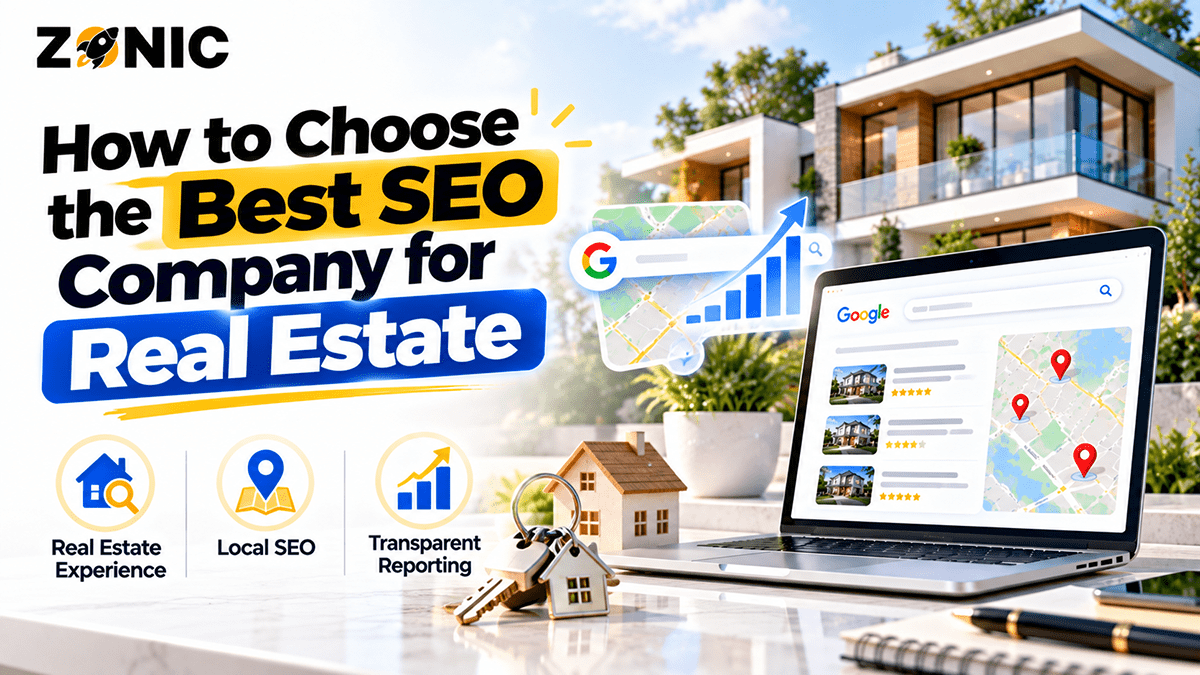
How to Choose the Best SEO Company for Real Estate Agents
Most SEO companies can show you rankings.
The harder question is whether those rankings produced buyers, seller consultations, relocation inquiries, home valuation requests, or any other meaningful opportunity for the real estate business paying for them.
That distinction matters when you are choosing an SEO company for real estate.
Agents and brokerages operate in a search market filled with national portals, franchise websites, IDX feeds, listing aggregators, local competitors, Google Maps results, and rapidly changing property inventory. A strategy that works for a local restaurant or ecommerce store cannot simply be copied onto a real estate website.
The right SEO partner needs to understand how people search before choosing an agent. It should recognize the difference between buyer and seller intent, know where neighborhood content makes sense, understand the limitations of IDX, handle Google Business Profile carefully, and measure whether organic visibility contributes to real leads.
Choosing the best SEO company for real estate is therefore less about finding the agency with the biggest promise and more about finding one that can explain its strategy, deliverables, risks, costs, and measurement clearly.
What Should You Look for in a Real Estate SEO Company?
The best real estate SEO company should understand buyer and seller intent, local search, Google Business Profile, neighborhood content, IDX limitations, technical SEO, reviews, and conversion tracking. Before hiring, compare the agency's proposed work, case studies, reporting, pricing, contract terms, account ownership, and ability to explain realistic outcomes without guaranteeing Google rankings.
Start With What the SEO Company Wants to Achieve
Before comparing packages, ask each company what it believes SEO should accomplish for your business.
A real estate agent may need stronger visibility for seller searches in a specific market. A team may want more relocation leads. A brokerage may have hundreds of pages but poor technical structure. Another agent may already receive organic traffic but struggle to turn it into consultations.
Google's own guidance for hiring an SEO recommends looking for a provider that wants to understand the business, competitors, customers, and how search can contribute to its goals. Google also recommends asking the SEO to explain its recommendations and the reasoning behind them.
That is a useful standard when comparing real estate SEO providers.
An agency should be able to tell you what it wants to improve, which searches matter, which pages need attention, and how that work connects to the business.
Make Sure the Agency Understands Real Estate Search Intent
Real estate SEO involves several different search journeys.
A buyer researching neighborhoods is in a different position from a homeowner searching for a listing agent. Someone relocating next summer has different needs from a property owner requesting a valuation today.
A capable real estate SEO agency should recognize those differences before recommending pages or keywords.
Instead of simply showing you a spreadsheet of search volume, ask how it will separate:
buyer searches
seller searches
neighborhood and community research
relocation intent
property-type searches
agent and brokerage searches
and high-intent local queries
The pages created for those searches should also have different conversion goals.
A neighborhood guide might lead to listings or a buyer consultation. A seller-focused page may lead to a valuation request. A relocation resource might encourage the visitor to discuss their move.
SEO becomes much more useful when ranking strategy and conversion intent are planned together.
Ask How the Agency Approaches Google Business Profile
A real estate SEO company does not need to spend half its proposal explaining Google Maps, but it should understand how Google Business Profile fits into an agent's local presence.
More importantly, it should know what not to do.
Ask how the company handles profile names, categories, practitioner profiles, office information, duplicate listings, former brokerage details, reviews, and account access.
An agency recommending keyword-stuffed business names, unsupported office locations, duplicate profiles, fake reviews, or other shortcuts should raise immediate concerns.
Google's third-party Business Profile policies explicitly prohibit misleading or unrealistic claims, including guarantees of top placement on Google. Google also recommends that when an agency manages a client's profile, the business owner should remain an owner while the agency normally operates as a manager.
That makes profile management an important test of an agency's judgment.
Evaluate How It Would Handle Neighborhood Content
You do not need another agency promising to publish 50 city pages.
You need to understand what would make those pages worth publishing.
Ask a prospective local SEO company to explain how it would differentiate one neighborhood page from another.
A weak answer usually revolves around inserting the city or neighborhood name into the same basic template.
A stronger answer should involve genuine market differences: housing stock, property types, buyer concerns, transportation, condo or HOA considerations, local amenities, market positioning, seller questions, or other details that are actually relevant to the location.
The goal is not to create the highest number of indexed location pages.
It is to create pages that deserve to exist.
If an agency cannot explain how its location content will avoid becoming thin, mass-produced, or near-duplicate, that is a meaningful warning sign.
Ask What the Agency Will Do With IDX
Real estate websites can contain large numbers of IDX-generated URLs, listings, filters, and search pages.
An agency familiar with real estate should know that having thousands of URLs is not the same as having thousands of strong organic landing pages.
Ask what it will review.
Does it understand crawlability and indexation?
Will it assess how listing pages interact with neighborhood content?
Will it identify thin or unnecessary search URLs?
Will it make sure original local content exists around important market pages?
You are not looking for an agency that promises to make every property feed URL rank.
You are looking for one that understands where IDX supports the user experience and where original content needs to carry more of the SEO strategy.
Ask These Questions Before Signing
A sales call should give you enough information to understand how the agency thinks, not just how well it sells.
Ask which searches it believes your business can realistically compete for, how it will separate buyer and seller intent, what it plans to work on during the first 90 days, what technical issues it will inspect, how Google Business Profile fits into the scope, and how it approaches neighborhood and IDX content.
Also ask how results will be measured, what work is completed each month, who actually performs the work, what happens if priorities change, and who owns every account and asset if the relationship ends.
One question is especially useful:
“Show me what I will actually receive, not just the names of the services.”
“Technical SEO,” “authority building,” and “content optimization” can mean very different things from one proposal to another.
The agency should be able to translate those labels into actual work.
Examine Case Studies More Carefully Than Ranking Screenshots
A screenshot showing a number-one ranking is not enough to prove that a strategy worked.
Ask for context.
What type of client was involved?
Was it an individual agent, brokerage, property portal, or unrelated local business?
How competitive was the market?
What condition was the website in before work started?
Which pages were changed or created?
How long did the case study cover?
What happened to qualified inquiries?
Did seller or buyer leads improve, or did only impressions and rankings increase?
Google itself recommends checking an SEO provider's references and asking previous clients whether the provider delivered useful service and was easy to work with.
A strong case study should help you understand the strategy and outcome, not simply display an impressive graph without context.
Watch for Real Estate SEO Red Flags
Guaranteed rankings are one of the easiest warning signs to recognize.
Google's guidance is explicit: no one can guarantee a number-one ranking, and if an SEO audit guarantees first place, Google recommends finding someone else.
Also be cautious when an agency refuses to explain its methods, promises unusually fast results without discussing the starting condition, or suggests that it has a special relationship with Google.
Other warning signs include mass-produced location pages, fake reviews, questionable local profiles, hidden ownership arrangements, undisclosed outsourced work, vague reporting, and contracts that make it difficult to regain control of your own assets.
A serious SEO company should be willing to explain what it intends to change.
Understand Real Estate SEO Pricing Before Comparing Proposals
There is no universal price for real estate SEO.
A single agent in a smaller market has different requirements from a brokerage operating across several competitive locations. A technically healthy site has different needs from one with thousands of poorly managed URLs. A strategy involving extensive content creation will not cost the same as an advisory engagement.
Pricing should therefore be evaluated alongside scope.
Industry-wide SEO pricing data can still provide useful context. In an Ahrefs survey of SEO professionals, $501 to $1,000 per month was the most commonly reported monthly retainer bracket, while 42.8% of respondents charged between $501 and $2,000 per month. The same survey estimated an average agency monthly retainer of about $3,209. These figures represent SEO providers generally, not real estate-specific pricing, so they should be treated as market context rather than a recommended budget.
Engagement Type | Where It Usually Fits |
One-time SEO audit | Diagnosing technical, content, local, tracking, and structural issues |
SEO consulting | Strategy and oversight when you already have internal execution resources |
Project-based work | Site migrations, page builds, technical cleanup, or specific local SEO projects |
Monthly retainer | Ongoing technical work, content, optimization, local SEO, measurement, and refinement |
When comparing prices, ask what is actually included.
A cheaper proposal is not automatically better value, and a more expensive proposal is not automatically more sophisticated.
Scope matters more than the headline number.
Review Ownership Before You Sign Anything
Ownership problems often become visible only when the client tries to leave.
Avoid that situation by establishing access before work begins.
Your business should retain control of core assets such as the domain, website, Google Business Profile, Google Analytics, Search Console, published content, and other accounts created specifically for your business.
For Google Business Profile, Google's third-party policy states that clients must retain ownership or co-ownership of their profile. Google also says third-party managers should honor ownership requests and, when possible, encourage the business owner to own the profile while the authorized representative is added as a manager.
Google's manager role can handle most routine profile work without giving the agency the same control as an owner.
Your contract should also explain what happens to content, tracking systems, landing pages, call-tracking numbers, dashboards, and other work if the relationship ends.
Know What Should Happen in the First 90 Days
No SEO company can responsibly promise that you will hold a particular ranking by day 90.
It can, however, tell you what work should be completed.
First 30 Days: Diagnosis and Priorities
The agency should become familiar with the business before racing into production.
That can include analytics and Search Console review, technical auditing, page and keyword mapping, conversion tracking, Google Business Profile assessment, competitor research, IDX review, and identification of priority buyer and seller opportunities.
Days 31–60: Fix the Highest-Value Problems
The second stage should move from diagnosis into implementation.
Depending on the site, that might include technical corrections, improvements to key service pages, Google Business Profile cleanup, internal linking, conversion improvements, or creation of the first priority local pages.
Days 61–90: Expand and Measure
Once the foundation is stronger, the agency can begin expanding the strategy.
That could mean publishing priority content, improving additional market pages, building the review process, measuring which landing pages generate useful activity, and adjusting the roadmap based on early data.
The exact sequence will vary.
What matters is that the agency can describe a logical progression rather than promising a ranking date.
Review the Contract and Monthly Deliverables
A good proposal tells you what the agency intends to do.
A good contract tells you what you are actually buying.
Check the contract length, cancellation terms, communication schedule, included deliverables, ownership, access requirements, reporting, and services that incur additional charges.
Ask whether technical implementation is included or merely recommended.
Ask whether content writing is included.
Ask whether Google Business Profile management is part of the agreement.
Ask whether developer work, digital PR, link acquisition, new landing pages, conversion tracking, or major website changes require separate approval.
The fewer assumptions you make before signing, the fewer disagreements you are likely to have later.
Real Estate SEO Consultant vs Agency: Which Fits Better?
Neither option is automatically better.
A real estate SEO consultant can be a strong fit when you already have developers, writers, designers, or marketers and mainly need audits, strategy, prioritization, or experienced oversight.
An agency may make more sense when you need one team to coordinate strategy and execution across technical SEO, content, local SEO, tracking, page improvements, and reporting.
The deciding factor should be what your business is missing.
If the problem is direction, expertise may matter more than team size.
If the problem is execution capacity, a larger delivery team may be more practical.
Use This Checklist to Compare Real Estate SEO Companies
Area | What a Strong Provider Should Demonstrate |
Real estate understanding | Understands agents, brokerages, buyer and seller intent, neighborhoods, and IDX |
Strategy | Connects keywords and pages to actual business goals |
Local SEO | Understands Google Business Profile without relying on risky shortcuts |
Content | Creates useful local pages rather than location-swapped copies |
Technical SEO | Can identify crawl, indexation, performance, architecture, and site-quality issues |
Case studies | Explains starting point, strategy, timeframe, and business outcome |
Reporting | Connects visibility with traffic, conversions, calls, and qualified inquiries |
Ownership | Keeps your business in control of core accounts and assets |
Pricing | Clearly connects fees with defined deliverables |
Contract | Explains cancellation, access, ownership, and scope |
Communication | Explains recommendations in language you can understand |
Do not expect every provider to use exactly the same process.
What matters is that the process is clear, defensible, relevant to your business, and measurable.
How Zonic Approaches Real Estate SEO
Zonic starts by identifying what is preventing a real estate website from turning search visibility into qualified opportunities.
That can involve the site's technical condition, page structure, buyer and seller coverage, Google Business Profile, neighborhood content, IDX implementation, reviews, outdated business information, competitive visibility, and conversion paths.
The strategy is then prioritized around the areas most likely to matter for that particular agent or brokerage rather than automatically pushing the same monthly package onto every client.
For one business, the priority may be seller-focused landing pages.
For another, it may be fixing technical and indexation problems.
Another may need stronger local pages, a safer Google Business Profile setup, or clearer conversion tracking before additional content makes sense.
The purpose is not to generate activity for an SEO report.
It is to connect search visibility with real business opportunities.
Conclusion
Choosing the best SEO company for real estate requires more than comparing keyword counts and monthly prices.
Look at how the provider thinks.
Does it understand the difference between buyer and seller intent?
Can it explain where your realistic search opportunities are?
Does it understand neighborhood content and IDX without overpromising?
Will it protect your Google Business Profile and account ownership?
Can it show what work will happen in the first 90 days?
Does its reporting connect rankings with actual leads?
And can it explain the strategy without hiding behind jargon?
Google itself recommends choosing an SEO that takes time to understand your business, explains its recommendations, and avoids guaranteed ranking promises.
The right partner should make the work easier to understand, not harder.
If you are comparing real estate SEO companies and want an independent look at what your website actually needs, Zonic can review your technical SEO, Google Business Profile, content, IDX setup, local visibility, and conversion paths.
Call Zonic Media at (302) 726-9736 or visit 8 The Green, Suite B, Dover, DE 19901 Request a free real estate SEO audit to identify the priorities worth addressing before you commit to a long-term strategy.