Your business already appears on Google Maps. Customers can read your reviews, see your hours, visit your website, and tap your phone number.
So why would you also need Google Ads?
It is a common question for local businesses trying to decide where their marketing budget should go.
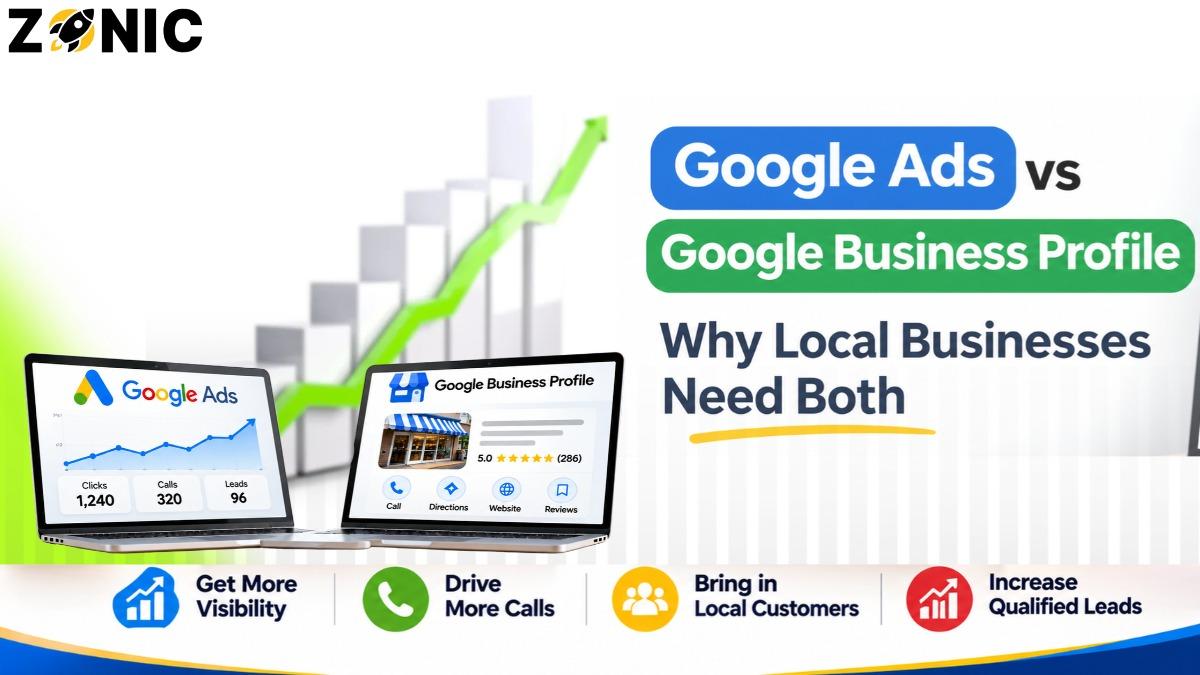
Google Business Profile and Google Ads can both help customers discover a company through Google, but they operate through different systems.
Google Business Profile supports organic visibility in Google Search and Maps. Google Ads gives businesses the opportunity to compete for paid placements when eligible campaigns enter Google's advertising auction.
Both channels can contribute to calls, website visits, bookings, and customer inquiries.
But neither guarantees leads.
Google says organic local rankings are mainly based on relevance, distance, and prominence. Google Ads placement is determined through an auction using factors such as bids, ad and landing-page quality, competition, search context, ad rank thresholds, and the expected impact of assets and formats.
A local business can perform well organically without advertising.
It can also generate paid leads while its Maps visibility remains limited.
For plumbers, roofing contractors, dentists, HVAC companies, attorneys, restaurants, auto repair shops, and other local businesses, the most useful strategy is often understanding when each channel solves a different problem.
This guide compares Google Ads vs Google Business Profile, explains their strengths and limitations, and shows when combining both can create a more balanced local search strategy.
What Is Google Business Profile and How Does It Work?
Google Business Profile is a free tool that allows eligible businesses to manage information displayed across Google Search and Maps.
A profile can show:
Business name
Primary category
Address or service area
Phone number
Website
Business hours
Reviews
Photos
Services
Other eligible business details
When people search for nearby businesses, Google may display relevant companies in local results or Maps.
A complete profile helps customers understand what the business does and whether it fits their needs.
Organic Google Maps Rankings Depend on Local Relevance
Google says local results are mainly determined by relevance, distance, and prominence.
Relevance reflects how closely the Business Profile matches what someone is searching for.
Distance considers how far the business is from the searcher or searched location.
Prominence reflects how well known or established the business appears. Google specifically mentions links, review volume, and positive ratings when explaining this factor.
That is why Maps visibility can change from one neighborhood to another.
A dental practice may appear strongly near its office but become less visible several miles away.
A roofer may rank for one service in one part of town while a competitor appears more prominently for another query.
Google Business Profile optimization can strengthen the factors within the business's control, but it cannot remove geographic distance or guarantee a particular Maps position.
A Complete Profile Builds Customer Confidence
A Google Business Profile does more than support visibility.
It helps people evaluate the company.
Reviews provide customer context.
Photos show the real business.
Accurate hours reduce confusion.
Services help people verify that the company provides what they need.
For example, a homeowner comparing three roofers may be more comfortable contacting the business with clear service information, real project photographs, current hours, and credible reviews.
That value exists even when the profile is not ranked first.
What Is Google Ads and How Does It Work?
Google Ads is Google's paid advertising platform.
Businesses can use it to compete for eligible placements across Google properties, including Search and certain Maps experiences.
Advertisers can choose campaign goals, targeting, budgets, bidding strategies, ad messaging, and landing pages.
When an ad is eligible to appear, Google runs an auction.
Google says Ad Rank is influenced by:
Bid amount
Ad quality
Landing-page quality
Ad Rank thresholds
Auction competition
Search context
Expected impact of assets and ad formats
Search context can include location, device, time, search terms, and other signals.
Google Ads Targets Customers With Commercial Intent
Paid search can be useful when people are actively looking for a service.
A plumber may advertise emergency drain repair.
An HVAC company may target air-conditioning replacement searches.
A law firm may advertise consultations related to specific practice areas.
The goal is to match the search with a relevant offer and landing page.
Sending someone who searched for a specific service to a generic homepage can weaken the campaign experience.
A stronger campaign connects:
search intent → ad message → landing page → conversion action
Advertising Cost Depends on Competition and Performance
Google Ads does not have one standard price for every business.
Costs vary according to the auction, industry, market competition, targeting, bids, quality, search context, and campaign setup.
Two businesses advertising similar services in different markets may pay very different amounts.
The most useful metric is not always cost per click.
A $5 click that produces qualified customers may be more valuable than a $2 click that never generates meaningful business.
The stronger business metric is usually something closer to:
cost per qualified lead
or:
cost per acquired customer
Google Ads vs Google Business Profile: The Key Differences
Both channels help businesses reach customers through Google, but they provide different types of visibility.
Feature | Google Business Profile | Google Ads |
Primary purpose | Organic local discovery | Paid customer acquisition |
Direct platform cost | Free to create and manage | Advertising budget required |
Visibility | Based on Google's local ranking system | Based on ad eligibility and auction |
Geographic reach | Strongly affected by proximity | Advertisers can target eligible geographic areas |
Trust signals | Reviews, business information, photos | Ad message, business identity, and landing page |
Speed | Organic visibility may take time to improve | Paid exposure can begin after campaign approval and eligibility |
Calls | Can occur through eligible profile interactions | Can occur through eligible ad formats and assets |
Long-term role | Supports ongoing local presence | Paid visibility depends on active campaign participation |
Neither platform is a complete substitute for the other.
Google Business Profile supports organic local discovery and business credibility.
Google Ads can create additional paid exposure when the company wants to reach more searchers.
Why Local Businesses Benefit From Using Both
A company relying entirely on organic Maps visibility may miss searches where it does not appear prominently.
A business relying entirely on advertising may become dependent on continued ad spending.
Using both can diversify how customers discover the company.
Google Business Profile Builds an Ongoing Local Foundation
An accurate profile helps a business remain discoverable for relevant local searches.
It also gives customers useful information before they contact the company.
That local presence can continue even if advertising spend is reduced.
However, organic visibility is not permanent or guaranteed.
Competitors, searcher location, reviews, reputation, and Google's ranking systems can all change over time.
Google Business Profile should therefore be treated as an important platform-managed local presence, not something the business fully owns in the same way it owns its website or domain.
Google Ads Captures Additional Demand
Google Ads can expand paid reach beyond the organic visibility a business already has.
For example, an auto repair shop may receive organic calls from nearby customers while running paid campaigns for a specific repair service.
A dental clinic may use ads to promote appointment availability for a particular treatment while maintaining its organic Maps presence.
The objective is not to replace local SEO.
It is to create another opportunity to capture relevant demand.
Does Google Ads Improve Google Business Profile Rankings?
No.
Running Google Ads does not directly improve organic Google Maps rankings.
Google explicitly states that there is no way to request or pay for better local ranking.
Organic local results and paid advertising use different systems.
Increasing the Google Ads budget does not purchase a higher unpaid Maps position.
Paid Listings and Organic Map Results Are Different
A local business may appear through both paid and organic placements for related searches.
The organic result is influenced by Google's local ranking system.
The paid result is governed by campaign eligibility and the Google Ads auction.
Those systems can support the same business goal, but they should not be reported as though they are the same type of visibility.
A marketing agency should explain that distinction clearly.
Advertising Data Can Inform Local SEO Strategy
Google Ads does not improve organic rankings directly.
But paid campaign data can provide useful business insight.
A plumbing company may discover that water heater replacement searches produce strong leads.
A roofing contractor may find strong demand for flat-roof repair.
A dental office may discover which services generate the most appointment requests.
That information can help prioritize future:
Service pages
Landing-page improvements
Content strategy
Conversion work
The benefit comes from better decision-making, not from ad spend influencing organic rankings.
Connect Google Ads With Google Business Profile
Eligible Business Profiles can be linked with Google Ads through location assets.
Google says location assets use Business Profile information to help advertisements show useful location details to customers.
Depending on campaign type, format, eligibility, and user context, business-location information may appear with ads across eligible Google surfaces.
Location Assets Help Customers Recognize Your Business
Location information can help customers confirm that an advertiser is a legitimate local company.
Depending on the eligible ad experience, users may see information such as:
Business location
Phone details
Directions
Other location information
For storefront businesses, this can support visits.
For service-area businesses, available features depend on the business setup, campaign type, and Google's current advertising requirements.
Business information should be accurate before being connected to advertising.
Incorrect addresses, outdated phone numbers, and inaccurate hours can undermine both advertising performance and customer trust.
Keep Account Access Under Business Control
The business should maintain appropriate control over both Google Business Profile and Google Ads.
For Business Profile, Google specifically recommends that when an agency manages a client's listing, the business owner remain the owner and the agency normally be added as a manager.
Google also advises businesses to retain access when third parties manage their profiles.
Managers can perform most routine Business Profile tasks without having the same ownership powers as profile owners.
For Google Ads, the business should also maintain appropriate administrative access and understand who controls billing, campaigns, and account permissions.
Changing agencies should not mean losing control of important marketing accounts.
When Google Ads Should Be the First Priority
Some businesses need visibility sooner than organic improvements are likely to provide it.
Google Ads may deserve early attention when the company is:
Newly launched
Entering another market
Promoting a seasonal service
Testing customer demand
Competing for time-sensitive searches
Paid advertising can begin producing eligible exposure once campaigns are approved and able to participate in auctions.
That does not guarantee immediate leads.
New Businesses Need Exposure While Building Local Authority
A new plumbing business may have:
few reviews,
limited organic rankings,
a new website,
and little existing brand recognition.
Even with an accurately configured Business Profile, competing organically against established local companies can take time.
Paid search can provide another source of visibility while the business strengthens its local foundation.
The company still needs a website or landing page capable of converting the traffic.
It also needs enough operational capacity to respond to inquiries.
High-Intent Services Can Benefit From Advertising
Certain searches indicate stronger urgency.
Examples include:
Emergency towing
Urgent plumbing
HVAC repair
Water damage services
Other immediate service needs
Paid search can help an eligible business compete for those searches.
The advertisement should accurately represent the real service, availability, and geographic coverage.
Advertising services outside the company's capabilities or territory wastes budget and creates customer frustration.
When Google Business Profile Deserves More Attention
A business should not automatically increase advertising when its existing local foundation has obvious problems.
If the phone number is incorrect, hours are outdated, categories are wrong, reviews are neglected, or the website is confusing, those issues may need attention first.
Improve the Local Foundation Before Increasing Spend
Review:
Business name
Primary category
Address or service-area setup
Phone number
Website
Services
Business hours
Reviews
Relevant photos
Make sure the profile matches how the business actually operates.
The website should also provide clear service information and obvious contact options.
If the business is already receiving visibility but very few calls, additional advertising may not solve the underlying conversion problem.
How to Divide Your Budget Between Google Ads and GBP
Google does not charge businesses to create or manage a Business Profile.
That does not mean local SEO is free.
Businesses may still invest in:
profile management,
website improvements,
local SEO,
review processes,
content,
and agency support.
Google Ads has a more direct paid-media model.
The business funds advertising spend and may also pay a separate management fee.
The right balance depends on:
competition,
current organic visibility,
lead value,
available budget,
and customer demand.
Business Situation | Suggested Priority | Reason |
New business with limited visibility | Strong GBP foundation plus focused Google Ads | Builds credibility while testing paid demand |
Established business with strong Maps visibility | GBP maintenance plus selective ads | Builds on existing organic strength |
Business needing additional inquiries sooner | Google Ads with accurate GBP | Supports paid demand capture |
Multi-location company | Location-level GBP management plus targeted ads | Reflects different markets and locations |
Business receiving visibility but few calls | Conversion improvements first | Fixes weaknesses before adding more traffic |
These are strategic examples, not fixed budget formulas.
Calculate Advertising Spend From Lead Value
Suppose a company wants 30 qualified leads per month and uses an estimated $50 cost per qualified lead for planning.
The illustrative advertising budget would be:
30 × $50 = $1,500 per month
That is only a planning example.
Actual lead costs can vary dramatically by industry, location, competition, campaign quality, and lead definition.
The next question is how many of those inquiries become paying customers.
If advertising produces more calls but few profitable sales, the business may need better targeting, stronger landing pages, better call handling, or improved qualification rather than simply increasing spend.
Measure Results Across Both Channels
Businesses should understand what Google Ads and Google Business Profile each contribute.
Google Ads provides campaign and conversion reporting.
Google Business Profile provides information about certain customer interactions.
Those metrics should not automatically be treated as equivalent.
Distinguish Call Clicks From Qualified Leads
A person tapping a call button is not necessarily a qualified lead.
An advertising conversion is also not automatically a sale.
Businesses should distinguish between:
Clicks
Call-button interactions
Connected calls
Qualified inquiries
Appointments or estimates
Closed customers
Revenue
That distinction matters when customer value varies.
A roof replacement inquiry may have a very different value from a minor repair request.
A dental implant consultation may be worth more financially than a routine cleaning appointment.
Reporting should reflect those differences.
Evaluate Combined Business Impact
A useful report explains what each channel contributes without double-counting customers.
Google Ads may produce paid inquiries.
Organic Maps visibility may contribute to discovery.
A customer may see an ad, later search the company name, read reviews, and then call through the Business Profile.
That does not mean each interaction should be counted as a separate unique lead.
Businesses should look at the full customer journey where possible.
Common Mistakes When Using Google Ads and GBP Together
One common mistake is believing advertising spend improves organic Maps rankings.
It does not.
Another is running paid campaigns while the Business Profile contains inaccurate information.
Other problems include:
Geographic targeting that extends beyond the real service area
Weak landing pages
Inaccurate conversion tracking
Outdated hours
Poor call handling
Measuring clicks instead of qualified customers
The strongest combined strategy aligns paid search, local business information, website content, and actual operations.
How Zonic Helps Local Businesses Use Both Channels
Zonic helps local businesses coordinate Google Business Profile optimization with Google Ads strategy.
The process starts by reviewing:
local visibility,
Business Profile accuracy,
website performance,
advertising opportunities,
competitors,
landing pages,
customer acquisition goals.
For a business with an incomplete profile, early work may focus on categories, hours, services, website links, or other business information.
For a company with a stronger organic foundation, paid search may provide an opportunity to reach additional high-intent customers.
Zonic also reviews ad targeting, landing pages, call tracking, and conversion measurement.
The objective is not to confuse paid and organic results.
It is to understand how both can contribute to qualified customer acquisition.
Conclusion
Google Ads and Google Business Profile serve different purposes.
Google Business Profile supports organic local discovery and provides customers with important business information.
Google Ads gives businesses paid opportunities to reach people through eligible advertising placements.
Running ads does not directly improve organic Google Maps rankings.
However, paid search can help capture additional demand while local SEO and Business Profile optimization strengthen the company's organic local presence.
For many local businesses, the right strategy is not choosing one channel permanently over the other.
Zonic helps local businesses improve Google Business Profile visibility, Google Ads performance, landing pages, and lead tracking across both channels.
If your business wants to understand where to invest first, contact Zonic Media at (302) 726-9736 or visit 8 The Green, Suite B, Dover, DE 19901 to discuss local SEO and Google Ads opportunities across the United States.
Frequently Asked Questions
What is the difference between Google Ads and Google Business Profile?
Google Business Profile is a free tool for managing business information displayed across Google Search and Maps. Google Ads is a paid advertising platform that allows businesses to compete for eligible advertising placements through Google's auction system.
Does running Google Ads improve Google Business Profile rankings?
No. Google Ads spending does not directly improve organic Maps rankings. Google says local rankings are mainly based on relevance, distance, and prominence, and businesses cannot pay Google for better organic local placement.
Do local businesses need both Google Ads and Google Business Profile?
Not every business needs paid advertising. However, a business seeking additional demand may benefit from combining Google Ads with an accurate and well-maintained Business Profile. The appropriate mix depends on competition, budget, existing visibility, and customer value.
Can Google Ads appear on Google Maps?
Eligible Google Ads campaigns can use location assets connected to Business Profile information, and certain advertising formats may appear across eligible Google properties including Maps. Exact availability depends on campaign type, account eligibility, and Google's current ad products.
Is Google Business Profile completely free?
Google does not charge businesses to create or manage a Business Profile. Companies may still pay an agency or consultant for local SEO, profile management, content, reporting, or related marketing services.