
Google Ads Cost in Philadelphia: Budgets by Industry Guide
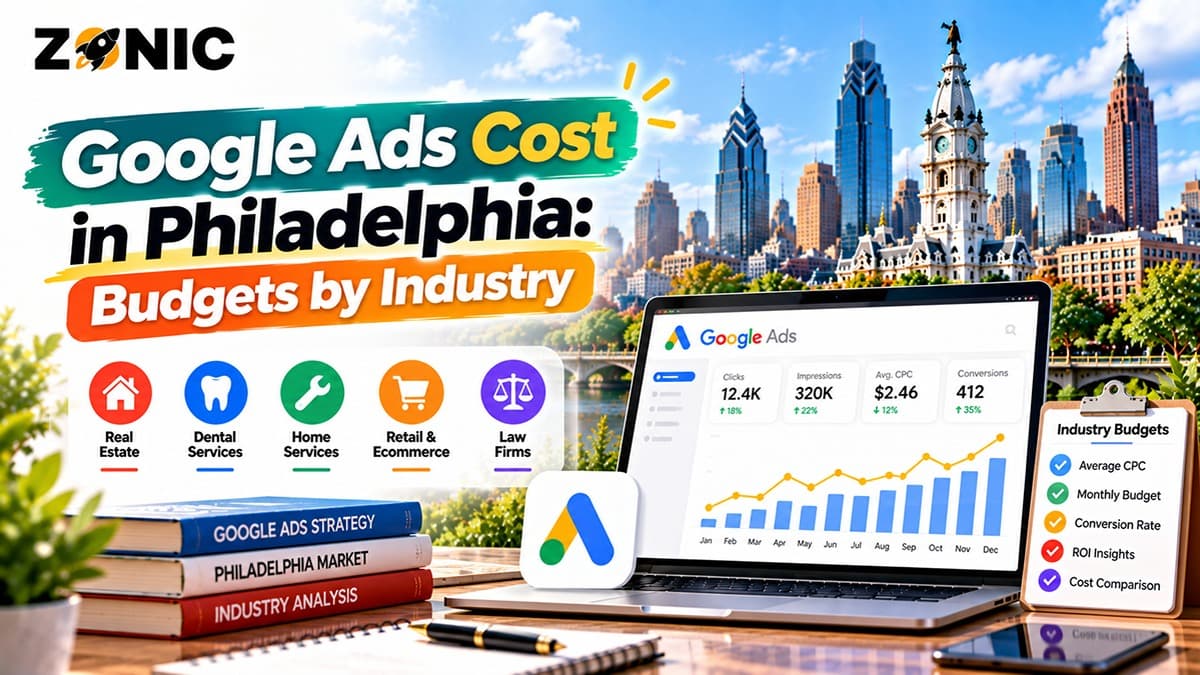
Your Google Ads budget should come from your cost per lead target, not a round number.
That is the mistake many businesses make when they start PPC. They choose $500, $1,000, or $3,000 per month because it feels comfortable, not because it matches the math required to generate leads in their market.
Google Ads cost in Philadelphia depends on your industry, keyword competition, location targeting, conversion rate, landing page quality, offer strength, and how much you are willing to pay for a qualified lead. A personal injury law firm, roofing contractor, med spa, HVAC company, dentist, auto repair shop, restaurant, ecommerce store, and B2B service provider will not pay the same cost per click or need the same budget.
Philadelphia PPC can be especially competitive because businesses are often targeting dense neighborhoods, nearby suburbs, and high-intent searches at the same time. A search from Center City can behave differently than a search from Fishtown, South Philly, University City, King of Prussia, Cherry Hill, or the Main Line.
That is why budget planning needs more than a guess.
This guide explains how Google Ads pricing works, how Philadelphia businesses should think about CPC by industry, how to set a starting budget, what a PPC agency adds on top, what management fees may look like, and which budget mistakes to avoid before launching your next campaign.
How Google Ads Pricing Works
Google Ads usually works on a pay-per-click model for search campaigns. That means you pay when someone clicks your ad, not simply when the ad appears.
The cost of that click depends on the auction. Google considers factors like bid, ad quality, expected click-through rate, landing page experience, ad relevance, competition, user location, device, search intent, and other signals.
This is why two businesses can target similar keywords and pay different amounts.
A well-built campaign with strong ad relevance and a useful landing page may pay less for better traffic than a poorly built campaign with broad keywords and weak landing pages. Google Ads is not only about who bids the most. It is about how well the ad and page match the search.
CPC Is Only One Part of the Cost
Cost per click matters, but it does not tell the whole story.
A $5 click can be expensive if none of those clicks turn into leads. A $25 click can be profitable if the lead quality is strong and the sale value is high.
The more important numbers are cost per lead, lead quality, booked appointment rate, sales close rate, and return on ad spend.
For service businesses, the goal is usually not the cheapest click. The goal is a qualified lead at a profitable cost.
Philadelphia CPC by Industry
Google Ads CPC varies by industry because some leads are worth more than others. Legal, home services, insurance, finance, healthcare, and high-ticket B2B services often pay more because one customer can be worth thousands of dollars.
Lower-cost industries may pay less per click, but they may also need more volume to make campaigns worthwhile.
National 2026 benchmark data from LocaliQ and WordStream shows wide CPC variation across industries, with search CPC averages differing significantly by vertical. Philadelphia-specific Keyword Planner data should be checked before launching, but national industry benchmarks can help set planning expectations.
Industry | Typical Search CPC Planning Range | Why Costs Vary |
Legal services | $8 to $30+ | High case value and strong competition |
Home services | $5 to $20+ | Emergency intent, lead value, seasonal demand |
Healthcare and dental | $4 to $15+ | Patient value, specialty competition, location targeting |
Real estate | $3 to $12+ | Market demand, buyer and seller intent, neighborhood competition |
Auto repair | $3 to $10+ | Service type, urgency, local competition |
Restaurants and hospitality | $1 to $5+ | Lower CPC but high volume needs |
B2B services | $5 to $25+ | Longer sales cycles and high contract value |
Ecommerce and retail | $1 to $8+ | Product margin, shopping competition, brand demand |
Education and training | $4 to $15+ | Program value and enrollment competition |
Med spa and beauty | $3 to $12+ | Service value, local demand, offer quality |
These are planning ranges, not fixed prices. Actual Philadelphia CPC should be confirmed with live account data, Google Keyword Planner, and campaign testing.
A business targeting “emergency plumber Philadelphia” may pay much more than a business targeting a softer informational keyword. A law firm targeting injury cases may pay far more than a general legal brand keyword. A restaurant targeting “private dining Philadelphia” may see very different costs from one targeting “lunch near me.”
Setting a Google Ads Budget
A useful starting budget should come from your lead goal and expected cost per lead.
Start with the number of leads you want. Then estimate your expected conversion rate and CPC. This gives you a rough traffic and budget target.
For example, if clicks cost $10 and your landing page converts at 10%, every 10 clicks may produce one lead. That means the estimated cost per lead is $100. If you want 20 leads per month, the ad spend target may need to be around $2,000 before management fees.
If the conversion rate is only 5%, the cost per lead doubles. If CPC rises, the budget needs to rise too.
Budget Formula for PPC Planning
A simple planning formula looks like this:
Monthly ad budget = target leads × expected cost per lead
A better version adds sales conversion rate:
Required leads = target customers ÷ lead-to-customer close rate
If you want 10 new customers and your team closes 25% of qualified leads, you need about 40 qualified leads. If each qualified lead costs $120, the ad spend needed is around $4,800.
This is why budget should start from business math, not a random monthly number.
Minimum Starting Budgets by Business Type
Some businesses can test Google Ads with a smaller budget. Others need more spend to collect enough data.
A low budget in a high-CPC industry may not generate enough clicks to learn anything. If a law firm spends $500 per month and clicks cost $25, the campaign may only get around 20 clicks before management fees. That is usually not enough data to optimize.
A restaurant or lower-CPC local service may learn more from the same spend because clicks cost less.
Business Type | Suggested Starting Ad Spend | Why |
Small local shop or restaurant | $750 to $1,500/month | Lower CPC and local radius testing |
Auto repair or local service | $1,500 to $3,000/month | Needs enough calls and service leads |
Med spa or dental practice | $2,000 to $5,000/month | Competitive CPC and higher patient value |
Roofing, HVAC, plumbing, pest control | $3,000 to $8,000/month | High-intent searches and strong competition |
Legal services | $5,000 to $15,000+/month | Very high CPC and case-value competition |
B2B services | $3,000 to $10,000+/month | Higher CPC and longer sales cycles |
Multi-location campaigns | $5,000 to $25,000+/month | Multiple markets and location-level data needs |
These ranges are starting points. A campaign with strong landing pages and tight targeting may do more with less. A broad campaign with poor conversion tracking can waste much more.
What a PPC Agency Adds on Top
A Google Ads agency Philadelphia businesses hire should do more than set up keywords and write ads. A strong agency helps connect ad spend to actual leads and revenue.
A PPC agency should handle account structure, keyword research, match types, negative keywords, ad copy, landing page recommendations, conversion tracking, bidding strategy, location targeting, audience signals, search terms review, call tracking, reporting, and ongoing optimization.
It should also help define what counts as a good lead.
For example, a plumber may want emergency calls in specific ZIP codes. A dentist may want implant consultations. A law firm may want qualified case inquiries. A med spa may want booked appointments for high-value treatments.
Good PPC Management Reduces Waste
Poorly managed Google Ads campaigns waste budget through broad match terms, irrelevant clicks, weak landing pages, bad location targeting, missing negative keywords, and broken conversion tracking.
A good agency reviews search terms regularly, blocks irrelevant traffic, tests ad copy, improves landing pages, and tracks meaningful conversions.
The goal is not just to spend the budget. The goal is to spend it where it can produce qualified opportunities.
Google Ads Management Fees
Google Ads management fees vary by agency, spend level, and campaign complexity.
Some agencies charge a flat monthly fee. Some charge a percentage of ad spend. Some use a hybrid model with a minimum fee plus a percentage. Some charge setup fees for campaign buildout, tracking, landing page work, or strategy.
A common small-business PPC management range may start around $500 to $1,500 per month for simpler accounts. More competitive or complex accounts may require $1,500 to $5,000+ per month in management fees, especially when multiple campaigns, landing pages, tracking, call recording, and ongoing testing are involved.
Ad Spend and Management Fee Are Separate
Your ad spend goes to Google. Your management fee goes to the agency.
A $5,000 monthly PPC budget might mean $4,000 in ad spend and $1,000 in management. Or it may mean $5,000 in ad spend plus a separate management fee. Always clarify the structure.
The proposal should clearly explain what goes to media spend and what goes to management.
If that is unclear, compare agencies carefully before signing.
Budget Mistakes to Avoid
The first mistake is starting with too little budget for the industry. If your clicks are expensive, you need enough spend to generate meaningful data.
The second mistake is using broad targeting. Philadelphia campaigns should be specific about location, services, intent, and negative keywords. A business serving Center City may not want clicks from far outside the service area.
The third mistake is sending paid traffic to a weak page. A homepage may not convert as well as a focused landing page built for the campaign.
The fourth mistake is tracking the wrong conversions. Page views, accidental clicks, and low-quality form fills should not be treated the same as qualified calls and booked appointments.
Do Not Judge PPC Too Quickly
Google Ads needs testing. The first few weeks often reveal what searches are relevant, which ads get clicks, which landing pages convert, and which leads are worth paying for.
That does not mean wasted spend is acceptable. It means optimization requires data.
A campaign should be monitored closely from the beginning, but final judgment should be based on enough clicks and leads to make a fair decision.
Philadelphia PPC Targeting Considerations
Philadelphia PPC needs careful location targeting. A campaign may target the city, specific ZIP codes, neighborhoods, suburbs, or radius areas depending on the business.
A storefront may only need a tight local radius. A service-area business may target multiple neighborhoods or counties. A law firm may target the broader metro area. A restaurant may focus on nearby searchers, tourists, and event-driven audiences.
Location targeting should match the business model.
Neighborhood Intent Matters
Search behavior can change by neighborhood. Someone searching in Center City may have different expectations than someone in Northeast Philadelphia, Manayunk, South Philly, Fishtown, or the Main Line.
Ad copy and landing pages can reflect that local intent.
A med spa may promote consultations near a specific neighborhood. A roofer may target rowhome roof repair in the city and storm damage in nearby suburbs. A restaurant may target private dining, brunch, or event searches based on location.
Better local relevance can improve lead quality.
How to Know If Your Google Ads Budget Is Working
A PPC campaign should be judged by more than clicks.
Track cost per click, click-through rate, conversion rate, cost per lead, lead quality, booked appointments, sales, revenue, and return on ad spend. Also review search terms to see what people actually typed before clicking.
If the campaign gets clicks but no leads, the issue may be the landing page, offer, targeting, or keyword intent. If the campaign gets leads but no sales, the issue may be lead quality, follow-up speed, or sales process.
Lead Quality Matters Most
A form fill from someone outside the service area is not as valuable as a qualified local prospect. A call asking for a service you do not offer is not a good conversion. A lead that never answers may not justify the same value as a booked consultation.
Your agency should help separate raw leads from qualified leads.
That is how PPC becomes more profitable over time.
How Zonic Helps With Philadelphia PPC
Zonic helps Philadelphia businesses plan PPC campaigns around cost per lead, lead quality, and business goals.
The process starts with reviewing the business model, service area, industry competition, landing pages, offer, current tracking, and expected lead value. Then Zonic helps estimate a practical starting budget based on CPC expectations, conversion rate, and target lead volume.
Zonic also reviews campaign structure, keyword intent, negative keywords, ad copy, landing page alignment, call tracking, form tracking, and reporting.
For local businesses, Zonic connects PPC with local search strategy. That means ads, landing pages, Google Business Profile, reviews, and service pages all support the same customer journey.
The goal is not simply to spend more on Google Ads. The goal is to spend smarter and turn ad clicks into qualified calls, forms, bookings, and sales opportunities.
Conclusion
Google Ads cost in Philadelphia depends on your industry, competition, CPC, conversion rate, service area, landing page quality, and lead value.
A restaurant may test with a smaller budget than a law firm. A med spa or dental practice may need enough spend to compete for high-value treatment searches. A roofer, HVAC company, plumber, or pest control business may need a stronger budget for emergency and service-based searches. A B2B company may need more patience because sales cycles are longer.
The right budget should come from your target cost per lead and close rate, not a random number.
Before launching, estimate your CPC, expected conversion rate, target leads, and management fee. Make sure tracking is set up correctly. Use focused landing pages. Review search terms. Measure lead quality, not just clicks.
If you want help planning a Philadelphia PPC campaign with a realistic budget, Zonic can review your market, landing pages, and lead goals.
Call Zonic Media at (302) 726-9736 or visit 8 The Green, Suite B, Dover, DE 19901 Request a free audit through Zonic’s Philadelphia PPC & SEM page to see what your starting budget and campaign structure should look like.