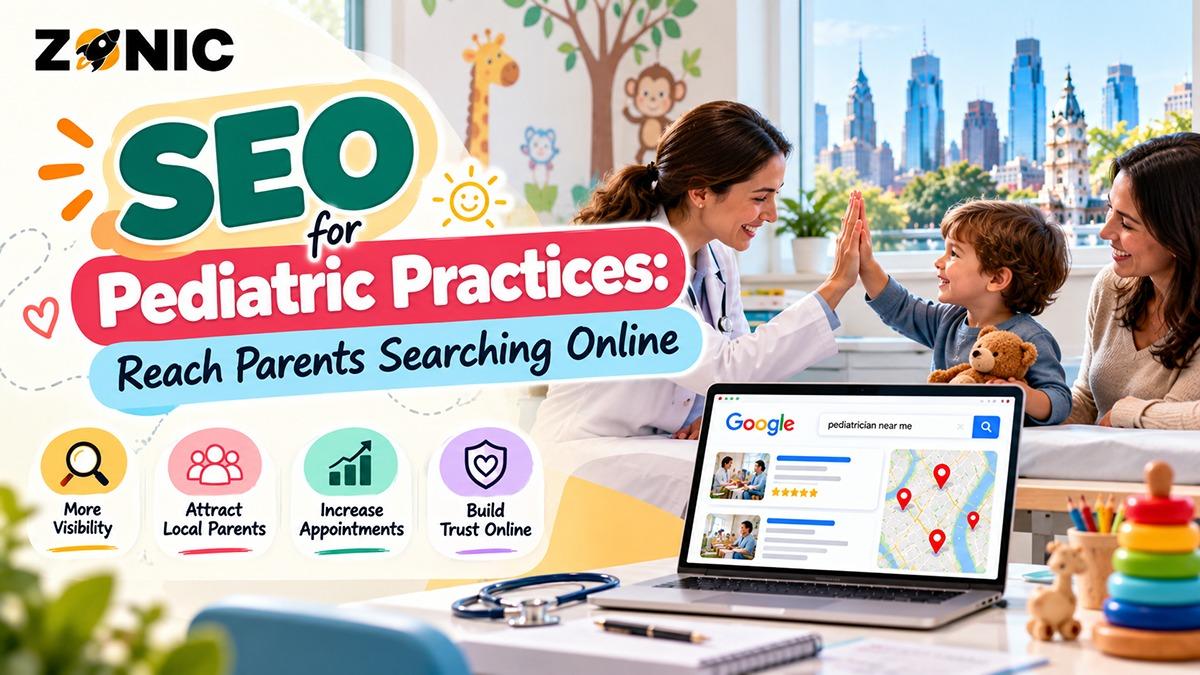
Parents usually research a pediatrician more carefully than they research an ordinary local service.
They are choosing someone who may care for their child from infancy through adolescence. That means location matters, but so do professional qualifications, communication, appointment availability, office policies, reviews, and confidence in the medical information the practice provides.
Many of those decisions begin on Google.
A family moving into a new neighborhood may search for a pediatrician nearby. First-time parents may research newborn visits before choosing a practice. Another parent may look for a pediatric office accepting new patients, while an established family may be comparing physicians after relocating.
If the practice is difficult to discover or its online information is incomplete, those families may never reach the appointment page.
That is where pediatric SEO becomes valuable.
Search engine optimization helps pediatric practices become easier to find through Google Search and local results while improving the information parents use to evaluate the clinic.
The objective is not simply to increase rankings.
A useful pediatric SEO strategy should help parents find accurate information, understand available services, evaluate qualified providers, and move toward an appropriate appointment without compromising patient privacy or making unsupported health claims.
This guide explains how pediatric practices can improve local visibility, provider pages, service content, parent education, reviews, technical website quality, and new-patient measurement.
How Parents Choose a Pediatrician Through Google
Choosing a pediatrician often involves more than one search.
A parent may begin by comparing practices close to home and later research individual physicians, office policies, insurance participation, or appointment availability.
Convenience can matter significantly.
Families may consider travel time, parking, public transportation, office hours, accessibility, whether newborns are accepted, and whether the clinic is currently accepting new patients.
A strong online presence should answer those basic questions before a parent needs to call.
Local Searches Reveal Different Patient Needs
Not every pediatric search has the same intent.
Someone researching childhood vaccination schedules is probably looking for general education.
A parent searching for “pediatrician accepting new patients” is much closer to choosing a clinic.
A search for a specific pediatrician's name may indicate the family already knows the provider and is looking for reassurance before booking.
The website should support those different needs.
Educational content can answer general questions.
Service pages can explain available care.
Provider biographies can establish professional credentials.
Location and appointment pages can help families take the next step.
Together, those pages create a clearer journey from discovery to contact.
Parents Look for Trust Before Booking
A pediatric website should help families understand who may care for their child.
That means publishing accurate physician credentials, understandable service information, real office details, and clear appointment policies.
Avoid broad promotional claims such as:
“the best pediatrician”
“guaranteed treatment results”
or other statements that cannot be objectively supported.
Healthcare trust is stronger when information is specific, accurate, and easy to verify.
Google Business Profile Optimization for Pediatric Practices
Google Business Profile can play an important role in pediatric local search because it displays information directly in Google Search and Maps.
Parents may see the practice name, reviews, address, phone number, hours, website, and other profile information before visiting the clinic's website.
Google says local rankings are mainly based on relevance, distance, and prominence.
A pediatric practice cannot control every factor, especially the searcher's location.
It can improve how accurately the practice is represented.
Choose Accurate Healthcare Categories
The primary category should accurately describe what the business actually is.
For a pediatric practice, that may involve an appropriate pediatrician or medical-practice category depending on the clinic structure and the categories Google currently makes available.
Do not treat categories as a list of every service the practice offers.
Vaccinations, developmental screenings, school physicals, and well-child visits are services.
They do not necessarily justify separate business categories.
The primary category should describe the practice itself.
Keep Essential Practice Information Current
Parents need reliable information.
The profile should show the correct:
Practice name
Address
Phone number
Website
Office hours
Appointment link
If the practice accepts new patients, make that clear through appropriate website and scheduling information.
Routine pediatric office hours should also not be confused with emergency availability.
A practice that does not operate an emergency department should not imply that it provides emergency services.
Accurate information helps families choose the appropriate level of care.
Manage Individual Pediatrician Profiles Carefully
A medical practice may have both an organization profile and separate profiles for eligible individual physicians.
Google says individual practitioners should be public-facing and directly contactable at the verified location during stated hours. A practitioner should not create separate profiles for each specialization.
That means pediatrician profiles should represent real physicians rather than being created for:
newborn care,
vaccinations,
developmental assessments,
or other service categories.
Provider profiles should use accurate professional names and current practice locations.
When a physician joins or leaves the clinic, relevant information should be reviewed promptly.
Create Provider Pages That Establish Clinical Credibility
Provider pages are especially important on pediatric websites because parents often want to learn about the physician before scheduling a child's first visit.
A useful biography should explain the physician's professional background without becoming an advertisement filled with vague claims.
Include Qualifications and Professional Background
A provider page can include:
Physician name
Appropriate professional credentials
Medical education
Residency training
Board certification where applicable
Relevant clinical experience
Genuine clinical interests
If a pediatrician has particular areas of interest, those can be described accurately.
Examples might include newborn health, preventive pediatrics, adolescent care, or developmental follow-up when those topics genuinely reflect the physician's practice.
Do not imply a specialist certification or qualification the provider does not hold.
Parents should be able to understand exactly who the physician is and what credentials support their role.
Explain the Physician's Approach to Patient Care
Professional qualifications answer only part of a parent's question.
Families may also want to know how the pediatrician communicates, approaches preventive care, discusses treatment options, and works with parents or caregivers.
A provider biography can explain those qualities in natural language.
Real physician photographs and accurate information about languages spoken may also make families more comfortable before their first appointment.
The goal is credibility and familiarity, not exaggerated promotion.
Build Pediatric Service Pages Around Family Needs
A pediatric website should clearly explain the care available at the practice.
Families may search for:
well-child visits,
newborn care,
vaccinations,
developmental assessments,
school or sports physicals,
or adolescent preventive care.
The exact services depend on the practice and its clinicians.
Dedicated pages can explain important services more clearly than one general page covering everything.
Explain Preventive and Routine Pediatric Care
Each service page should explain what the visit is for and what families may generally expect.
A well-child page, for example, can discuss preventive monitoring and age-appropriate evaluation without attempting to diagnose an individual child online.
A newborn page can explain how the practice handles early visits.
Information about vaccinations, developmental screening, or other clinical recommendations should reflect current professional guidance and be reviewed by qualified healthcare professionals.
Because pediatric recommendations can change over time, medical content should be reviewed rather than left online indefinitely without clinical oversight.
Make Appointment Expectations Clear
Parents frequently have practical questions before booking.
They may want to know:
Whether the practice accepts their insurance
Whether a referral is needed
What records to bring
How new-patient registration works
Whether forms can be completed online
How appointment scheduling works
Answering these questions can reduce uncertainty.
Appointment instructions should also work well on mobile devices.
If the practice uses a patient portal or third-party scheduling system, the website should clearly explain the process without exposing private health information.
Answer Parents' Questions With Helpful Educational Content
Educational content can introduce families to the practice before they are ready to choose a pediatrician.
Parents search for information about developmental milestones, vaccinations, routine examinations, nutrition, childhood symptoms, and preventive care.
Those topics can be valuable, but pediatric health content needs careful clinical review.
Focus on Common Parent Questions
Useful educational topics may include:
What happens during a newborn's first pediatric visit?
How often are well-child visits typically scheduled?
What should parents bring to a pediatric appointment?
How are developmental milestones discussed during routine visits?
What signs mean parents should contact a healthcare professional about a fever?
What questions should families ask when choosing a pediatrician?
The purpose is education.
A general article should not attempt to diagnose an individual child or replace personalized medical advice.
Where symptoms may require urgent care, the content should direct families toward appropriate professional or emergency evaluation rather than encouraging them to self-diagnose from an article.
Keep Pediatric Health Content Clinically Reviewed
Healthcare guidance changes as evidence and professional recommendations evolve.
Articles discussing vaccinations, illness, preventive screening, medication, or development deserve ongoing review.
Where appropriate, identify the qualified healthcare professional who authored or clinically reviewed the page.
Publication dates and review dates can also help readers understand when the content was last evaluated.
A responsible editorial process helps protect both patients and the practice's credibility.
HIPAA-Conscious Review Management for Pediatric Practices
Online reviews influence how parents compare pediatric clinics.
Families may read comments about communication, scheduling, office organization, staff interactions, and the overall experience.
Google also says review volume and positive ratings can help local ranking.
Pediatric practices need additional caution because the underlying healthcare relationship may involve protected information about a child.
Encourage Genuine Reviews Without Pressure
Google permits businesses to ask customers for genuine reviews and provides review links and QR codes for that purpose.
The request should remain neutral.
Do not:
Offer incentives for reviews
Ask only families expected to leave positive feedback
Pressure parents to post reviews
Tell reviewers what to say
Encourage disclosure of medical information
Google prohibits incentivized and manipulated review activity.
Authentic feedback is more useful than manufactured ratings.
Respond Without Revealing Patient Information
A parent choosing to discuss a child's care publicly does not automatically authorize the practice to discuss that care in response.
For HIPAA-covered practices, public replies should avoid confirming:
that the child is a patient
appointment history
diagnosis
treatment
medication
payment information
other protected health information
Even when a reviewer has already disclosed those details, the practice should not assume that repeating or expanding on them is permitted.
A general acknowledgment with an invitation to contact the office privately is usually safer than discussing a clinical situation publicly.
The same privacy caution applies to testimonials, patient photographs, and family stories used for marketing.
Improve Technical SEO and the Parent Booking Experience
A pediatric website needs to work well on mobile devices.
Parents may search while commuting, caring for a child, or trying to schedule during a busy day.
Slow pages, difficult forms, hidden phone numbers, and confusing navigation create unnecessary friction.
Technical SEO helps search engines discover and understand pages while also improving usability.
Prioritize Mobile Experience
Important information should be easy to find on a phone.
That includes:
office location,
hours,
physician information,
insurance details,
phone number,
and appointment instructions.
Text should remain readable without excessive zooming.
Buttons should be easy to use.
Large images should not unnecessarily slow down important pages.
The booking path should require as few confusing steps as possible.
Protect Information Collected Through Booking Tools
Online scheduling systems, appointment forms, patient portals, and certain tracking configurations may involve sensitive or protected information.
Healthcare practices should evaluate whether analytics scripts, advertising pixels, session-recording software, forms, or third-party integrations collect or transmit PHI.
HHS says HIPAA-regulated organizations cannot use tracking technologies in ways that create impermissible PHI disclosures. HHS also notes that a 2024 federal court ruling vacated the portion of its guidance that treated an IP address plus a visit to an unauthenticated public healthcare webpage as automatically triggering HIPAA obligations.
That means a visit to a public article about pediatric care is not automatically equivalent to transmitting PHI from an authenticated portal or appointment workflow.
The practice still needs to review the actual implementation.
Patient names, appointment details, medical record information, diagnoses, form responses, or other protected data should not be transmitted improperly to advertising or analytics vendors.
Measure New Patient Inquiries Instead of Traffic Alone
Traffic by itself does not show whether pediatric SEO is helping the practice grow.
Educational articles can attract many readers who never intend to become patients.
A provider page or location page may receive fewer visits but generate more qualified inquiries.
Performance measurement should therefore distinguish visibility from patient acquisition.
Track Relevant Search and Booking Performance
Useful metrics may include:
Organic visits to provider and service pages
Appropriate Google Business Profile interactions
Appointment-page visits
Qualified new-patient inquiries
Booking-form completions
Confirmed first appointments where appropriate
Inquiry-to-booking conversion
Marketing reports should avoid unnecessary patient-level medical information.
General dashboards do not need diagnoses, treatment details, or other private health information to show whether SEO is producing meaningful inquiries.
Evaluate the Quality of New Patient Inquiries
Not every website visitor is a potential patient.
Some people may live outside the practice's area.
Others may only be researching general health information.
The more useful question is whether the website attracts families who:
live within a realistic service area,
need services the clinic actually provides,
and are considering contacting or joining the practice.
That distinction helps the clinic prioritize the pages closest to real patient acquisition.
How Zonic Helps Pediatric Practices Reach More Families
Zonic helps pediatric practices strengthen local search visibility, provider information, website quality, and appointment conversion.
The process begins by reviewing the clinic's Google Business Profile, provider pages, service content, local competitors, reviews, important business information, technical website condition, and booking experience.
For one clinic, the first priority may be improving local visibility.
Another may need stronger physician biographies.
Another may have useful medical content but a difficult appointment process.
The strategy should reflect the practice's actual weaknesses rather than applying the same SEO package to every clinic.
Healthcare marketing also requires appropriate restraint.
Clinical information should be reviewed for accuracy.
Patient privacy should remain protected.
Tracking technologies should be evaluated carefully.
And digital marketing should make legitimate pediatric expertise easier to find rather than creating unsupported medical authority.
Conclusion
Pediatric SEO is about more than appearing higher in Google.
It helps parents find accurate information, evaluate qualified physicians, understand available care, and contact a practice when the fit is appropriate.
An accurate Google Business Profile supports local discovery.
Detailed provider pages establish professional credibility.
Useful service information explains what the practice actually offers.
Clinically reviewed educational content can answer common parent questions.
Responsible review management protects patient trust.
And a clear mobile booking experience helps convert relevant search visibility into appointment opportunities.
The strongest pediatric practice marketing balances visibility with clinical accuracy, transparency, and patient privacy.
Zonic Media helps pediatric practices improve Google Maps visibility, provider pages, website content, technical SEO, and appointment conversion opportunities through responsible search strategy. Request a free audit through Zonic's Pediatric SEO services page, or contact Zonic at (302) 726-9736, located at 8 The Green, Suite B, Dover, DE 19901, for pediatric SEO support across the United States.
Frequently Asked Questions
What is pediatric SEO?
Pediatric SEO is the process of improving a pediatric practice's visibility in Google Search and local results. It can include Google Business Profile optimization, physician pages, service content, local business information, educational resources, technical improvements, and appointment conversion work.
How can a pediatrician improve Google Maps visibility?
A pediatric practice can strengthen local visibility by maintaining accurate Google Business Profile information, selecting appropriate categories, earning genuine reviews, improving website relevance, and keeping important clinic information current. Google mainly evaluates local results through relevance, distance, and prominence.
Can individual pediatricians have their own Google Business Profiles?
Potentially. Google allows eligible public-facing practitioners to have dedicated profiles when they can be contacted directly at the verified location during stated hours. Practitioners should not create multiple profiles for separate specialties or services.
What pages should a pediatric website have?
A pediatric website commonly benefits from physician biographies, service pages, office information, appointment guidance, insurance information, and clinically reviewed educational resources. The exact structure should reflect the practice's actual services.
Can pediatric practices ask parents for Google reviews?
Yes. Practices can invite genuine, voluntary feedback. Google allows review links and QR codes but prohibits incentives, biased solicitation, rating manipulation, and requests that pressure users to leave particular content.