Real Estate SEO vs Zillow Leads: Which Pays Off for Agents?
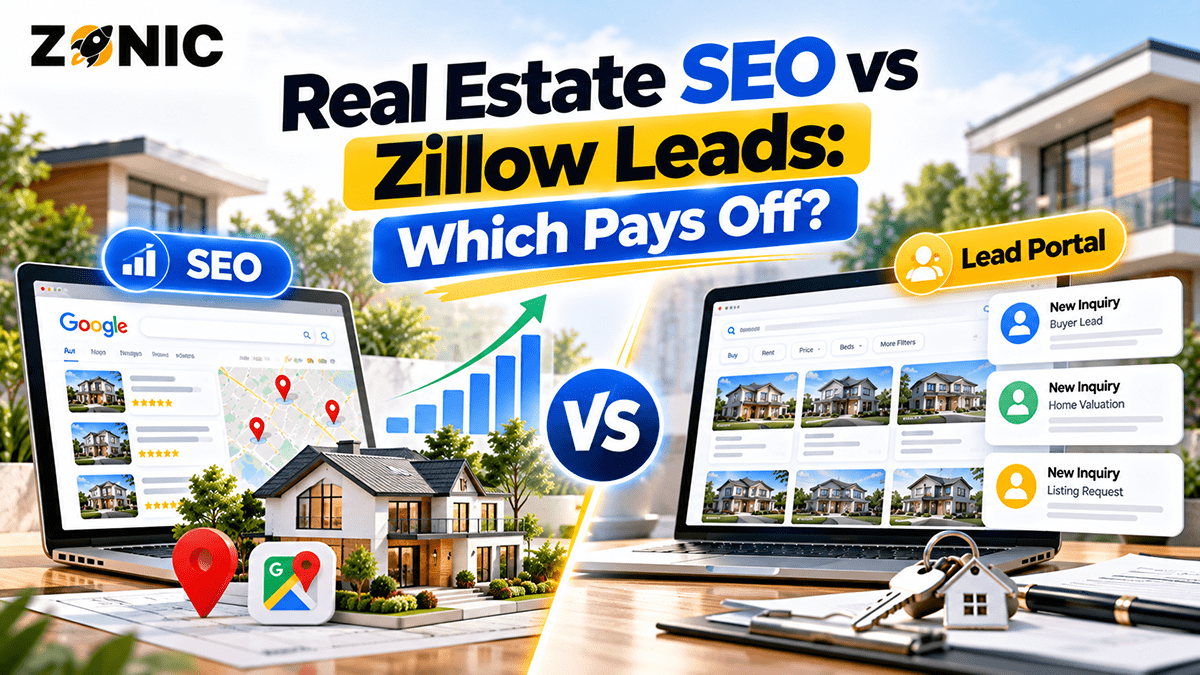
Zillow Premier Agent and real estate SEO can both generate opportunities for agents, but they solve different marketing problems.
Zillow gives agents access to demand already happening inside a major real estate marketplace. SEO focuses on making an agent’s own website and brand more discoverable when buyers and sellers search through Google.
That creates a very different cost structure, timeline, level of control, and measurement model.
Zillow can potentially produce connections sooner because agents are purchasing exposure in markets where consumers are already active. SEO generally takes longer because search visibility has to be built through useful pages, technical improvements, local relevance, reputation, and site authority.
Neither channel guarantees closed business.
The better comparison is not “Which one is always better?”
It is:
Which channel fits your current budget, pipeline needs, market, follow-up capacity, and long-term lead-generation strategy?
Zillow Leads or SEO?
Zillow Premier Agent can give agents paid access to active real estate shoppers sooner, while SEO usually requires more time to build visibility through an agent’s own website and local search presence. Zillow depends on ongoing advertising spend and ZIP-level marketplace conditions. SEO does not charge per lead, but rankings are not guaranteed and require ongoing maintenance. Many agents can use the two channels for different purposes.
How Zillow Premier Agent Generates Opportunities
Zillow Premier Agent is an advertising program that allows agents to purchase exposure in selected ZIP codes.
Zillow currently describes share of voice as the percentage of exposure an advertiser receives compared with other advertisers in that ZIP code. Budget influences share of voice, and Zillow provides estimated monthly connections based on the selected market and advertising level.
This makes Zillow fundamentally different from organic SEO.
You are not waiting for a page to become visible in search results. You are buying exposure inside an existing marketplace where buyers are already browsing homes and requesting information.
Zillow Pricing Depends on the Market
There is no single Zillow Premier Agent price that applies everywhere.
Zillow allows advertisers to view ZIP-specific information, competition, share of voice, expected connections, and monthly advertising budget. Availability can also be limited in some ZIP codes.
That means two agents can spend very different amounts depending on where they advertise.
A competitive ZIP code may require a larger budget to reach the same level of exposure available more cheaply elsewhere.
The important number is therefore not simply monthly spending.
It is what that spend produces.
How Real Estate SEO Generates Leads
Real estate SEO works differently.
Instead of purchasing marketplace exposure, the agent invests in making their own website and brand discoverable through search engines.
Potential leads may arrive through:
buyer pages
seller pages
neighborhood guides
relocation content
home valuation pages
local search results
or other useful pages that match what buyers and sellers are researching.
The main difference is that the content and website are business-controlled assets.
Your domain, website copy, landing pages, analytics setup, and first-party lead data can continue to support the business after the month in which they were created.
Organic rankings themselves are not owned, however.
Google Business Profile Optimization: Its search results and visibility can rise or fall as competitors improve, algorithms change, pages become outdated, or technical issues develop.
That distinction matters when comparing SEO with a paid marketplace.
Zillow Access vs. Business-Controlled Search Assets
It is tempting to describe the difference as “renting versus owning,” but that is too simple.
Zillow gives an agent paid access to an audience the platform already has.
SEO builds visibility around assets the agent controls, especially the website and original content, but still depends on external search engines to provide discovery.
A better comparison is:
Zillow: paid access to existing marketplace demand.
SEO: investment in making your own site and brand easier to discover.
Both remain dependent on external platforms to some degree.
The difference is where the marketing investment accumulates.
Cost Structure: Zillow Leads vs SEO
The easiest way to compare the channels is to look at how the money is spent.
Factor | Zillow Premier Agent | Real Estate SEO |
Primary spend | Paid marketplace exposure | Website, content, technical and local SEO work |
Geographic model | ZIP-based advertising and share of voice | Visibility varies by query, site strength and searcher location |
Speed | Paid connections can potentially begin sooner | Competitive visibility often takes longer |
Website asset creation | Limited | Significant |
Cost per lead | Directly influenced by spend and resulting connections | Calculated from campaign cost and organic leads |
Ongoing requirement | Advertising spend supports continued paid exposure | Ongoing work often needed to maintain and expand visibility |
Main dependency | Zillow marketplace | Search engines |
Best measurement | Cost per connection and cost per closing | Cost per qualified lead and cost per closing |
This framework is more useful than assuming one channel is automatically cheaper.
An expensive SEO campaign that produces no meaningful leads is not efficient.
Neither is a Zillow campaign that produces many contacts but very few clients.
Compare Cost Per Closing, Not Just Lead Volume
This is one of the most important calculations an agent can make.
Suppose Zillow produces 40 leads in a month and SEO produces only 10.
Zillow may appear stronger based on volume.
But if the Zillow leads produce one closing and the organic leads produce two, the economics look very different.
Zillow Cost Per Closing
Use:
Total Zillow Spend ÷ Zillow-Sourced Closings
If you spend $4,000 and close two transactions attributed to Zillow:
$4,000 ÷ 2 = $2,000 per closing
SEO Cost Per Closing
Use:
Total SEO Spend ÷ Organic-Sourced Closings
If you invest $3,000 in SEO and close three organic leads during the measured period:
$3,000 ÷ 3 = $1,000 per closing
Those examples are illustrations only.
The real numbers depend on your market, transaction value, attribution method, conversion rate, and campaign maturity.
Also Track Revenue Against Marketing Cost
A useful additional calculation is:
Gross Commission Income Attributed to the Channel ÷ Channel Spend
This helps agents compare the business value created by different lead sources rather than focusing only on traffic or inquiry count.
Lead Intent Is Different on Each Channel
Zillow and Google often catch people at different moments.
A Zillow user may already be viewing properties and requesting information about a home. That can create high-intent opportunities.
But paid marketplace leads still need strong follow-up
Some people may contact several agents
Some may already have representation
Others may be early in the process
SEO leads can also vary widely
Someone who lands on a general neighborhood guide may be researching months before moving.
Another visitor may arrive through a seller page and request a valuation immediately.
That means lead source alone does not determine quality.
The page, query, timing, and follow-up process all matter.
Zillow Works Best When Follow-Up Is Strong
Paid lead programs can lose value quickly when follow-up is slow.
An agent using Zillow should track more than total leads.
Useful metrics include:
response time
contact rate
appointment rate
signed-client rate
closing rate
cost per signed client
cost per closed transaction
A large volume of leads does not automatically mean the campaign is profitable.
If leads are entering the CRM but nobody follows up consistently, the marketing channel may be blamed for a sales-process problem.
SEO Works Best When the Website Has a Clear Purpose
SEO does not succeed simply because an agent publishes more pages.
The site needs to connect visibility with action.
A seller page should make it easy to request a consultation or valuation.
A buyer page should create a path toward contacting the agent or exploring appropriate listings.
A relocation page should help someone understand the market while making professional guidance easy to access.
The SEO channel becomes more valuable when the website supports the next step instead of treating traffic as the final result.
How Long Does SEO Take Compared With Zillow?
Paid marketplace advertising can usually begin operating sooner than a new organic local SEO campaign because it does not require waiting for competitive search rankings to develop.
SEO has a less predictable timeline.
Google says some website changes can be reflected within a few hours, while others may take several months. Google generally recommends allowing at least a few weeks before evaluating whether changes have produced an effect in search results.
For a real estate website, meaningful growth depends on factors such as:
existing site strength
competition
technical condition
content quality
local reputation
links
and how competitive the target searches are.
This means SEO should not be sold with a fixed ranking deadline.
When Zillow Premier Agent May Make Sense
Zillow can be a practical option when an agent wants access to marketplace demand sooner and has the systems to work the resulting opportunities.
It may fit agents or teams that:
have strong response processes
Use a CRM consistently
can handle additional buyer conversations
understand their cost per closing
have enough budget to test a ZIP code properly
The key is measurement.
If the campaign produces profitable closed business, the platform can have a valid role regardless of whether the agent also invests in SEO.
When Real Estate SEO May Make Sense
SEO becomes more attractive when the business wants to build greater visibility around its own brand and website.
It can fit agents who have:
clear target markets
strong neighborhood knowledge
seller-focused services
relocation expertise
specialized property experience
or an existing referral brand that does not appear strongly in Google.
SEO is particularly useful when the website itself can become part of the sales process rather than simply acting as an online brochure.
When Using Both Channels Makes Sense
The two channels do not have to compete for the entire marketing budget.
They can serve different time horizons.
Zillow may support immediate marketplace exposure.
SEO can be built in parallel to improve the agent’s discoverability through Google and strengthen the website prospects visit after encountering the brand elsewhere.
For example, a buyer may first encounter an agent through Zillow and later search the agent’s name.
At that point, the website, Google presence, reviews, and local content can influence whether the buyer responds or continues the relationship.
That means organic visibility can improve the effectiveness of other marketing channels even when it was not the original source of the lead.
A More Useful Zillow vs SEO Scorecard
Decision Factor | Zillow Premier Agent | Real Estate SEO |
Access to existing audience | Zillow marketplace | Google/Search audience |
Potential startup speed | Generally faster | Usually slower |
Paid exposure required | Yes | No per-lead platform fee |
Website asset creation | Low | High |
Geographic targeting | ZIP/share-of-voice based | Query and location dependent |
Lead follow-up speed | Very important | Important |
Search visibility ownership | Platform-controlled | Rankings remain platform-dependent |
Content ownership | Limited relevance | Website content controlled by business |
Cost measurement | Cost per connection/closing | Cost per qualified lead/closing |
Long-term role | Paid acquisition channel | Organic acquisition and brand visibility |
Neither side automatically wins every row.
That is the point.
The better channel depends on what the business needs.
Common Mistakes When Comparing Zillow and SEO
One mistake is comparing Zillow's first month with SEO's first month.
The channels develop differently, so the timeframes are not equivalent.
Another is comparing lead volume without checking closing rate.
Twenty low-quality inquiries are not automatically more valuable than five strong consultations.
Agents also sometimes count every organic visitor as an SEO lead or every Zillow connection as a genuine sales opportunity.
Neither approach gives an accurate picture.
How Zonic Helps Agents Evaluate Their Lead Mix
Zonic helps real estate agents understand where organic search fits within their wider lead-generation strategy.
The process starts by reviewing the website, current organic visibility, Google Business Profile, lead sources, conversion paths, and the markets the business wants to grow.
The goal is not to argue that SEO must replace Zillow.
For some agents, paid marketplace leads may continue to make financial sense.
For others, growing organic visibility can provide another acquisition source and reduce reliance on any single platform.
The useful question is not:
“Should I stop Zillow?”
It is:
“Where is my next marketing dollar most likely to improve qualified lead generation?”
That decision should be based on actual channel performance.
Conclusion
Real estate SEO and Zillow Premier Agent are different acquisition models.
Zillow gives agents paid access to demand already taking place inside its marketplace. Pricing and expected connections vary according to factors such as ZIP code, budget, competition, and share of voice.
SEO focuses on making an agent’s own website and brand easier to discover through search.
It usually develops more slowly, does not guarantee rankings, and still depends on Google for visibility. But it can build business-controlled website content, stronger branded search presence, and another lead source that is not priced per marketplace connection.
For agents who need pipeline sooner and have strong follow-up, Zillow may deserve part of the budget.
For agents building long-term discoverability around their own brand, SEO may deserve part of the budget.
For many businesses, both can operate together.
The decision becomes much clearer when you stop comparing raw lead counts and start comparing cost per qualified lead, cost per closing, revenue generated, and the role each channel plays in the overall marketing system.
If you want to understand whether your current real estate marketing mix is relying too heavily on paid leads or missing organic opportunities, Zonic can review your website, local visibility, conversion paths, and current search presence.
Call Zonic Media at (302) 726-9736 or visit 8 The Green, Suite B, Dover, DE 19901 Request a free real estate SEO audit to identify where organic search could contribute more qualified opportunities.