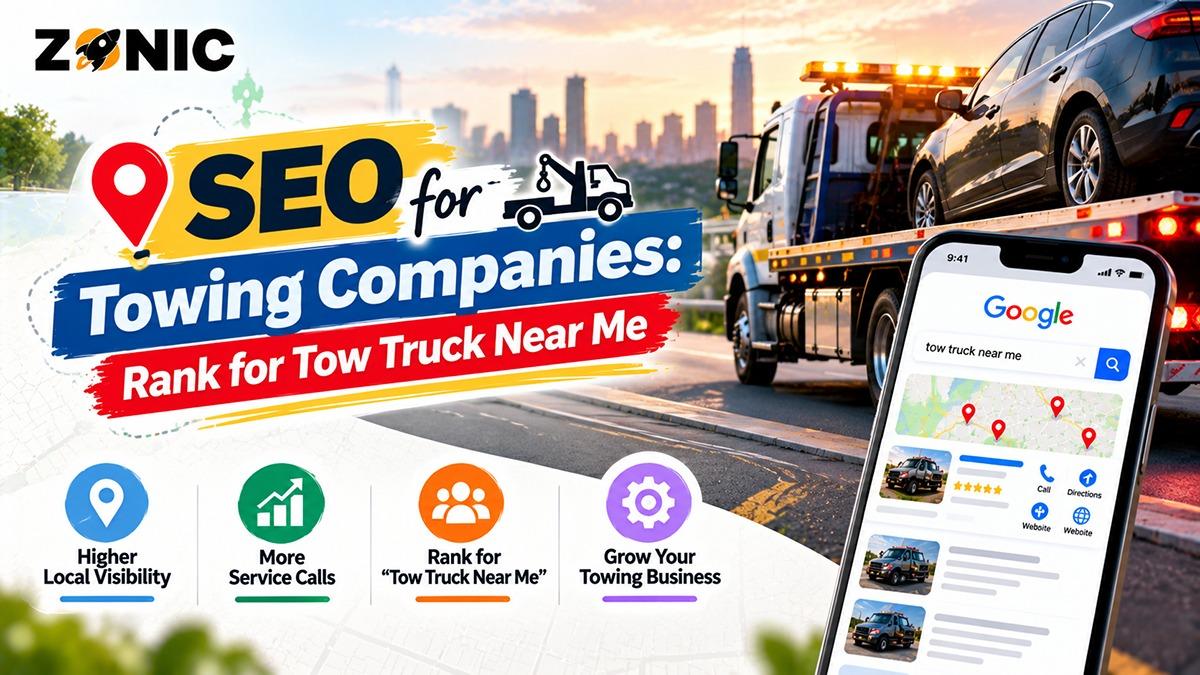
A stranded driver usually calls the first towing company they trust and can actually reach. SEO helps determine whether your business becomes one of those options.
When a vehicle breaks down on a highway, will not start in a parking lot, or becomes undrivable after an accident, the driver usually wants help quickly. They are unlikely to spend much time reading long articles or comparing a large number of companies.
Instead, they may search for “tow truck near me,” “emergency towing,” “24 hour towing,” “flatbed towing near me,” or “roadside assistance.”
Those searches create valuable opportunities for towing companies.
However, appearing prominently in Google Maps is not automatic. Competing towing operators, roadside-assistance providers, large directories, and other local businesses may all appear for the same search.
That is why SEO for towing needs to account for location, emergency search intent, service availability, website clarity, and direct phone-call conversion.
A strong towing SEO strategy helps search engines understand the company's genuine services and operating territory while making it easy for drivers to contact dispatch.
This guide explains how towing companies can strengthen Google Maps visibility, optimize Google Business Profile, build useful service and highway pages, earn genuine reviews, track qualified calls, and compete without relying on misleading local SEO tactics.
Why Google Maps Is Central to Towing SEO
Towing searches are different from many ordinary local searches because drivers frequently need immediate assistance from wherever the vehicle happens to be.
Someone planning a remodel might compare contractors for days.
A stranded driver may choose a towing provider within minutes.
Google Maps can therefore play an important role because local results display nearby businesses along with phone numbers, reviews, hours, websites, and other useful information.
A towing company that appears prominently for a relevant local search has an opportunity to receive the call before the driver researches conventional website results.
Google Maps Visibility Changes With the Driver's Location
Google says local results are mainly based on relevance, distance, and prominence.
Relevance reflects how closely a Business Profile matches the search.
Distance considers how far each business is from the customer searching.
Prominence reflects how well known the business appears, with Google noting factors such as links, review volume, and positive ratings.
For towing companies, distance is particularly important because drivers may be searching from roads, parking lots, neighborhoods, industrial areas, or interstate exits several miles apart.
A company may appear strongly near its operating base and become less visible farther away.
That does not automatically mean the SEO campaign is failing.
Google is also considering the searcher's location, competing providers, relevance, and prominence.
Towing businesses should therefore evaluate visibility across the areas that actually matter rather than relying on one search performed from the office.
Optimize Google Business Profile for Towing Services
Google Business Profile may be the first interaction between a towing company and a stranded driver.
The profile should make the company's identity, operating hours, contact information, services, and customer reputation easy to understand.
Complete and accurate information also helps Google understand which searches the business is relevant to.
Select the Correct Primary Business Category
The primary category should accurately describe the main operation.
For a business primarily providing towing, the most specific available towing category will generally make more sense than a broad unrelated automotive category.
Additional categories should only represent genuine business functions.
For example, a towing operator that also runs a legitimate customer-facing repair garage may have different category needs from a company that only provides towing and roadside assistance.
Do not add unrelated categories merely to reach more searches.
The objective is to accurately describe the real business.
Handle Dispatch Addresses and Service Areas Correctly
Many towing companies operate from dispatch yards, storage lots, garages, or other facilities.
Whether that address should appear publicly depends on how customers actually interact with the business.
Google says service-area businesses that do not serve customers at their business address should hide that address and use service areas instead. A hybrid business can show its address when it genuinely serves customers at a staffed location and also travels to customers.
A physical storage lot or dispatch base does not automatically qualify as a storefront simply because the business operates there.
If customers are not served there, the profile should not present the location as though it were a customer-facing office.
Google currently allows up to 20 service areas and says the overall coverage generally should not extend more than about two hours of driving time from the business base, although some businesses may appropriately cover a larger area.
Service areas should reflect genuine operating territory.
Adding more cities, ZIP codes, or service areas does not guarantee Maps rankings in those places. Distance remains part of Google's local-ranking system.
Avoid mailboxes, unsupported virtual offices, and fake highway locations created only to appear closer to searchers.
Keep Emergency Availability Accurate
Towing customers rely heavily on published availability.
If dispatchers genuinely answer calls and trucks are available around the clock, the Business Profile can accurately reflect 24-hour operation.
If overnight coverage stops, the business should not advertise 24/7 service simply because emergency searches are valuable.
Accurate hours help reduce wasted calls, customer frustration, and poor experiences.
Build Towing Service Pages Around Real Customer Needs
A towing website should explain what the company actually does.
One generic homepage may not give stranded drivers enough information about equipment, vehicle types, or service limitations.
A customer needing a flatbed tow has different requirements from someone needing a jump-start. A commercial vehicle operator may need equipment that a light-duty towing provider does not have.
Dedicated service pages make those differences easier to understand.
Separate Towing and Roadside Assistance Services
Depending on its real capabilities, a towing company may provide:
Light-duty towing
Flatbed towing
Motorcycle towing
Accident recovery
Jump-start assistance
Vehicle lockout assistance
Tire changes
Fuel delivery
Heavy-duty towing or recovery
Each significant service should have an accurate explanation.
A flatbed page can describe which vehicles the company's equipment is designed to transport.
A roadside-assistance page can explain which minor problems technicians can attempt to resolve at the vehicle location.
Heavy-duty pages should describe real equipment and capabilities without implying the company can recover vehicles beyond its operating capacity.
Make the Call Button Impossible to Miss
Emergency visitors should not have to search for the phone number.
Mobile pages should provide a prominent tap-to-call option.
The website should also clarify availability, operating area, and any important service limitations.
Dispatch may need information such as:
Exact or approximate vehicle location
Vehicle type
Vehicle condition
Requested destination
Required towing or roadside service
Relevant roadside safety concerns
If the company provides estimated arrival times, they should reflect real truck availability, traffic, distance, and current dispatch conditions rather than unrealistic guarantees.
Create Highway and Route Pages Without Keyword Stuffing
Highway-related searches can matter because many towing emergencies happen away from residential areas.
Drivers may search around an interstate, bridge, highway corridor, industrial area, or major roadway.
A towing company that genuinely serves those routes can create useful website content explaining that coverage.
Highway pages primarily support organic search visibility and customer understanding. They do not override Google's Maps distance factor.
Explain Actual Roadside Coverage
A useful highway page can explain:
Major roads the company genuinely covers
Nearby communities
Relevant service territory
Towing and roadside services available
Supported vehicle types
How drivers can communicate their location
For example, a company regularly operating along an interstate corridor can explain the communities and sections of the route it serves and what customers should do when requesting help.
Do not claim to operate a dispatch facility at every exit unless those locations genuinely exist.
Avoid Duplicate Highway and City Pages
Creating dozens of nearly identical pages for individual exits is unlikely to provide much value to drivers.
A stronger structure may group genuine service coverage by highway corridor, city, or service region.
Each page should contain information that makes that location meaningfully different.
That can include actual operating territory, roadway connections, supported vehicle types, relevant coverage limitations, and useful dispatch guidance.
The goal is not to create hundreds of geographic keyword combinations.
It is to help drivers understand whether the company can reasonably serve their location.
Reviews Help Stranded Drivers Decide Who to Call
Reviews matter because towing decisions often happen under pressure.
A driver may compare several nearby businesses while waiting beside the road.
Reviews can provide information about responsiveness, communication, vehicle handling, billing experiences, and professionalism.
Google also says review volume and positive ratings can help local ranking.
Ask for Reviews After Completed Towing Jobs
A completed tow or roadside-assistance job creates a natural opportunity to request honest feedback.
Google allows businesses to share a review link or QR code with customers.
The request should remain voluntary.
Do not purchase reviews, offer discounts or other incentives in exchange for reviews, manipulate ratings, or ask staff to create fake feedback.
Google prohibits incentivized and manipulated review activity.
Authentic feedback builds a more reliable reputation.
Respond Professionally to Complaints
Towing can involve stressful situations, disputed charges, vehicle storage issues, insurance questions, and customers who are already frustrated.
Negative reviews should be handled professionally.
A useful response can acknowledge the concern and invite the customer to discuss the issue privately rather than arguing publicly or revealing unnecessary personal information.
Future customers often judge not only the complaint but also how the company responds.
Local Citations Support Towing Company Credibility
Local citations are online references to the company's business information.
For towing operators, they may appear on mapping services, business directories, automotive platforms, associations, and industry listings.
The main objective is accuracy.
Customers should see consistent business names, phone numbers, websites, and legitimate location information across important platforms.
Correct Old and Misleading Listings
Towing companies can change ownership, phone numbers, yards, service territory, or business names over time.
Old listings may continue showing outdated information.
Those inconsistencies can confuse customers and lead to missed calls.
Prioritize meaningful public listings rather than creating large numbers of low-value directory entries.
Citation work should support a clear, recognizable business identity.
Track Calls and Actual Towing Jobs
Towing SEO should not be judged only by rankings or website traffic.
The real business question is whether search visibility produces qualified calls and completed jobs.
A company can receive many calls from drivers outside its service area and generate little revenue from them.
Another business may receive fewer calls but dispatch a much higher percentage because those calls closely match its real territory and services.
Measure Calls Beyond Google Business Profile
Google Business Profile interactions can indicate interest, but a call-button interaction is not the same thing as a completed phone conversation or towing job.
Customers may also call from the company website, directories, or other platforms.
Call tracking can help identify inquiry sources when implemented carefully.
If tracking numbers are used, the business should preserve its primary number and avoid creating conflicting public business information.
Google also advises businesses to use a number under the direct control of the business and warns against URLs or phone numbers that redirect users to an unrelated business.
Track:
Answered calls
Missed calls
Qualified towing inquiries
Dispatches
Completed jobs
Service type
General service territory
This is particularly important overnight and on weekends.
Improve Dispatch Conversion Rates
SEO can create demand.
Dispatch determines whether much of that demand becomes revenue.
A caller who receives no answer may immediately contact another provider.
Dispatchers should be able to identify the customer's location, vehicle type, required service, destination, and realistic availability.
If the company promotes emergency or overnight towing, the operational capacity should support that promise.
Compete With Spam and Misleading Listings
Towing search results may include profiles with inaccurate names, unsupported locations, duplicate listings, or other misleading business information.
Third-party lead-generation companies may also appear in search results, but their presence alone does not mean they violate Google's policies.
A genuine towing operator should not respond by creating fake locations or manipulating its own profile.
Identify Genuine Listing Violations
Not every competitor ranking higher is violating policy.
The other company may simply have:
a closer location
stronger relevance
more reviews
higher prominence
a stronger website
Possible issues worth investigating include verifiable fake locations, misleading business names, duplicate profiles representing the same operation, or business information that clearly does not represent the company being advertised.
A routed or tracked phone number by itself is not proof of a violation.
Look for contact details that appear inconsistent with the claimed business and cannot be reasonably verified.
Reports should be based on evidence rather than assumptions.
Use Google's Official Reporting Tools
Google provides tools for reporting inaccurate or policy-violating information in Maps and Business Profiles.
Because reporting workflows can change, use Google's current official reporting process for the type of violation involved.
Avoid repeatedly submitting complaints against legitimate competitors simply because they rank higher.
Spam reporting is not a substitute for improving your own profile, website, reviews, service information, and customer experience.
Towing SEO Priorities by Business Goal
Business Goal | SEO Priority | What to Measure |
More emergency tow calls | Google Maps visibility and accurate availability | Qualified calls and dispatched jobs |
Better highway organic visibility | Useful route and genuine coverage pages | Calls from covered corridors |
More flatbed towing jobs | Dedicated flatbed page and local relevance | Flatbed inquiries and jobs |
More roadside assistance | Clear service pages and mobile contact | Service-specific calls |
Stronger local reputation | Genuine reviews and professional responses | Review activity and qualified inquiries |
Less dependence on directories | Business-controlled website and organic visibility | Direct leads and organic conversions |
Better overnight performance | Accurate hours and dispatch monitoring | Answered calls and completed jobs |
These priorities connect SEO to actual towing operations instead of focusing only on traffic.
How Zonic Helps Towing Companies Generate More Calls
Zonic helps towing and roadside-assistance businesses build local SEO strategies around genuine service territory, qualified calls, and completed towing opportunities.
The process starts by reviewing the company's Google Business Profile, website, services, operating territory, competitors, reviews, and current organic and Maps visibility.
For one towing operator, the first priority may be correcting Business Profile information.
Another may need stronger flatbed towing pages, clearer roadside-assistance content, better route coverage pages, citation cleanup, or more effective mobile call paths.
Call performance is also important.
More visibility has limited value when drivers cannot reach dispatch or the company receives large numbers of calls outside its territory.
The goal is to help towing companies compete through accurate business information, useful website content, legitimate local reputation, and better conversion from search to dispatch.
Conclusion
SEO for towing is about reaching drivers when they need assistance and making it easy for them to contact a legitimate provider.
A strong strategy combines accurate Google Business Profile information, genuine service-area settings, useful towing pages, honest highway coverage content, real customer reviews, consistent business information, and responsive call handling.
Google Maps visibility matters because towing searches are highly location dependent.
However, adding cities to a service area or publishing highway pages does not guarantee Maps rankings in those locations. Google still considers relevance, distance, and prominence.
The towing company also needs to deliver on what its online presence promises.
Operating hours should be accurate.
Dispatch should answer when service is advertised.
Coverage information should reflect real operations.
Equipment claims should match actual capabilities.
Businesses that build these foundations can create a stronger source of towing inquiries without relying entirely on paid advertising or third-party directories.
Zonic Media provides SEO services for towing companies, helping operators improve Google Maps visibility, service-area content, highway coverage pages, and emergency call conversion. Request a free audit through Zonic's Towing SEO services page, or contact Zonic at (302) 726-9736, based at 8 The Green, Suite B, Dover, DE 19901, for towing SEO support across the United States.
Frequently Asked Questions
How can a towing company rank for “tow truck near me”?
A towing company can strengthen local visibility by maintaining an accurate Google Business Profile, selecting appropriate categories, keeping hours current, earning genuine reviews, improving website relevance, and building a credible local presence. Google still considers relevance, distance, and prominence, so visibility can change depending on the driver's location.
Does a towing company need a Google Business Profile?
An eligible towing business can benefit significantly from a Google Business Profile because customers can discover business information, reviews, hours, phone details, and other information through Search and Maps. The profile setup should accurately reflect whether the towing company is a service-area, storefront, or hybrid business.
Should towing companies create pages for highways and exits?
Highway and route pages can be useful when they explain genuine coverage and provide helpful information to drivers. Avoid creating large numbers of nearly identical exit pages. Highway content can support organic search visibility but does not override Google's Maps distance factor.
Can towing companies rank in multiple cities without separate offices?
A towing company can build organic visibility for areas it genuinely serves and can set accurate service areas in Google Business Profile. However, adding service areas does not guarantee Maps rankings in those cities. Google currently permits up to 20 service areas and generally recommends that overall coverage remain within roughly two hours of driving time from the business base.
Do customer reviews help towing SEO?
Yes. Google says review volume and positive ratings can help local ranking. Reviews also help stranded drivers evaluate reliability, communication, and service quality before making a call. Reviews should reflect genuine customer experiences and must not be purchased or incentivized.