The Local SEO Glossary: 40 Terms Every Business Owner Should Know
Local SEO can feel confusing when every report, agency call, audit, or dashboard uses different terms. One person talks about citations. Another talks about NAP. Someone else mentions proximity, prominence, indexing, conversion rate, or GBP optimization. If you are a business owner, it can quickly feel like you need a marketing dictionary before you can make a decision.
That is exactly why this local SEO glossary matters.
Local SEO is not only about ranking higher on Google. It is about helping nearby customers find, trust, and contact your business when they are ready to act. A plumber wants emergency calls. A dentist wants appointment requests. A roofer wants quote inquiries. A law firm wants qualified leads. A restaurant wants visits, reservations, and directions. A med spa wants bookings. An auto repair shop wants calls and walk-ins.
When you understand the basic language of local SEO, it becomes easier to review reports, ask better questions, avoid bad advice, and understand what actually affects your visibility.
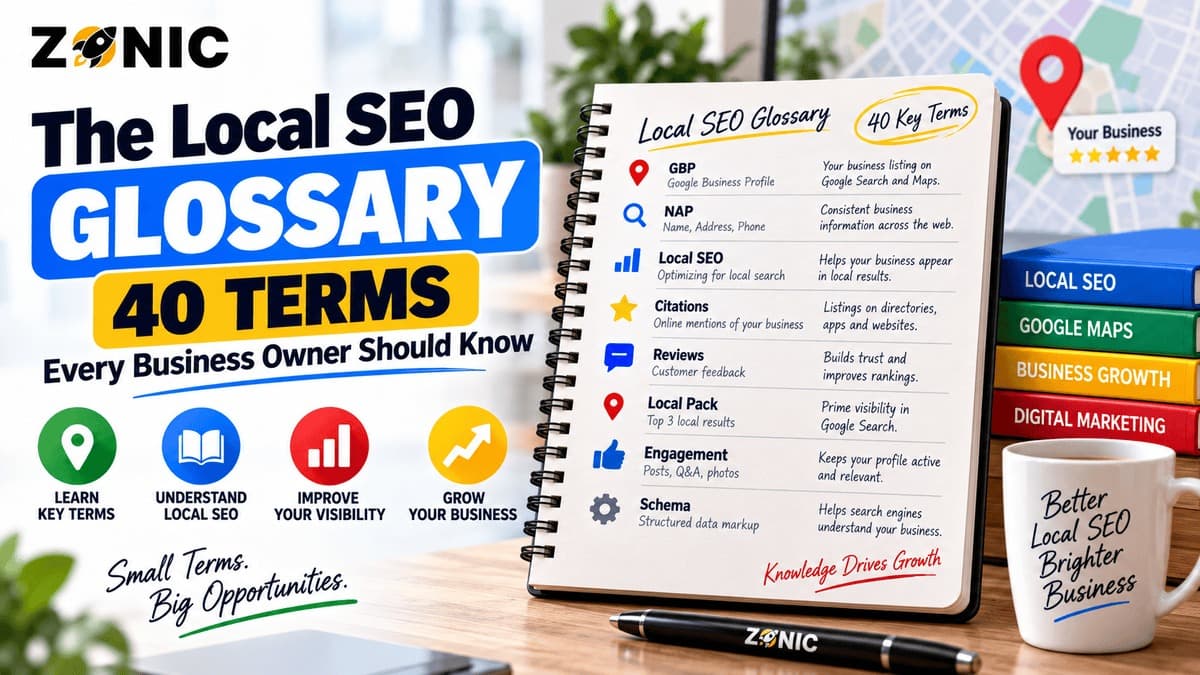
This guide explains 40 local SEO terms in plain English. These are the words business owners commonly see when working on Google Business Profile, Google Maps, website SEO, reviews, citations, local rankings, and lead generation.
Why Business Owners Should Understand Local SEO Terms
You do not need to become a full-time SEO expert to run a local business. But you do need to understand enough to know what your marketing team is doing and why it matters.
Local SEO affects real business outcomes. It can influence whether people find your company in Google Maps, whether your website shows for service searches, whether your reviews build trust, and whether profile views turn into phone calls.
If you do not understand the terms, it becomes harder to judge whether the work is useful. A report may look impressive because it includes rankings, impressions, clicks, traffic, citations, and technical fixes. But without context, you may not know which numbers are connected to actual leads.
A glossary helps separate activity from results.
For example, “impressions” are not the same as calls. “Traffic” is not the same as booked jobs. “Citations” are not the same as reviews. “Ranking” is not the same as revenue.
Once those terms are clear, local SEO becomes easier to manage.
The Core Local SEO Terms
These are the foundational terms every local business owner should understand first.
1. Local SEO
Local SEO means improving your online presence so nearby customers can find your business in local search results. It includes your Google Business Profile, website, reviews, citations, local content, maps visibility, and conversion path.
For a local company, SEO is not just about traffic. It is about being found by people in your service area who are likely to call, visit, book, or request a quote.
2. Google Business Profile
Google Business Profile, often called GBP, is the business listing that appears on Google Search and Google Maps. It can show your business name, category, address, phone number, website, hours, reviews, photos, services, and other details.
For many local businesses, GBP is one of the most important lead sources because customers can call, get directions, read reviews, or visit the website directly from the profile.
3. Google Maps
Google Maps is Google’s map platform where customers search for nearby businesses, directions, locations, reviews, and service providers. Local businesses can appear in Maps when their profile and online presence match the search.
Maps visibility is especially important for businesses that depend on nearby customers, service-area leads, or walk-in traffic.
4. Local Pack
The local pack is the group of local business results that appears near the top of Google Search for many local queries. It usually shows a small map and a few business listings.
Appearing in the local pack can be valuable because customers often compare those results before scrolling to the regular organic listings.
5. Map Pack
Map pack is another name people use for the local pack. It refers to the Google Maps-style business results shown for local searches.
When someone says they want to rank in the map pack, they usually mean they want their Google Business Profile to appear in those top local results.
Google Ranking and Visibility Terms
These terms explain how Google decides what to show and how business owners measure local search visibility.
6. Relevance
Relevance means how well your business matches what someone is searching for. If a customer searches for “emergency plumber,” Google needs to understand that your business offers emergency plumbing.
Your category, services, website pages, business description, reviews, and content all help Google understand relevance.
7. Distance
Distance means how far your business is from the searcher or from the location used in the search. A nearby business often has an advantage for local searches, but the closest business does not always rank first.
Distance matters because local search is designed to help users find businesses that are useful for their location.
8. Prominence
Prominence means how well known or trusted your business appears. Google explains prominence using signals from across the web, including reviews, links, articles, and directories.
A business with strong reviews, good local mentions, quality links, and a trusted website may appear more prominent than a business with a weaker online footprint.
9. Organic Results
Organic results are the unpaid website listings that appear in Google Search. These are different from ads and different from the map pack.
For local businesses, organic results can include homepages, service pages, location pages, blog posts, and helpful resources that answer customer searches.
10. Local Ranking
Local ranking means where your business appears in local search results such as Google Maps or the local pack. Local ranking can change based on the search term, searcher location, competition, and business signals.
A business may rank well in one neighborhood but not another. It may also rank for one service but not a different service.
Google Business Profile Optimization Terms
These local SEO terms definitions are especially useful when reviewing your GBP setup.
11. Primary Category
The primary category is the main business type selected in your Google Business Profile. It helps Google understand what your business is.
A plumber should use a plumbing-related category. A dentist should use a dental category. A law firm should use a legal category. The wrong primary category can weaken local relevance.
12. Secondary Categories
Secondary categories describe additional real business functions. They can help support related services when they are accurate.
A business should not add unrelated categories just to chase rankings. Categories should match what the business truly offers.
13. Business Description
The business description is the short summary shown in the “From the business” section of a Google Business Profile. It explains what the business offers, who it serves, and what customers should know.
The description should be clear and natural. It should not include keyword stuffing, URLs, prices, promotions, or hype.
14. Services
Services are the specific offerings listed on a Google Business Profile. For example, a roofer may list roof repair, roof replacement, inspections, and flat roofing. A cleaning company may list deep cleaning, move-out cleaning, and recurring house cleaning.
Services should be accurate and supported by the website when possible.
15. Attributes
Attributes are extra details that describe business features, options, or qualities. Depending on the industry, they may include accessibility details, appointment options, service options, amenities, or business identity details.
Attributes help customers understand practical information before contacting or visiting the business.
Business Information and Trust Terms
These terms are connected to profile accuracy, verification, and suspension prevention.
16. NAP
NAP stands for name, address, and phone number. These are the core business details that should stay consistent across your Google Business Profile, website, directories, documents, and customer-facing materials.
NAP consistency helps customers and search engines understand that all listings refer to the same real business.
17. NAP Consistency
NAP consistency means your business name, address, and phone number match across important platforms. Small formatting differences are usually less serious than major conflicts.
Major problems include old addresses, wrong phone numbers, duplicate business names, or a profile that does not match the website.
18. Citation
A citation is an online mention of your business details. It may appear on directories, review sites, chamber websites, industry listings, map platforms, or local business databases.
Citations can support local trust when they are accurate and consistent.
19. Duplicate Listing
A duplicate listing is another profile or directory listing that represents the same business in a confusing way. It may use an old name, old phone number, old address, or slightly different business details.
Duplicates can confuse customers and can create problems for Google Business Profile management.
20. Service-Area Business
A service-area business, or SAB, is a business that travels to customers instead of serving customers at its own location. Plumbers, roofers, cleaners, electricians, HVAC companies, pest control companies, and landscapers often operate this way.
SABs should set up their profiles accurately and should not show a public address if customers do not visit that location.
Website SEO Terms for Local Businesses
A Google Business Profile is important, but the website also plays a major role in local SEO.
21. Indexing
Indexing means Google has discovered a page and added it to its search index. If a page is not indexed, it usually cannot appear in regular Google Search results.
A service page or location page needs to be indexable if you want it to rank organically.
22. Crawling
Crawling is the process search engines use to discover and revisit pages. Search engines follow links and read pages to understand what exists on a website.
If a website has crawl issues, Google may struggle to discover important local pages.
23. On-Page SEO
On-page SEO means improving the content and elements on a page so search engines and users can understand it. This includes headings, title tags, meta descriptions, internal links, images, service details, and helpful content.
For local businesses, on-page SEO helps service and location pages match customer searches.
24. Title Tag
A title tag is the clickable page title that can appear in search results. It helps search engines and users understand the topic of the page.
A local service page title should usually include the main service and location in a natural way.
25. Meta Description
A meta description is a short summary that may appear under the title in search results. It does not guarantee ranking, but it can influence whether people click.
A strong meta description explains the page clearly and encourages the right users to visit.
Local Content and Page Terms
These terms matter when building website pages that support local rankings and leads.
26. Service Page
A service page explains one main service your business offers. Examples include roof repair, emergency plumbing, dental implants, brake repair, pest control, or move-out cleaning.
Strong service pages help customers understand the service and help Google connect your website to relevant searches.
27. Location Page
A location page explains your services for a specific city, neighborhood, borough, county, or service area. Good location pages include real local detail, not just swapped city names.
A strong location page helps connect your services to the places you actually serve.
28. Landing Page
A landing page is a page designed for a specific action, such as calling, booking, requesting a quote, or filling out a form. It may be used for organic SEO, ads, email campaigns, or local service campaigns.
For local businesses, landing pages should be clear, fast, mobile-friendly, and easy to contact from.
29. Internal Link
An internal link is a link from one page on your website to another page on the same website. Internal links help users move through the site and help search engines understand page relationships.
A service page may link to a related location page, and a blog post may link to a relevant service page.
30. Anchor Text
Anchor text is the clickable text used in a link. For example, “roof repair services” could be anchor text linking to a roof repair page.
Anchor text should describe the linked page naturally. It should not be overused or stuffed with keywords.
Reviews, Reputation, and Conversion Terms
Local SEO does not end at visibility. These terms connect rankings to customer trust and leads.
31. Review Velocity
Review velocity means how often your business receives new reviews. A steady flow of real reviews can make a profile look active and trusted.
The goal is not fake speed. The goal is consistent, honest feedback from real customers.
32. Review Response
A review response is the business owner’s reply to a customer review. Responses show that the business is active and attentive.
Professional review responses can help future customers judge how the business communicates.
33. Rating
Rating usually refers to the star rating shown on a Google Business Profile or review platform. It can influence whether customers call, visit, or book.
A high rating helps, but customers also read the content, recency, and detail of reviews.
34. Conversion
A conversion is a valuable action taken by a visitor or searcher. For a local business, this may be a phone call, form submission, booking, direction request, online order, appointment request, or quote request.
Good local SEO should focus on conversions, not just rankings.
35. Call Tracking
Call tracking is a system that helps businesses measure where phone calls come from. It can show whether calls came from Google Business Profile, organic search, ads, or landing pages.
Call tracking should be set up carefully so it does not create confusing phone number inconsistencies.
Reporting and Performance Terms
These terms help business owners understand local SEO reports.
36. Impression
An impression happens when your business or page appears in search results or on Google Maps. It means someone had a chance to see it.
An impression is not the same as a click, call, or lead. It is visibility, not action.
37. Click
A click happens when someone selects your website link, call button, direction button, booking button, or another action. Clicks show engagement.
Clicks are useful, but the quality of the click matters. A click that becomes a booked job is more valuable than a click from someone outside your service area.
38. CTR
CTR stands for click-through rate. It measures the percentage of people who clicked after seeing your result.
A stronger title, description, review profile, photo set, or offer can improve CTR when the business appears in search results.
39. GBP Performance
GBP Performance is Google’s reporting area for Business Profile activity. It can show interactions such as calls, messages, bookings, direction requests, website clicks, and other customer actions depending on the business type and available features.
This helps business owners understand how people interact with the profile.
40. Lead Quality
Lead quality means how useful the lead is for the business. A high-quality lead is usually in the right service area, needs a service you offer, has real intent, and can become a customer.
Local SEO should not only increase leads. It should increase the right leads.
How to Use This Local SEO Glossary in Real Business Decisions
Knowing the terms is useful, but applying them is where the value comes from.
When reviewing an SEO report, separate visibility metrics from lead metrics. Impressions and rankings show exposure. Calls, bookings, forms, and direction requests show action. Revenue and booked jobs show business impact.
When reviewing your Google Business Profile, separate accuracy from optimization. A profile should first be correct, eligible, and consistent. After that, it can be improved with better services, photos, reviews, descriptions, and posts.
When reviewing your website, separate traffic from intent. A blog post may bring visitors, but a service page may bring better leads. A location page may help with local relevance, but only if it is specific and useful.
Local SEO works best when every term connects back to a business outcome.
How Zonic Helps Business Owners Understand Local SEO
Zonic helps business owners understand local SEO without turning every conversation into technical jargon.
The process starts by reviewing the full local presence. This includes the Google Business Profile, website, service pages, location pages, reviews, citations, NAP consistency, competitors, tracking, and conversion path.
Then Zonic explains what is actually affecting visibility and leads. Sometimes the problem is a weak Google Business Profile. Sometimes it is thin service pages. Sometimes it is inconsistent business information. Sometimes it is poor reviews, duplicate listings, or weak call tracking.
The goal is not to overwhelm business owners with terms. The goal is to make the strategy clear.
When you understand the words, you can understand the work. When you understand the work, you can make better decisions about marketing, rankings, and lead generation.
Conclusion
Local SEO becomes much easier when the terms make sense. You do not need to memorize every technical detail, but you should understand the words that appear in reports, audits, profile reviews, and strategy calls.
Terms like Google Business Profile, local pack, relevance, distance, prominence, NAP, citations, reviews, indexing, service pages, location pages, call tracking, and conversions all connect to how customers find and choose your business.
A strong local SEO strategy is not only about ranking. It is about being visible, trusted, accurate, and easy to contact.
If your business wants clearer local SEO reporting, stronger Google Business Profile visibility, better website structure, and more qualified local leads, you can reach out to Zonic for a local SEO review.
Call Zonic Media at (302) 726-9736 or visit 8 The Green, Suite B, Dover, DE 19901 to discuss local SEO strategy for your business in New York City or anywhere across the United States.