Local SEO Statistics for 2026: Data Every Business Owner Should Know
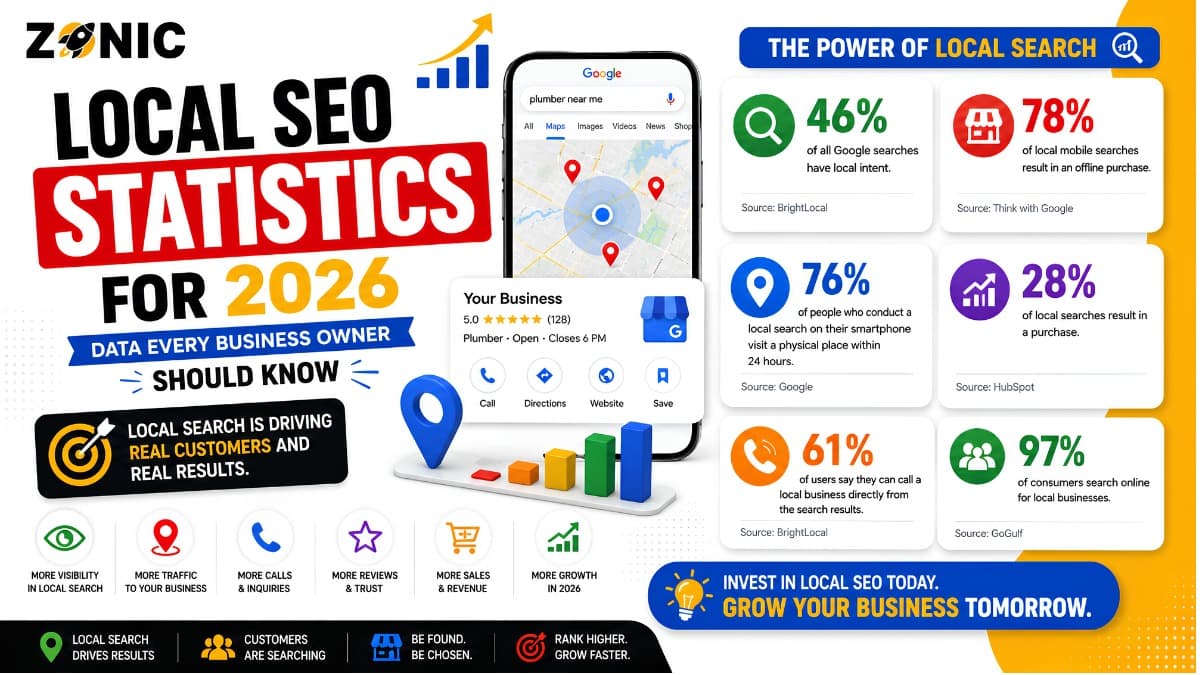
Local SEO keeps changing, but the reason it matters has stayed the same. Customers still search online before they call, visit, book, or buy from a local business.
A homeowner may search for a roofer after a leak. A parent may compare dentists before booking an appointment. A driver may look for a nearby repair shop. A restaurant customer may check reviews before choosing where to eat. In each case, the business that looks more visible, trusted, and easy to contact has a better chance of winning the customer.
The latest data shows that customers are using Google, reviews, maps, social media, websites, and AI tools together. They are not relying on one source. They are checking multiple signals before making a decision.
For business owners, the lesson is simple. Local SEO is no longer only about ranking higher. It is about being found, being trusted, and giving customers enough confidence to take action.
This guide breaks down the most useful local search data for 2026 and explains what each statistic means for business owners.
Why Local SEO Statistics Matter in 2026
Local SEO data helps business owners understand how customers search, compare, and choose nearby businesses. Without data, marketing decisions become guesswork.
Customers Check Proof Before They Contact You
A customer may find your business on Google, but that does not mean they will call right away. They may check your star rating, read recent reviews, look at photos, compare hours, visit your website, and see whether your business looks active.
If your profile is incomplete or your reviews are old, you may lose the lead before the customer ever speaks to you.
Local SEO statistics show that trust signals matter. People want current information, real reviews, and clear proof that your business is a safe choice.
Local Discovery Is Spread Across More Platforms
Google is still a major local search platform, but customers also use social media, navigation apps, review sites, business websites, and AI tools.
That means local SEO in 2026 should not be treated as one small task. Your Google Business Profile, website, reviews, citations, social proof, and business information all need to work together.
Key Local SEO Statistics for 2026
The best statistics are the ones that help you make better business decisions. This table connects current local search data with clear actions.
Statistic | Source and Year | What It Means | Recommended Action |
97% of consumers read reviews for local businesses | BrightLocal Local Consumer Review Survey, 2026 | Almost every customer checks reviews before choosing | Build a steady review request process |
31% of consumers only use businesses with 4.5 stars or higher | BrightLocal Local Consumer Review Survey, 2026 | Low ratings can filter you out before a customer calls | Improve service quality and respond to reviews |
74% of consumers focus on reviews from the previous three months | BrightLocal Local Consumer Review Survey, 2026 | Old reputation is not enough by itself | Ask for reviews consistently |
45% of consumers use ChatGPT or other generative AI tools for local business recommendations | BrightLocal Local Consumer Review Survey, 2026 | AI is becoming part of local discovery | Keep business information consistent and easy to cite |
52% of consumers started their most recent local search on Google | BrightLocal Consumer Search Behavior, 2026 | Google is still a leading starting point | Optimize your Google Business Profile and website |
75% of consumers used more than one channel during their most recent local search | BrightLocal Consumer Search Behavior, 2026 | Customers compare across platforms | Keep Google, website, social, and citations aligned |
96% of consumers think it is important for a local business to actively manage its online presence | BrightLocal Consumer Search Behavior, 2026 | Customers notice inactive or outdated profiles | Update profiles, reviews, photos, and key details |
Only 35% of SMBs surveyed had a Google Business Profile | BrightLocal SMB Marketing Report, 2025 | Many U.S. SMBs still miss a basic visibility asset | Claim, verify, and complete your profile |
83% of consumers use traditional search engines for local discovery | SOCi Consumer Behavior Index, 2025 | Search engines remain central to local discovery | Keep Google and organic local SEO strong |
73% of consumers use social media for local discovery | SOCi Consumer Behavior Index, 2025 | Social proof supports search decisions | Keep social profiles active and consistent |
What the Data Shows
These numbers point to one major trend. Customers want fresh proof before they trust a local business.
They read reviews. They care about star ratings. They check multiple platforms. They use Google, maps, social media, and AI tools together. They expect business information to be accurate.
For business owners, the opportunity is clear. A complete and active local presence can help you win customers who are already searching.
How Google Looks at Local Rankings
Google says local results are mainly based on relevance, distance, and prominence. These three ideas explain why some businesses appear more often than others.
Relevance Means Your Business Matches the Search
Relevance is about how well your business fits what the customer searched for.
If someone searches for “roof repair near me,” Google needs to understand that your business actually offers roof repair. Your Google Business Profile category, services, business description, reviews, photos, and website pages all help Google understand that match.
A vague profile makes this harder. A complete profile gives Google more useful information.
Distance Still Matters
Distance is about how close your business is to the searcher or the location used in the search.
You cannot fully control distance. A customer searching across town may see different results than someone searching near your office.
Still, distance is only one factor. A nearby business with weak reviews, poor profile information, and no website support may lose to a stronger competitor nearby.
Prominence Means Trust Across the Web
Prominence is about how well known and trusted your business appears. Google considers information from across the web, including reviews, links, articles, directories, and other signals.
This is why local SEO is bigger than your Google Business Profile alone.
Your website, citations, reviews, social presence, backlinks, and local mentions all support trust.
Review Statistics That Matter Most
Reviews remain one of the strongest local trust signals. They influence both customer decisions and local visibility.
97% of Consumers Read Reviews
BrightLocal’s 2026 survey found that 97% of consumers read reviews for local businesses.
That means reviews are no longer optional. They are part of how customers judge whether your business is worth contacting.
A business with no reviews, very old reviews, or poor review responses may look less trustworthy than a competitor with fresh, detailed feedback.
31% Only Use Businesses With 4.5 Stars or Higher
Star rating can decide whether a customer even considers your business. BrightLocal’s 2026 research found that 31% of consumers only use businesses with 4.5 stars or higher.
This does not mean every business needs a perfect rating. A profile with only perfect reviews can even look suspicious. But it does mean low ratings can cost real leads.
The best long-term review strategy is simple. Deliver better service, ask real customers for honest feedback, and respond professionally.
74% Care About Recent Reviews
BrightLocal’s 2026 research also found that 74% of consumers focus on reviews from the previous three months.
That is important because many businesses rely on old reputation. A company may have great reviews from two years ago, but customers want to know what the business is like now.
Fresh reviews show current activity. They tell customers that the business is still open, still serving people, and still delivering good experiences.
Google Business Profile Statistics and Opportunities
Google Business Profile remains one of the most important local visibility tools. Yet many businesses still do not fully use it.
Many SMBs Still Do Not Have a Google Business Profile
BrightLocal’s 2025 SMB Marketing Report surveyed 778 U.S. small and midsize business owners and managers. Only 35% said they had a Google Business Profile.
This statistic should not be treated as a worldwide number for every business. It is based on a U.S. SMB survey. Even with that context, it shows a major opportunity.
Many businesses still have not claimed, verified, completed, or actively managed one of the most important local marketing assets available.
Complete Profiles Build More Confidence
BrightLocal’s local SEO statistics page cites Google data showing that customers are 2.7 times more likely to consider a business reputable when they find a complete Business Profile. It also reports that customers are 70% more likely to visit and 50% more likely to consider purchasing from businesses with complete profiles.
That is a strong reminder that profile completion is not just an SEO task. It affects customer trust and action.
A complete profile should include accurate hours, phone number, website, category, services, address or service area, photos, reviews, and business details.
Local Search Behavior Is Changing
Local customers are not using one path anymore. They often move between Google, websites, reviews, maps, social platforms, and AI tools before choosing.
52% Start Their Local Search on Google
BrightLocal’s 2026 local search data shows that 52% of consumers started their most recent local search on Google.
This keeps Google at the center of local discovery. If your business is not visible on Google Search or Google Maps, you may miss customers at the start of their decision process.
Your Google Business Profile and website should work together to capture those searches.
75% Use More Than One Channel
BrightLocal also reports that 75% of consumers used more than one channel during their most recent local search.
This means customers may find you on Google, check your reviews, visit your website, look at social media, and compare other platforms before contacting you.
A strong local SEO strategy should support that full journey.
AI Search Is Becoming Part of Local Discovery
BrightLocal’s 2026 review research found that 45% of consumers use ChatGPT or other generative AI tools for local business recommendations.
SOCi’s 2025 Consumer Behavior Index reported 19% AI-tool usage for local discovery in its survey. These are different studies, with different timing and methodology, but the direction is clear. AI discovery is growing.
For local businesses, this makes consistency more important. AI tools may rely on public business information, reviews, websites, structured data, listings, and mentions. If your information is messy across the web, your business becomes harder to understand and recommend.
What Local SEO Statistics 2026 Mean by Industry
The same data affects different industries in different ways. A roofing company, dental office, law firm, restaurant, and retail shop may all need local SEO, but their highest-value signals can differ.
Home Services Need Fast Trust
Roofers, plumbers, HVAC companies, electricians, cleaners, pest control companies, and restoration businesses often deal with urgent searches.
Customers want proof quickly. They check reviews, photos, service areas, hours, and phone numbers before calling.
For these businesses, review recency, strong service pages, real project photos, and easy click-to-call buttons matter a lot.
Healthcare and Professional Services Need Confidence
Dentists, doctors, med spas, attorneys, accountants, and consultants need trust before a customer books.
People may read more reviews, compare credentials, check websites, and look for signs of professionalism.
For these industries, reputation, clear service pages, practitioner details, and accurate profile information are especially important.
Restaurants and Retail Need Accuracy
Restaurants, shops, salons, gyms, and local retail businesses depend heavily on accurate hours, directions, menus, product information, photos, and reviews.
Wrong hours can cause a lost visit. Poor photos can reduce interest. Old business information can frustrate customers.
For walk-in businesses, accuracy is part of the customer experience.
Sources and Methodology
This article uses current local SEO and consumer behavior research from multiple sources. The goal is to avoid treating every number as if it comes from the same study.
The main sources used include:
BrightLocal Local Consumer Review Survey 2026. This survey used a representative panel of 1,002 U.S. adult consumers and focused on review behavior, rating expectations, review recency, and AI recommendations.
BrightLocal Local SEO Statistics for 2026. This resource compiles current local search, review, Google Business Profile, AI search, and local marketing data from BrightLocal research and other cited studies.
BrightLocal SMB Marketing Report 2025. This survey included 778 U.S. small and midsize business owners or managers. The Google Business Profile adoption statistic should be understood within that U.S. SMB survey context.
SOCi Consumer Behavior Index 2025. This report measured how consumers use search engines, social media, navigation apps, review sites, and AI tools for local discovery.
Google Business Profile Help. Google’s local ranking guidance explains relevance, distance, and prominence as the main local ranking factors.
Because these studies use different sample sizes, years, and question wording, the numbers should be used as directional insight rather than exact predictions for every industry.
Practical Takeaways From the Data
Business owners do not need to memorize every number. The real value is knowing what to do next.
Use these takeaways:
Ask for reviews consistently after real customer interactions
Keep review quality and customer service high
Update your Google Business Profile regularly
Make sure your business information is consistent everywhere
Add real photos that prove your business is active
Build clear service pages on your website
Keep social profiles accurate and active
Track calls, forms, bookings, and actual leads
Use structured data where it fits your website
Treat AI discovery as another reason to clean up business information
The businesses that win in local search are usually not the ones that chase one trick. They are the ones that keep their information accurate, reviews fresh, website useful, and customer experience strong.
Common Local SEO Mistakes the Data Warns Against
The statistics show that customers are careful. They compare, research, and check multiple signals before choosing a business.
Avoid these mistakes:
Letting reviews get old
Ignoring negative reviews
Leaving your Google Business Profile incomplete
Using outdated photos
Showing wrong hours or phone numbers
Having inconsistent business information online
Ignoring social media and website trust signals
Using thin service or location pages
Tracking rankings but not leads
Treating local SEO as a one-time setup
Fixing these problems can improve both visibility and customer trust.
Internal Links to Add
Add these internal links naturally when publishing the article:
Google Business Profile optimization checklist
How to get more local business leads from Google
What is local SEO?
Local SEO for roofing companies
Google Maps Pack ranking guide
Local citation cleanup
Local review management
Local SEO services
These internal links can help users move to related resources and help search engines understand the topic cluster around local SEO.
How Zonic Helps Businesses Use Local Search Data
Zonic helps business owners turn local search data into a practical growth plan. Statistics are useful, but they only matter when they lead to better actions.
Google Business Profile Optimization
Zonic reviews your profile name, category, services, photos, reviews, hours, website link, address setup, service area, and overall profile health.
The goal is to make your business easier to find, easier to trust, and easier to contact.
Review and Reputation Strategy
Since customers care about review quality, rating, and recency, Zonic helps businesses build a consistent review process.
This includes asking real customers for honest feedback, responding naturally, and improving the trust signals customers see before contacting you.
Local SEO and Lead Tracking
Zonic helps improve service pages, location pages, citations, content, tracking, and conversion paths.
The focus is not only ranking. The focus is calls, forms, bookings, estimates, and real business growth.
Conclusion
The most important local SEO statistics for 2026 all point to the same message. Customers want proof before they choose a local business.
They read reviews. They care about rating and recency. They search on Google. They compare multiple platforms. They use social media, maps, websites, and AI tools. They expect business information to be accurate and easy to verify.
For business owners, the next step is clear. Complete your Google Business Profile. Keep reviews fresh. Use real photos. Build helpful website pages. Clean up citations. Keep your business information consistent. Track real leads instead of only rankings.
If you want help turning local search data into more calls, bookings, and leads, Zonic can help.
Call Zonic at (302) 726-9736 or visit 8 The Green, Suite B, Dover, DE 19901 to request a Google Business Profile and local visibility audit for your business in New York City or anywhere across the United States.