
HVAC Local SEO: How to Stay Booked During Every Season
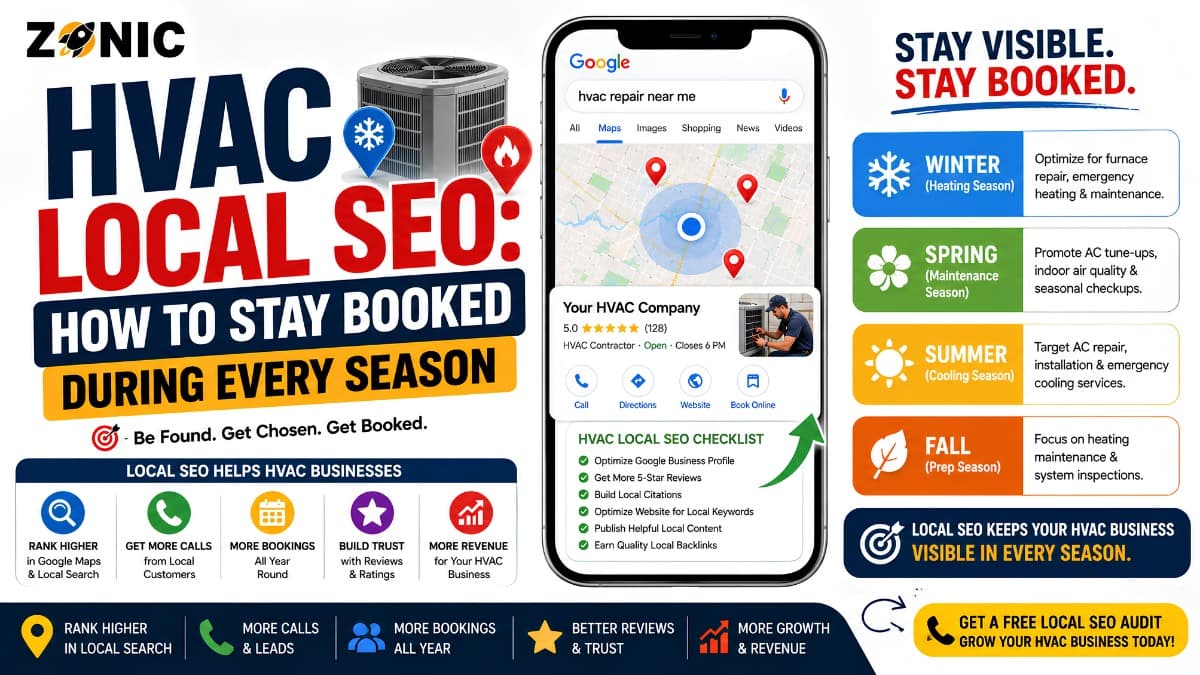
HVAC demand changes with the weather. When summer heat arrives, customers search for AC repair, emergency cooling service, refrigerant issues, and system replacement. When winter temperatures drop, they search for furnace repair, heating installation, heat pump problems, and no-heat service.
Between those peak seasons, many HVAC companies struggle to keep the schedule full.
That is where HVAC local SEO becomes important.
Local SEO helps your HVAC company appear when nearby customers search on Google for heating, cooling, repair, maintenance, replacement, and emergency service. It supports Google Maps visibility, phone calls, service requests, website visits, and booked appointments.
For HVAC businesses, local SEO is not only about ranking higher. It is about staying visible before, during, and after seasonal demand spikes. The company that appears before the first heat wave or cold snap often wins the call before competitors even start adjusting their marketing.
Google says local rankings are mainly based on relevance, distance, and prominence. That means your Google Business Profile, service areas, reviews, website pages, photos, citations, and local reputation all work together.
If you want a stronger HVAC company Google Maps ranking, the goal is to build a local presence that proves what you do, where you work, and why customers should trust you in every season.
Why HVAC Local SEO Matters Year-Round
HVAC companies deal with seasonal demand, urgent service calls, and high-value replacement jobs. A strong local SEO strategy helps your business stay visible when customers need help fast.
HVAC Customers Search With Urgency
Many HVAC searches happen when something is already wrong. A homeowner may wake up to no heat. A tenant may report that the AC is blowing warm air. A business owner may need commercial HVAC service before customers complain.
These searches often happen on mobile.
The customer may not spend hours comparing companies. They check who is nearby, who has good reviews, who answers quickly, and who appears reliable.
If your Google Business Profile looks strong, you have a better chance of getting the call.
Seasonal Visibility Protects Your Schedule
HVAC companies need calls in more than one season. Cooling jobs may peak in summer, heating jobs may peak in winter, and maintenance calls can fill the slower months.
Local SEO helps you prepare before demand rises. You can build service pages, update photos, collect reviews, improve your profile, and publish seasonal content before customers start searching heavily.
A company that waits until the first hot week of summer may already be behind.
How Google Maps Ranking Works for HVAC Companies
Google does not rank HVAC companies by one single factor. It uses multiple signals to decide which business profiles are most useful for a local search.
Relevance Connects Your Services to Customer Searches
Relevance means Google understands that your company provides the service someone searched for.
If a customer searches for “AC repair near me,” your profile and website should clearly support AC repair. If someone searches for “furnace repair,” Google should see heating service signals across your profile, reviews, service pages, and content.
Your categories, services, business description, website pages, photos, and reviews all help build relevance.
A profile that only says “HVAC contractor” may be weaker than one that clearly shows AC repair, furnace repair, heat pump service, emergency HVAC, maintenance, and installation.
Distance Still Matters in HVAC Search
Distance matters because customers often want a nearby technician. A company closer to the searcher may have an advantage.
You cannot fully control distance, but you can improve how well your business competes within the areas you actually serve.
This is why accurate service areas, city pages, neighborhood pages, and local citations matter.
Prominence Builds Trust
Prominence means Google sees your HVAC company as known and trusted. Reviews, ratings, website authority, citations, links, local mentions, and online reputation can all support prominence.
A company with steady reviews, strong service pages, real job photos, and consistent listings often looks more trustworthy than a profile that has not been updated in months.
Build a Strong HVAC Google Business Profile
Your Google Business Profile is one of the most important local SEO assets for an HVAC company. It is often the first thing customers see before calling.
Choose the Right HVAC Categories
Your primary category should match your main business. For most HVAC companies, this may be an HVAC contractor or a closely related category that fits the company’s core service.
Secondary categories should support real services. Depending on your business, that may include air conditioning contractors, heating contractors, furnace repair services, air conditioning repair services, or related categories.
Do not add categories for services you do not provide. The profile should be accurate, not inflated.
Add Heating and Cooling Services
Your service list should reflect what customers actually search for.
Add real services such as AC repair, AC installation, furnace repair, furnace installation, heat pump service, HVAC maintenance, ductwork, indoor air quality, thermostat replacement, emergency HVAC repair, and commercial HVAC service.
Keep the wording simple. Customers should understand your services quickly.
Keep Hours and Emergency Availability Accurate
HVAC customers often search during urgent moments. If you offer emergency service, after-hours support, or weekend appointments, make that clear.
Do not list 24-hour service unless your company truly answers and serves customers around the clock.
Wrong hours can create bad customer experiences and poor leads.
Set Up Service Areas Correctly
Most HVAC companies travel to customers. That makes service-area setup very important.
Match Service Areas to Real Coverage
Your service areas should reflect where your company actually sends technicians. Do not list every city just because you want to rank there.
Google says service areas help people find a business profile when a company visits or delivers to customers. Service areas should be specific and accurate.
For HVAC companies, this means your service area should match your team size, dispatch range, response time, and website content.
Hide the Address If Customers Do Not Visit
If customers do not visit your office or shop, the profile should usually be set up as a service-area business rather than a public storefront.
This matters for HVAC companies that operate from a warehouse, home office, private shop, or dispatch location.
The profile should reflect how customers actually receive service.
Build Seasonal HVAC Service Pages
Your website should support your Google Business Profile. Service pages help Google understand what you offer and help customers decide whether to call.
Cooling Pages for Summer Demand
AC service pages should be ready before the weather gets hot. A strong cooling section may include pages for AC repair, AC installation, AC replacement, tune-ups, refrigerant issues, thermostat problems, ductless mini-splits, and emergency cooling service.
Each page should explain the problem, signs the customer needs help, how your process works, and what areas you serve.
Do not wait until peak season to publish these pages.
Heating Pages for Winter Demand
Heating pages should be built before cold weather starts. Important pages may include furnace repair, furnace replacement, boiler service, heat pump repair, heating maintenance, no-heat service, and emergency heating repair.
A customer with no heat wants quick confidence. The page should make your phone number easy to find and explain how fast your team can respond.
Maintenance Pages for Slower Months
Maintenance content helps fill the schedule between peak seasons. Pages for spring AC tune-ups, fall furnace inspections, filter replacement, maintenance plans, and indoor air quality can bring calls before emergencies happen.
This helps smooth out seasonal dips and keeps your team active.
Use Reviews to Win HVAC Calls
Reviews matter because HVAC customers need trust before letting a technician into their home or business. They want to know your team is reliable, honest, clean, and skilled.
Ask After Completed Jobs
Ask happy customers for reviews after repairs, installations, maintenance visits, and emergency calls.
A review after a summer AC repair can help you rank and convert during cooling season. A review after a winter heating repair can support future furnace and no-heat searches.
Do not offer rewards or write reviews for customers. Ask for honest feedback.
Encourage Real Service Detail
You should not script reviews, but you can ask customers to describe their experience.
A review that mentions “AC repair,” “furnace replacement,” “heat pump service,” or “emergency HVAC repair” gives future customers more useful context than a review that only says “great job.”
Detailed reviews also help your profile feel more relevant to real searches.
Respond to Every Review
Reply to positive and negative reviews in a calm, professional way.
Mention the service naturally when it fits. For example, you might thank a customer for trusting your team with an AC tune-up before summer or a furnace repair during cold weather.
Natural replies show that your business is active and customer-focused.
Add Real HVAC Photos to Build Trust
Photos help prove that your HVAC company is real, active, and experienced. They can also make your profile more convincing before a customer calls.
Show Technicians, Trucks, and Equipment
Use photos of branded vans, uniforms, technicians, tools, equipment, job sites, warehouse areas, and completed installations.
For HVAC companies, real photos matter because customers want to know who may arrive at their home.
Avoid relying on stock images. Real company photos build more trust.
Show Seasonal Work
Add cooling-related photos before summer and heating-related photos before winter.
For example, share photos of outdoor condensers, furnace work, heat pump systems, ductwork, thermostats, maintenance visits, and installation projects.
Seasonal photos help your profile feel current.
Create Local Content Around Seasonal HVAC Problems
Blog content can support local SEO when it answers real customer questions and connects to services.
Write Before the Season Starts
Do not publish “AC repair tips” after the heat wave has already passed. Publish seasonal content before demand rises.
Good HVAC topics include:
When to schedule an AC tune-up before summer
Why your AC is blowing warm air
Signs your furnace needs repair before winter
Heat pump problems during cold weather
How often to replace HVAC filters
When HVAC replacement makes more sense than repair
This is the first bullet section. Each topic should connect to a real service page and a clear call to action.
Add Local Weather and Home Context
Make content specific to your service area. Discuss local weather patterns, older homes, common system types, energy usage, humidity, pollen season, winter cold snaps, or summer heat waves.
Local detail makes the content more useful and less generic.
Keep HVAC Citations and NAP Consistent
Citations are mentions of your business information on directories, platforms, social profiles, and local websites. They help support trust when they are accurate.
Clean Up Old Phone Numbers and Addresses
If your HVAC company changed phone numbers, moved locations, rebranded, or switched websites, old listings can confuse customers and search engines.
Check major directories, industry platforms, supplier pages, chamber listings, and social profiles.
The name, address, phone number, website, and service areas should match your current business.
Use HVAC and Local Directories
Industry-specific directories, local chambers, trade associations, supplier websites, and contractor platforms can help support local trust.
Do not chase low-quality listings. Focus on accurate, relevant platforms that make sense for a real HVAC business.
Track HVAC Leads by Season
Ranking alone does not keep your schedule full. You need to know which searches, services, and seasons bring real calls.
Track Calls and Booked Jobs
Track calls from Google Business Profile, website forms, booking requests, emergency calls, tune-up requests, and replacement estimates.
Then compare which leads turn into booked jobs.
An AC repair call, a maintenance-plan request, and a full system replacement lead may have very different value.
Watch Seasonal Service Trends
Review lead data before each season. If furnace repair calls dropped last winter, improve heating pages, reviews, photos, and content before the next cold season.
If AC replacement calls are strong in spring, prepare campaigns earlier.
The goal is to use local SEO data before the schedule slows down.
Common HVAC Local SEO Mistakes
Many HVAC companies lose visibility because their profile and website are not aligned. Some also take shortcuts that create risk.
Avoid these mistakes:
Using a keyword-stuffed Google Business Profile name
Listing service areas that are too broad
Showing an address customers do not visit
Choosing unrelated categories
Ignoring seasonal service pages
Letting reviews get old
Using only stock HVAC photos
Not responding to reviews
Publishing content after the season is already over
Tracking rankings but not booked jobs
This is the second and final bullet section. Fixing these basics can improve both visibility and lead quality.
Seasonal HVAC Local SEO Plan
HVAC marketing works best when it is planned around the calendar. Each season should support the next one.
Season | Customer Demand | Local SEO Focus |
Spring | AC tune-ups, indoor air quality, maintenance plans | Update cooling pages, publish AC prep content, request maintenance reviews |
Summer | AC repair, emergency cooling, replacement calls | Promote AC repair pages, add cooling job photos, track emergency calls |
Fall | Furnace tune-ups, heating inspections, filter changes | Update heating pages, publish winter-prep content, ask for maintenance reviews |
Winter | Furnace repair, no-heat calls, heat pump issues | Strengthen heating visibility, add winter job photos, track urgent calls |
Use Each Season to Prepare for the Next
The best HVAC companies do not wait for demand. They prepare before demand arrives.
Spring is the time to build cooling visibility. Fall is the time to build heating visibility. Slower months are the time to strengthen maintenance content and reviews.
How Zonic Helps HVAC Companies Stay Booked
Zonic helps HVAC companies improve local visibility, Google Maps ranking, seasonal content, and lead generation.
HVAC Google Business Profile Optimization
Zonic reviews your profile name, categories, services, service areas, hours, reviews, photos, website link, and profile health.
The goal is to improve visibility while keeping the profile accurate and safe.
Seasonal HVAC SEO Content
Zonic helps build service pages, local pages, and seasonal blog content around cooling, heating, maintenance, emergency service, indoor air quality, and replacement demand.
This helps customers find your company before peak season hits.
Lead Tracking and Local Growth
Zonic helps HVAC companies focus on calls, booking requests, service appointments, replacement estimates, and seasonal lead trends.
The goal is not just more traffic. The goal is a fuller schedule.
Conclusion
HVAC local SEO helps your company stay visible when customers need heating, cooling, maintenance, and emergency service. Since demand changes by season, your SEO strategy should change with it.
A strong plan starts with a complete Google Business Profile, accurate service areas, clear HVAC categories, real services, steady reviews, seasonal photos, service pages, citations, and lead tracking.
Do not wait until summer to optimize AC pages. Do not wait until winter to improve heating visibility. Build before the season arrives.
If you want a better HVAC company Google Maps ranking and more booked jobs throughout the year, Zonic can help.
Call Zonic Media at (302) 726-9736 or visit 8 The Green, Suite B, Dover, DE 19901 to request an HVAC local SEO and Google Maps visibility audit for your business in New York City or anywhere across the United States.