Google Maps Statistics: What the Data Says About Local Search in 2026
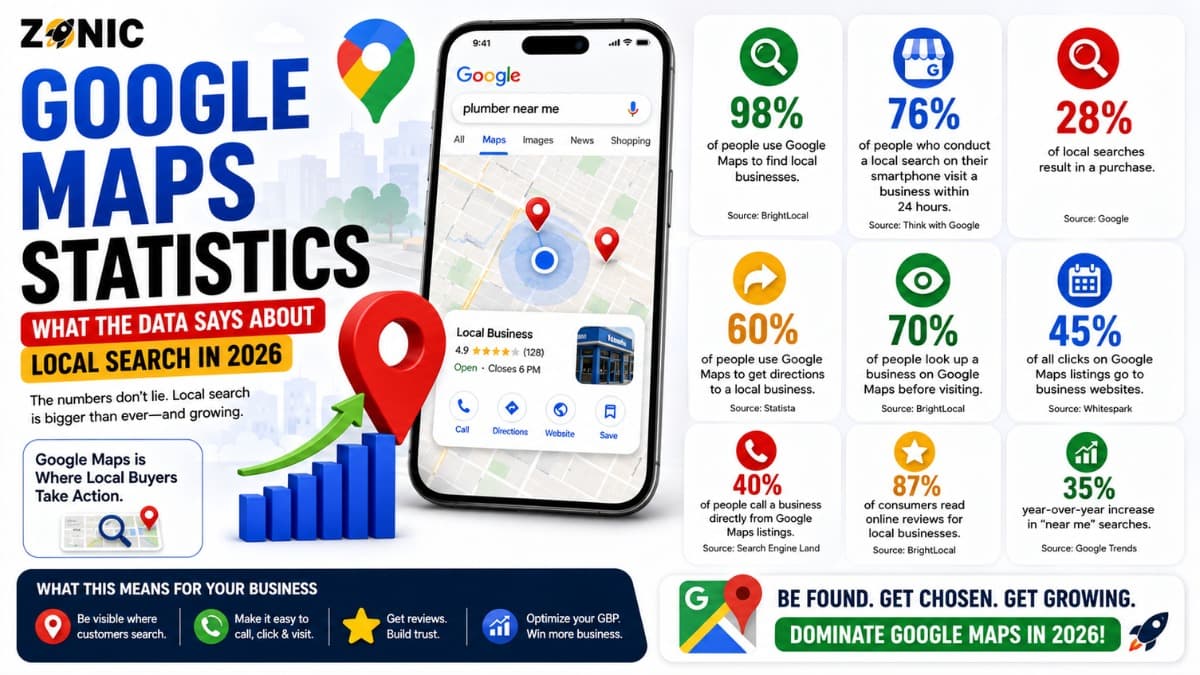
Google Maps is no longer just a navigation tool. For local businesses, it has become one of the most important places where customers discover, compare, trust, and contact nearby companies.
A homeowner looking for a roofer may open Google Maps before visiting a website. A patient searching for a dentist may compare star ratings before calling. Someone with no heat, a pest issue, a plumbing emergency, or a broken AC system may choose from the map pack within minutes.
The data shows that local search is not only about ranking on a website anymore. It is about showing up where people make fast local decisions. Google Maps, Google Business Profile, reviews, photos, service categories, local content, and business information all work together to influence whether a customer calls you or chooses a competitor.
For business owners, the main lesson is simple. If your Google Maps presence is weak, incomplete, outdated, or poorly reviewed, you may be losing leads even if your website looks good.
Google Maps Is a Major Part of the Local Customer Journey
Local search behavior has changed. Customers no longer follow one straight path from search to website to phone call. They move between Google Search, Google Maps, reviews, social platforms, AI tools, business websites, and directories before making a decision.
Even with more platforms available, Google remains central to local discovery. BrightLocal’s 2026 consumer search behavior research found that many consumers who start on other platforms still return to Google before making a final decision.
That matters because Google Maps often becomes the decision point.
A customer may first hear about a business on social media. They may ask AI for suggestions. They may see a company name on a referral site. But before calling, many still check Google to confirm location, reviews, hours, photos, and credibility.
For local businesses, that means Maps visibility is not separate from trust. It is part of how customers validate whether your company is real, nearby, and worth contacting.
Google Maps Search Data Shows Local Intent Is Action Based
Google Maps searches are often closer to action than broad informational searches. Someone searching “how long does a roof last” may still be researching. Someone searching “roof repair near me” in Google Maps is much closer to calling.
This difference is important.
Google Maps users often want something practical. They want directions, a phone number, business hours, service availability, reviews, photos, or proof that the company serves their area.
That makes Google Maps traffic valuable for local businesses because it often comes with buying intent.
A user searching inside Maps is not always casually browsing. Many are comparing nearby options and deciding who to contact next. This is why ranking in Maps can drive phone calls, appointment requests, direction clicks, and quote submissions.
The data around local search keeps pointing to the same idea. Customers want quick answers, real proof, and an easy next step.
Local Ranking Still Depends on Relevance, Distance, and Prominence
Google says local results are mainly based on relevance, distance, and prominence. These three factors help determine which businesses appear for local searches.
Relevance means how well your profile matches what the searcher wants. If someone searches for “emergency HVAC repair,” Google needs to understand whether your company actually provides that service.
Distance means how close your business or service area is to the searcher or searched location. A business does not always rank everywhere just because it wants to serve that area.
Prominence means how well known or trusted the business appears to be. Google considers factors such as review count, review score, links, articles, directories, and overall web presence.
This is why Google Maps SEO cannot rely on one trick.
A business needs accurate categories, complete services, strong reviews, real photos, consistent business information, useful website pages, and a healthy local reputation.
If one of those areas is weak, the profile may struggle against competitors.
Google Maps and the Local Pack Are Not the Same as Organic SEO
Traditional organic SEO focuses mostly on website pages. Google Maps visibility depends more heavily on the business entity itself.
That means your Google Business Profile is a major asset.
Your profile tells Google what your business is, where it operates, what services it offers, when it is open, and how customers interact with it. Your reviews, photos, categories, services, and business details all help shape local visibility.
A website is still important, but it is not the only ranking asset.
For example, a local roofing company may have a strong website but still struggle in Maps if the Google Business Profile has weak reviews, wrong categories, poor service-area setup, or inconsistent business information across the web.
A dental office may rank organically for blog content but lose map visibility to competitors with stronger reviews and better profile engagement.
Google Maps search data reminds business owners that local SEO must include both the profile and the website.
Key Google Maps Statistics for Local Businesses in 2026
The numbers below show why Google Maps visibility deserves serious attention.
Data Point | What It Means for Local Businesses |
Google local ranking is based mainly on relevance, distance, and prominence | Businesses need accurate profiles, strong local signals, and real trust |
42% of searchers click Google map pack results for local queries | The map pack can capture a large share of local action |
71% of consumers use Google to read local business reviews | Reviews remain a major trust factor before customers call |
Many users return to Google even after starting on social, AI, review sites, or Apple Maps | Google remains a key validation point in the customer journey |
AI local recommendations are growing, but Google reviews still influence trust | Businesses need visibility beyond one platform, but Google remains foundational |
Younger consumers use multiple discovery channels | Google Maps should work together with website, reviews, and social proof |
These statistics do not mean every business will see the same results. Industry, location, competition, review quality, and search intent all matter.
The broader message is still clear. Google Maps is one of the most important local decision platforms in 2026.
Reviews Continue to Drive Google Maps Decisions
Reviews are one of the biggest reasons customers choose one local business over another. A high Maps ranking may get attention, but reviews often decide whether the customer trusts the business enough to call.
BrightLocal’s 2026 Local Consumer Review Survey shows that consumers still rely heavily on reviews when evaluating local businesses. Google remains one of the most important places where customers read those reviews.
This matters because reviews influence both visibility and conversion. A business with more recent, detailed, positive reviews may appear more trustworthy than a competitor with fewer reviews or older feedback. Customers also look at how the business responds to reviews.
A professional reply can show that the company is active, responsible, and customer-focused. For local service businesses, review content matters too. A review that mentions “roof leak repair,” “emergency HVAC service,” “termite treatment,” or “same-day dental appointment” can help future customers understand what the business actually does.
Reviews are not just stars. They are proof.
Map Pack Clicks Can Be More Valuable Than Regular Traffic
Website traffic is useful, but map pack clicks can be closer to revenue. A map pack result often includes call buttons, directions, hours, reviews, photos, and service details.
That means a customer can decide quickly. A user may not need to read five blog posts before calling an emergency plumber. They may compare three map results, check ratings, read a few reviews, and tap the call button.
This is why local businesses should not measure success only by organic website sessions. Google Maps activity can include calls, direction requests, website clicks, booking clicks, menu views, appointment actions, and customer questions.
For a service business, a smaller number of high-intent map interactions can be more valuable than a larger number of low intent blog visits. The goal is not just more traffic. The goal is more qualified local actions.
Complete Business Profiles Perform Better for Local Search
Google recommends complete and detailed business information because it helps Google better understand the business and match it with relevant searches.
A weak or incomplete profile can limit visibility. Many businesses have missing services, outdated hours, old photos, wrong categories, inconsistent phone numbers, or vague business descriptions. These details make it harder for customers and search engines to trust the listing.
A strong profile should include accurate name, address or service area, phone number, website, primary category, secondary categories, hours, services, photos, attributes, appointment links, and review responses.
For service-area businesses, the profile should clearly show where the company works without pretending to have offices in every city. For storefronts and clinics, the address should be accurate and match the real location customers visit. Completeness does not mean keyword stuffing. It means giving Google and customers accurate information.
Google Maps Visibility Depends on Local Trust Signals
Prominence is one of Google’s local ranking factors. This makes local trust signals important. Trust signals can include reviews, ratings, local citations, backlinks, news mentions, business directories, industry listings, social proof, and website authority.
A company with a real local footprint is usually easier to trust than a listing with thin information and no supporting presence.
For example, a roofing company may strengthen local trust with project photos, reviews, licensing information, service pages, and citations on relevant directories. A dental office may build trust through provider information, patient reviews, appointment details, and consistent address information. A restaurant may depend on photos, menus, reviews, hours, and directions.
Google Maps visibility is not only about the profile itself. It is about how well the business is supported across the web.
AI Search Is Growing, but Google Maps Still Matters
AI search is becoming part of local discovery. Consumers are starting to ask tools like ChatGPT and other AI assistants for business recommendations, comparisons, and local suggestions.
BrightLocal’s 2026 research shows that AI is becoming more common in local decision-making. At the same time, Google reviews and Google search behavior still remain important.
This creates a bigger local visibility challenge. Businesses cannot rely only on ranking a website page. They need a strong brand footprint across Google, reviews, local pages, citations, and other trusted sources. AI systems often pull from public information, review signals, websites, and structured business data.
That means good local SEO can support both Google Maps visibility and AI visibility. A business with accurate information, strong reviews, detailed service pages, and consistent mentions has a better chance of being understood across search systems. Google Maps is still a major part of that foundation.
What Google Maps Statistics Mean for Small Businesses
The data points to one practical message. Local customers are comparing businesses before they contact anyone.
They are checking ratings, reading reviews, looking at photos, comparing distance, scanning hours, and deciding which company feels safest. For small businesses, this means map optimization is not optional.
A business with an incomplete profile, few reviews, poor photos, or inconsistent information may lose leads even if it provides great service. A competitor with a stronger profile may win the call because they look more active, more trusted, and easier to contact.
This is especially true in industries where customers need fast decisions, such as HVAC, roofing, pest control, plumbing, dentistry, legal services, med spas, restaurants, and home improvement. The companies that win in Maps are usually not relying on luck. They are maintaining their profiles, earning reviews, improving pages, and keeping business information accurate.
How to Improve Google Maps Visibility in 2026
Improving Google Maps visibility starts with accuracy. Before chasing advanced tactics, make sure the basics are correct.
Your business name should match real-world branding. Your category should describe the core service. Your address or service area should reflect how the business actually operates. Your phone number and website should be consistent across the web.
Ask satisfied customers for reviews in a compliant way. Respond to reviews professionally. Add real photos. Keep hours updated. Add services that truly apply. Build location and service pages on your website. Make sure your website supports the same business information shown on your profile.
Calls, form submissions, bookings, direction requests, and qualified leads matter more than vanity metrics. Google Maps SEO works best when the profile, website, reviews, and local reputation all support the same message.
Google Maps Data Mistakes Businesses Should Avoid
Many businesses misunderstand Google Maps statistics. They see big numbers and assume ranking is only about one factor. That is not how local search works.
Avoid chasing only reviews while ignoring categories. Avoid adding fake service areas. Avoid stuffing keywords into the business name. Avoid creating duplicate profiles for every city. Avoid using a virtual office that does not represent a real customer-facing location. Avoid copying competitor profiles without checking Google’s guidelines. Also avoid treating Maps as separate from the website.
A strong profile can bring attention, but a weak website can lose the lead. If a customer clicks through and sees outdated content, slow pages, confusing service information, or no clear contact path, the profile did its job, but the website failed. Local search success comes from the full journey.
How Zonic Helps Businesses Use Google Maps Data
Zonic helps local businesses turn Google Maps search data into a practical growth strategy.
The process starts with reviewing the Google Business Profile, map visibility, categories, services, reviews, photos, service areas, website connection, and competitor position.
Zonic also looks at how customers move from Maps to calls, forms, bookings, and website visits. That matters because visibility alone is not enough. A profile should create qualified action.
For businesses in competitive categories, Zonic helps identify gaps that may be holding back map performance. This can include weak review signals, missing service pages, incomplete profile information, inconsistent citations, thin location content, or poor conversion flow.
The goal is not to chase every statistic. The goal is to use the data to make smarter local SEO decisions.
Conclusion
Google Maps statistics in 2026 show that local search is still one of the strongest ways customers find and choose nearby businesses. People use Google to compare reviews, check hours, view photos, request directions, visit websites, and call companies directly from search results.
The data also shows that the local search journey is expanding. Customers may use AI, social media, review platforms, and other tools, but Google remains a major validation point before they make a decision.
For local businesses, the lesson is clear.
Your Google Business Profile must be accurate, complete, trusted, and connected to a strong website. Your reviews should be active. Your photos should look real. Your services and categories should match what customers search for. Your business information should stay consistent across the web.
If your business depends on local calls, appointments, directions, or quote requests, Google Maps visibility should be part of your growth strategy.
If you are not sure what your Google Maps data means or why competitors are getting more local visibility, you can reach out to Zonic for a local SEO and Google Business Profile review.
Call Zonic Media at (302) 726-9736 or visit 8 The Green, Suite B, Dover, DE 19901 to discuss whether local SEO, traditional SEO, or a combined strategy is the right fit for your business in New York City or anywhere across the United States.