Local SEO vs Traditional SEO: What's the Difference and Which Do You Need?
Many business owners know they need SEO, but they are not always sure what kind of SEO they need. Some agencies talk about ranking on Google. Others talk about Google Maps, local packs, reviews, citations, and Google Business Profile. Both sound important, but they are not the same thing.
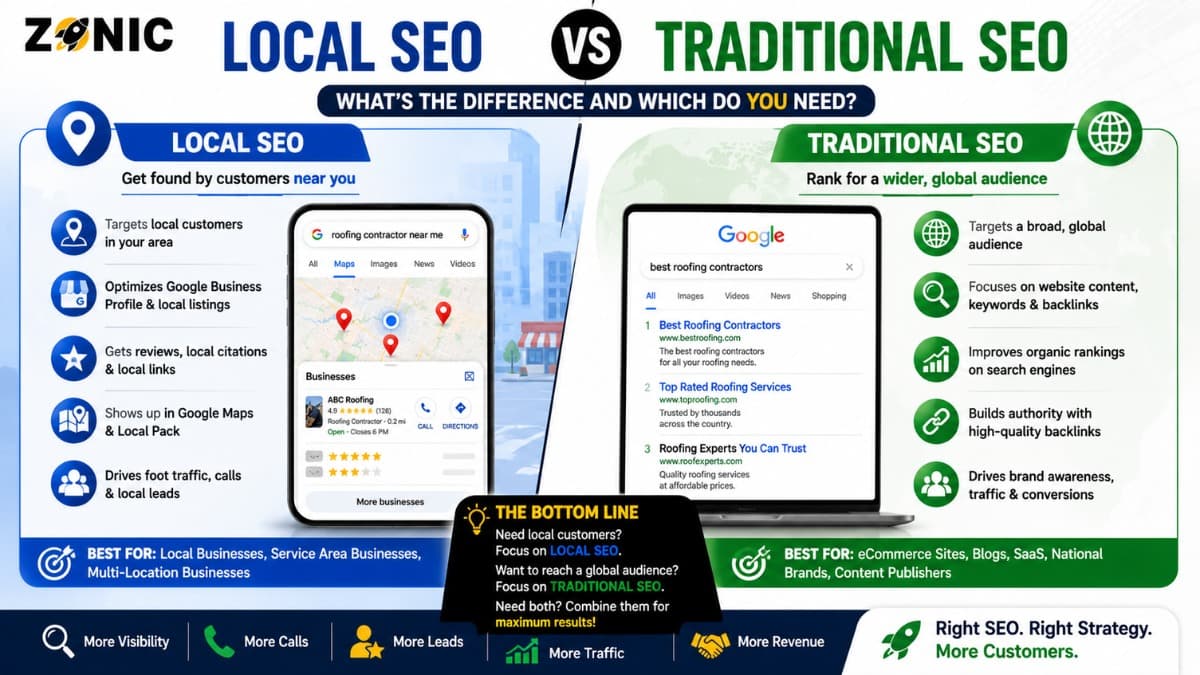
Traditional SEO focuses on improving a website’s visibility in standard organic search results. Local SEO focuses on helping a business show up when people search for nearby products or services, especially in Google Maps, the local pack, and location-based search results.
A national software company, online store, blog, or media site may care more about traditional SEO. A dentist, roofer, HVAC company, restaurant, med spa, law firm, plumber, electrician, pest control company, or local agency usually needs local SEO because customers are searching with location intent.
The important part is not choosing one because it sounds better. The right strategy depends on how your customers search, where you serve them, and what action you want them to take.
If your business depends on phone calls, appointment requests, quote forms, directions, walk-ins, or local service leads, local SEO is usually essential. If your business sells nationally, educates a broad audience, or wants to grow website traffic across many regions, traditional SEO may matter more.
For many service businesses, the best answer is both. But the priority should match the way revenue is actually generated.
What Traditional SEO Really Means
Traditional SEO is the process of improving a website so it can perform better in organic search results. These are the regular blue-link style listings people see when they search Google.
Traditional SEO is not limited to one city, neighborhood, or map result. It focuses on helping pages rank for relevant keywords based on content quality, technical performance, authority, user experience, and how well the page answers the searcher’s question.
For example, a business may use traditional SEO to rank for topics like “how to choose roof shingles,” “best CRM software,” “email marketing tips,” “how much does website design cost,” or “benefits of solar panels.” These searches may come from people in many cities, states, or countries.
The main asset in traditional SEO is the website. Your service pages, blog posts, landing pages, product pages, category pages, internal links, metadata, site speed, mobile experience, and backlink profile all matter.
Traditional SEO is often best when the searcher does not need a nearby business immediately. The user may be researching, comparing options, learning about a topic, or looking for a product that can be sold outside one local area.
That does not mean traditional SEO is only for national brands. Local businesses also need strong website SEO. The difference is that traditional SEO alone may not be enough when customers are searching for a nearby provider.
What Local SEO Really Means
Local SEO is the process of improving your visibility for searches with local intent. These searches usually include a city, neighborhood, “near me,” or an implied local need.
For example, searches like “roof repair near me,” “dentist in Brooklyn,” “HVAC company in Dover,” “pest control near me,” “best restaurant nearby,” and “personal injury lawyer NYC” all have local intent.
Local SEO focuses on more than the website. It includes your Google Business Profile, Google Maps visibility, reviews, local citations, service areas, business categories, photos, local landing pages, location pages, and consistency of your business information across the web.
Google says local results are mainly based on relevance, distance, and prominence. That means your profile should match what people search for, your location or service area should make sense for the searcher, and your business should have trust signals such as reviews, links, mentions, and strong overall presence.
Local SEO is especially important for businesses that serve customers in a defined area. That may include storefronts, offices, clinics, restaurants, retail shops, home service companies, and professionals who depend on local leads.
The Main Difference Between Local SEO and Traditional SEO
The biggest difference is the search intent. Traditional SEO usually targets broader informational, commercial, or national searches. Local SEO targets searches where the user wants a nearby business, local provider, address, appointment, phone call, quote, or directions.
A traditional SEO campaign may focus heavily on content clusters, backlinks, technical site improvements, and organic ranking growth. A local SEO campaign also cares about those things, but it adds Google Business Profile optimization, review growth, location signals, map rankings, NAP consistency, local citations, and city-specific service pages.
For example, a blog about “how to prevent roof leaks” is traditional SEO content. A page targeting “roof repair in Queens” is local SEO content. A Google Maps listing ranking for “roofer near me” is local SEO visibility.
Local SEO vs Traditional SEO Comparison
Area | Local SEO | Traditional SEO |
Main goal | Get found by nearby customers | Improve website visibility in organic search |
Best for | Local service businesses, clinics, restaurants, stores, offices | National brands, blogs, ecommerce, SaaS, publishers, broad service companies |
Main search examples | “dentist near me,” “roof repair Brooklyn,” “HVAC company Dover” | “how long does a roof last,” “best CRM software,” “SEO tips” |
Key assets | Google Business Profile, reviews, citations, local pages, service-area pages | Website pages, blogs, backlinks, technical SEO, content clusters |
Ranking environment | Google Maps, local pack, local organic results | Standard organic search results |
Trust signals | Reviews, proximity, local mentions, photos, business info consistency | Content quality, links, authority, technical performance, user experience |
Lead type | Calls, directions, bookings, local forms, quote requests | Traffic, email leads, product sales, demos, informational conversions |
This is why comparing the two as if one is always better does not work. They solve different search problems.
When Your Business Needs Local SEO More
Your business needs local SEO more when customers choose you based on location, service area, reviews, availability, and trust. If someone must be nearby to buy from you or hire you, local SEO should usually be a priority.
A plumber cannot serve every state from one office. A dentist needs patients within a realistic driving area. A roofing contractor needs leads from the cities and neighborhoods the company actually serves. A restaurant needs customers close enough to visit. A med spa needs local appointment bookings.
For these businesses, Google Maps visibility can matter as much as website rankings, sometimes more.
Local SEO is usually the better first priority if your business depends on:
Phone calls from nearby customers
Appointment bookings
Direction requests
Local quote forms
Emergency service searches
Store visits
Service-area leads
Reviews and reputation
A business with weak local SEO may have a decent website but still lose leads because competitors appear above it in the map pack.
If your Google Business Profile is incomplete, your reviews are weak, your location pages are thin, or your business information is inconsistent across directories, traditional SEO alone will not fix the full local visibility problem.
When Your Business Needs Traditional SEO More
Traditional SEO becomes more important when your business wants to attract people beyond one local market. It is also important when your sales process starts with education, research, comparison, or long-form content.
For example, a national software company needs traditional SEO to rank for product and problem-aware searches. An ecommerce store needs category and product pages to rank. A publisher needs informational content. A consulting company serving clients nationwide may need authority-building articles and service pages that are not tied to one city.
Traditional SEO also helps local businesses when customers research before buying.
A homeowner may search “metal roof vs asphalt shingles” before searching for a roofer nearby. A patient may search “dental implant cost” before choosing a dental clinic. A business owner may search “what is local SEO” before hiring an agency.
That means traditional SEO can create early awareness and trust.
However, if the final sale depends on a local action, traditional SEO should connect back to local service pages, Google Business Profile, reviews, and clear conversion paths.
Why Many Local Businesses Need Both
Many small businesses should not treat local SEO and traditional SEO as separate worlds. They work best when they support each other.
A strong Google Business Profile can bring map traffic. A strong website can help the profile look more trustworthy. Local service pages can support local relevance. Blog content can answer customer questions and internally connect to service pages. Reviews can support trust. Backlinks and local mentions can improve prominence.
For example, an HVAC company may need local SEO to rank for “AC repair near me” and traditional SEO to rank for “why is my air conditioner blowing warm air.” The first search may bring an urgent call. The second may educate a customer and lead them toward a repair page.
A dental office may need local SEO for “dentist near me” and traditional SEO for “how long do dental crowns last.” A pest control company may need local SEO for “exterminator near me” and traditional SEO for “signs of termites in walls.”
The website should not only attract visitors. It should guide them toward the next step.
This is where the difference local SEO organic SEO becomes practical. Local SEO helps you win nearby demand. Traditional organic SEO helps you build topic authority and capture searchers before they are ready to choose.
How Google Business Profile Changes the Local SEO Game
Google Business Profile is one of the biggest differences between local SEO and traditional SEO. Traditional SEO is mostly website-centered. Local SEO is business-entity-centered.
Your GBP tells Google who the business is, where it operates, what category it belongs to, when it is open, what services it offers, and how customers engage with it.
A strong profile includes accurate name, address or service area, phone number, website, business category, services, hours, photos, reviews, attributes, and updates.
For local businesses, the profile often appears before the website in the customer journey. A searcher may see your rating, call button, directions, photos, and business information without visiting your website first.
That means local SEO must optimize both the profile and the website.
A beautiful website will not fully compensate for a weak or incorrect Google Business Profile. At the same time, a good profile can lose conversions if the website looks outdated, slow, thin, or inconsistent.
The two should match.
Content Strategy: Local SEO vs Traditional SEO
Content also works differently in each strategy. Traditional SEO content usually targets broader questions, comparisons, definitions, guides, and product research. Local SEO content connects those services to real locations, neighborhoods, customer needs, and service areas.
A traditional SEO page might be titled “How Much Does Roof Replacement Cost?”
A local SEO version might be “How Much Does Roof Replacement Cost in Brooklyn?”
The local version needs more than a city name. It should discuss local property types, climate, permit considerations, access issues, service expectations, and real customer concerns in that market.
That is why thin city-swap pages often fail. Replacing one city name with another does not create strong local relevance.
Good local content feels like it was written for that market. It mentions the types of customers served, common problems in the area, local search intent, and the service process.
Traditional content builds topical authority. Local content turns that authority into local visibility and leads.
Tracking Success for Each SEO Strategy
Local SEO and traditional SEO should not be measured the exact same way. Both can use rankings and traffic, but the best success metrics are different.
For local SEO, track Google Business Profile calls, direction requests, website clicks from the profile, local pack rankings, reviews, form submissions from location pages, appointment bookings, and qualified local leads.
For traditional SEO, track organic traffic, keyword rankings, impressions, clicks, engagement, backlinks, content-assisted conversions, demo requests, product sales, and newsletter or lead magnet conversions.
A local business should pay special attention to lead quality. A blog may bring traffic, but if it does not create calls, bookings, or quote requests, it may need better internal linking and conversion flow.
A national content strategy may be successful with traffic and authority growth, even if not every visit becomes a lead immediately.
The right tracking depends on the purpose of the SEO campaign.
Which One Do You Need?
You need local SEO if your customers search for a nearby provider, visit your office, call for service in a defined area, or compare local reviews before contacting a business.
You need traditional SEO if you want to rank website pages for broader searches, build national authority, educate buyers, support ecommerce growth, or attract traffic outside one city.
You need both if your local business also wants to build long-term organic authority.
Most service businesses should start with local SEO first because that is where high-intent leads often come from. Once the Google Business Profile, reviews, local pages, and service pages are strong, traditional SEO content can expand reach and build trust earlier in the customer journey.
The priority should follow revenue.
If your best customers search “near me,” start local. If your best customers search broad topics and buy online or remotely, start traditional. If both are true, build a strategy that connects the two.
How Zonic Helps Businesses Choose the Right SEO Strategy
Zonic helps businesses decide whether local SEO, traditional SEO, or a combined strategy is the right move based on how customers actually search.
The process starts with reviewing your business model, service area, website, Google Business Profile, current rankings, lead sources, competitors, and conversion path.
For local companies, Zonic reviews map visibility, reviews, categories, location pages, local citations, and service-area relevance. For broader SEO campaigns, Zonic reviews website structure, content gaps, technical issues, keyword opportunities, internal links, and organic search performance.
The goal is not to sell every tactic at once. The goal is to focus on the SEO work most likely to create qualified leads, calls, bookings, or sales.
A business that needs urgent local calls should not begin with only broad blog content. A business that serves customers nationally should not put all its effort into Google Maps. A smart SEO strategy matches the way people actually buy.
Conclusion
Local SEO and traditional SEO both help businesses grow through search, but they are not the same strategy.
Traditional SEO focuses on improving website visibility in organic search results. Local SEO focuses on helping nearby customers find and contact your business through Google Maps, local pack results, Google Business Profile, reviews, citations, and local landing pages.
The right choice depends on your business model.
If you serve a specific city, neighborhood, county, or region, local SEO should usually be a priority. If you sell nationally, publish educational content, or want broad organic traffic, traditional SEO may be more important. If you are a local service business that also wants long-term authority, both strategies should work together.
If you are unsure which approach fits your business, you can reach out to Zonic for an SEO strategy review.
Call Zonic Media at (302) 726-9736 or visit 8 The Green, Suite B, Dover, DE 19901 to discuss whether local SEO, traditional SEO, or a combined strategy is the right fit for your business in New York City or anywhere across the United States.