
GBP Suspension Issues for Medical Practices and How to Navigate Reinstatement
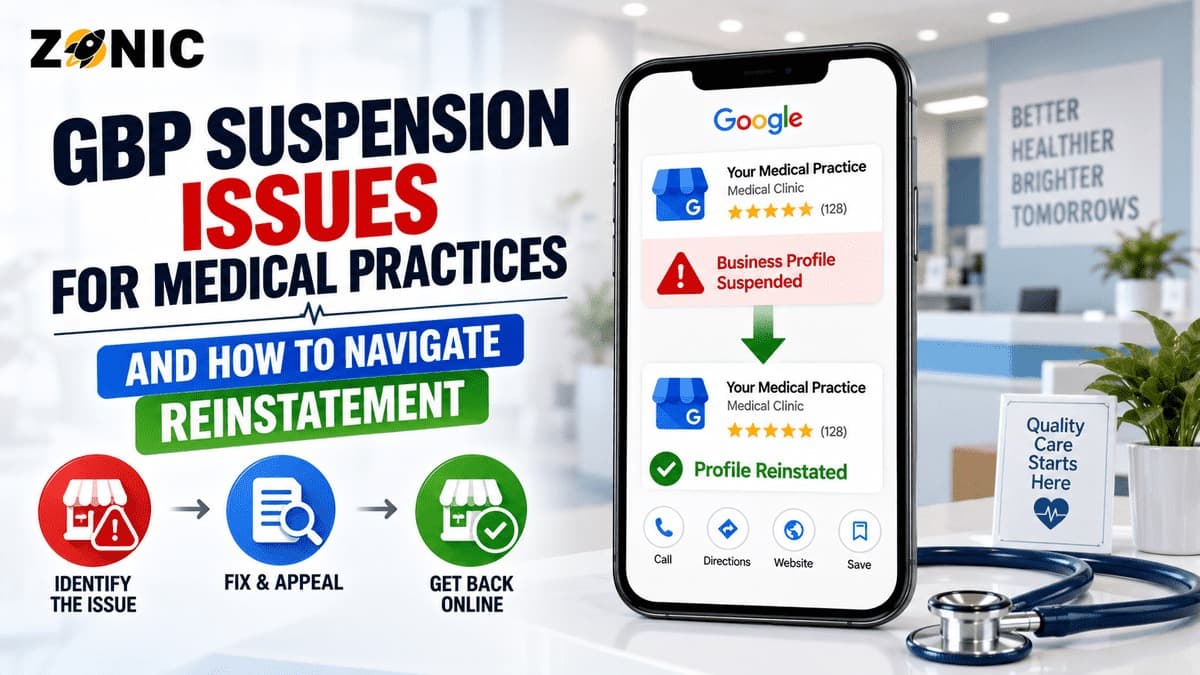
When a medical practice GBP suspension issue happens, it can create serious concern for the office, providers, and patients trying to find care. Your practice may stop showing properly on Google Search or Maps. Patients searching for your clinic name, doctor name, specialty, treatment, directions, phone number, or appointment information may not see the profile the way they expect.
A Google Business Profile can help patients confirm whether a practice is real, open, nearby, and appropriate for their needs. It may show the address, phone number, hours, reviews, photos, services, appointment links, and provider information. If the profile disappears or becomes restricted, the patient journey becomes harder.
The difficult part is that many doctors, office managers, and practice administrators do not know why the suspension happened. The profile may have been active for years. Then one edit, one verification issue, one duplicate profile, one practitioner listing conflict, or one address problem can trigger a restriction.
The best response is not panic. It is careful review, correction, evidence, and appeal.
This guide explains why medical practices lose Google Business Profile visibility, what to check before submitting an appeal, how doctor Google Business reinstatement works, and how to reduce the risk of another suspension after recovery.
Why Medical Practice Google Business Profiles Get Suspended
Medical practices can be suspended when Google believes the profile may not follow Business Profile guidelines. Sometimes the issue is simple, such as an incorrect address or duplicate listing. Other times, the problem is harder to identify because healthcare profiles often have more complex setups.
A medical office may include multiple doctors, nurse practitioners, physician assistants, departments, specialties, locations, and appointment phone numbers. A hospital-owned clinic may use one brand name, while documents may show another legal entity. A doctor may have a practitioner profile at one location and an outdated profile at a former office.
These details can create confusion.
Google needs to understand what the profile represents. Is it the medical practice, an individual doctor, a clinic location, a specialty office, or a healthcare organization? If the profile name, address, category, website, phone number, and evidence do not support the same answer, reinstatement becomes harder.
A legitimate medical practice can still get suspended if the listing looks inconsistent, duplicated, unverifiable, or over-optimized.
Do Not Create a New Medical Profile After Suspension
Creating another Google Business Profile after a suspension may feel like a quick fix. It is usually the wrong move.
Google’s suspension guidance says not to create a new business profile for the same business while an appeal is under review. A second profile can create duplicate issues and make the reinstatement process more confusing.
A new listing does not remove the original problem.
Google may connect the new profile to the suspended one through the same practice name, provider name, address, phone number, website, manager account, category, or clinic location. If that happens, the new listing may also be restricted or treated as a duplicate.
The original medical profile may already have valuable reviews, patient trust, photos, appointment links, Q&A, directions activity, and years of history. Starting over can mean losing that value.
For most medical offices, the safer path is to review and recover the original profile.
Identify Whether the Profile Represents a Practice, Doctor, or Clinic
Before appealing, clarify exactly what the suspended profile is supposed to represent. This is one of the most important steps in medical GBP reinstatement.
A practice profile should represent the medical office or clinic as a business. A practitioner profile should represent an individual public-facing doctor or provider. A clinic location profile should represent a real location where patients can receive care.
If the profile name says one thing and the evidence proves another, Google may not approve the appeal.
For example, a profile named after a doctor may need evidence that connects that doctor to the location. A profile named after a clinic may need documents supporting the clinic name and address. A hospital-owned practice may need evidence that connects the public-facing clinic brand to the legal entity on documents.
Medical profiles need clear identity.
Do not use one profile to represent several unrelated practices. Do not create separate profiles for every treatment if they all belong to the same office. Do not create staff profiles for people who are not eligible public-facing practitioners.
Practitioner Listings Need Extra Care
Healthcare profiles often include both practice-level listings and provider-level listings. This can be acceptable when handled correctly, but it can also create duplicate and suspension problems.
Google’s guidelines say an individual practitioner may create a dedicated Business Profile if they are public-facing, if their contact details can be verified at the listed location during stated hours, and if they directly work with customers. Google also says support staff should not create their own business profiles.business profile
For medical practices, this means a doctor may have a practitioner listing in some cases, but front desk staff, billing staff, administrative staff, and non-public-facing team members should not have separate profiles.
Provider profiles should also use the real professional name, not a keyword-stuffed version of the name.
A doctor profile should not be titled “Best Cardiologist Near Me” or “Top Pain Specialist NYC” unless those words are part of the real-world name, which they usually are not. The profile should clearly represent the provider.
If a doctor leaves the practice, changes locations, retires, or joins another group, the profile should be reviewed carefully. Old practitioner profiles can create conflicts that affect the main practice listing.
Common Suspension Triggers for Medical Practices
Many medical profile suspensions come from details that appear small but create large verification issues. Review these areas before submitting an appeal.
Possible Issue | Why It Can Hurt a Medical GBP | What to Review |
Keyword-stuffed practice name | Google expects the name to match real-world branding | Compare profile name with signage, website, license, documents, and appointment materials |
Practitioner duplicate profiles | Multiple profiles for one doctor can confuse Google | Search doctor names, old offices, old phone numbers, and former affiliations |
Wrong address or suite | Patients need accurate directions to the real clinic | Check street address, suite, floor, building, and entrance |
Department confusion | Separate department profiles can be risky if not clearly eligible | Confirm whether the department is public-facing and distinct |
Website mismatch | Conflicting details weaken the appeal | Match name, phone, address, specialty, and provider details |
Wrong category | Google may not understand the practice type | Review whether doctor, medical clinic, specialty, or practice category fits |
Support staff profiles | Non-practitioner profiles can violate guidelines | Remove or correct staff listings that should not exist |
Recent major edits | Sudden changes can trigger review | Check edits to name, address, phone, category, and website |
This table should be reviewed before the appeal. If the same issue remains, the reinstatement request may be weaker.
Review the Medical Practice Name Carefully
The name on the Google Business Profile should match the real-world name of the practice or provider. It should not be used like a marketing headline.
A clinic named “Advanced Family Care” should not become “Advanced Family Care Primary Care Doctor Urgent Care Walk-In Clinic Near Me” on Google. A physician profile should not add extra specialty phrases, city names, or promotional terms that are not part of the professional name.
The name should match what patients see on the website, signage, appointment reminders, insurance directories, provider pages, licenses, business records, and office materials.
Medical marketing often uses specialties and treatment names throughout a website. That is fine when written naturally on service pages. The Business Profile name field should stay clean and accurate.
If the legal entity name differs from the public-facing clinic name, prepare evidence that connects them clearly.
Check Address, Suite, Floor, and Clinic Access
Address accuracy is critical for medical practices because patients rely on Google for directions. A small address error can create serious confusion.
Check the street address, suite number, floor, building name, entrance, parking instructions, and phone number. Make sure the profile matches the website, appointment system, signage, insurance directories, healthcare directories, and official documents.
Medical offices often share buildings with other providers. Several clinics may operate in the same medical plaza, hospital campus, or suite area. If the profile does not clearly identify the correct office, Google may struggle to verify it.
A public address should represent a real patient-facing location where care is provided during stated hours. If the profile uses an administrative office, mailbox, virtual office, or location where patients cannot receive care, the listing may be risky.
Photos can support location proof when they show the exterior, entrance, suite sign, reception area, and clinic branding. Avoid anything that exposes patient information.
Department and Multi-Location Profiles Must Be Accurate
Some medical organizations have multiple departments, specialty clinics, or locations. These profiles need careful setup.
A separate department profile may make sense only when the department is clearly distinct, public-facing, and easy for patients to contact or visit. A hospital department, imaging center, urgent care clinic, or specialty clinic may have a separate identity in some cases.
The problem starts when a practice creates multiple profiles only to rank for more services.
A single clinic should not create separate profiles for “cardiology,” “primary care,” “weight loss,” “urgent care,” and “medical aesthetics” unless each profile represents a clearly eligible, distinct public-facing entity.
Multi-location practices should also be careful. Each location should have a real address, accurate hours, correct phone number, and proof that patients can receive care there.
Do not use fake offices or administrative addresses to create extra local listings.
Search for Duplicate Medical and Doctor Profiles
Duplicate listings are common in healthcare. They may come from old offices, previous employers, hospital affiliations, insurance directories, data aggregators, former marketing agencies, or doctor moves.
Before appealing, search Google Maps for the practice name, doctor names, old practice names, phone numbers, old phone numbers, website URL, current address, old addresses, and specialty terms.
Look for profiles that represent the same practice or provider.
One doctor may have profiles at old clinics. A practice may have an old listing with a previous name. A hospital system may have a profile that overlaps with the clinic. An insurance directory may have created inconsistent data that Google picked up.
Do not delete, close, or edit profiles randomly. Some may have review history or ownership complications. Others may need to be corrected through proper duplicate or ownership handling.
A clean reinstatement case should make the active profile easy to identify.
Prepare Evidence for Doctor Google Business Reinstatement
Google may ask for evidence during the appeal process. The strongest evidence is clear, current, and matches the profile being appealed.
For medical practices, helpful evidence may include business registration, medical license, provider license, professional license, clinic license where applicable, tax certificate, utility bill, lease, insurance document, accreditation proof, office signage photos, exterior photos, suite photos, reception photos, website screenshots, provider bio pages, and appointment page screenshots.
The evidence should match the business name and address shown on the profile.
If the profile is for an individual doctor, evidence should connect that doctor to the listed practice location. This may include a provider license, official provider page, practice website bio, clinic affiliation page, or appointment listing.
If the profile is for a clinic, evidence should support the clinic name and address.
Do not upload patient records, appointment lists, prescriptions, charts, insurance claim documents, lab reports, ID cards, billing records, intake forms, or any protected patient information. Reinstatement evidence should prove the business without exposing private medical data.
Submit the Appeal Through the Correct Process
Use the official Google Business Profile appeals tool while signed in to the account that manages the suspended profile. Select the restricted profile and review any moderation reason or policy information shown.
Do not rush through this step.
If the issue appears to be the name, address, category, practitioner setup, or duplicate listings, review and correct what you can before submitting.
If Google offers the option to submit evidence, prepare the files before opening the form. Google says evidence should match the profile being appealed, and the appeal process is designed to review the restricted profile.
Your message should be calm and factual.
Explain that the profile has been reviewed, inaccurate details have been corrected if needed, and the attached evidence supports the medical practice or doctor shown on the listing.
Avoid long emotional messages. Google does not need a full story about lost appointments. It needs clear proof that the profile is eligible and accurate.
What to Avoid While the Appeal Is Pending
Once the appeal is submitted, keep the case stable. Do not create another profile for the same practice or provider. Do not keep changing the name, address, phone number, category, website, or provider details. Do not submit repeated appeals before Google responds.
Too many changes can make the case harder to review.
For medical practices, also avoid creating new practitioner profiles during the appeal just to regain visibility. Do not create profiles for nurses, assistants, billing teams, departments, or services that are not eligible separate public-facing entities.
Review profile access as well. Remove old agencies, former staff members, previous clinic managers, or unknown users who should not manage the listing.
A pending appeal should look clean, consistent, and easy to verify.
If the Medical Practice Appeal Is Denied
A denied appeal does not always mean the profile cannot be recovered. It means the first request did not satisfy Google or the profile still appears to have an unresolved issue.
Do not immediately send the same appeal again.
Review the profile carefully. Check the practice name, provider name, category, address, suite, phone number, website, duplicate profiles, practitioner listings, department listings, and evidence match.
If an additional review is available, use stronger evidence that was not included before. This may include clearer provider license information, clinic registration, office signage, lease proof, utility bill, official provider page, appointment page, accreditation proof, or website screenshots that match the profile.
The next request should be more organized than the first one.
If the real problem is an unsupported profile setup, duplicate pattern, or confusing practitioner listing, fix that before sending more documents.
Protect the Medical Profile After Reinstatement
After reinstatement, avoid making several major edits immediately. A restored profile should remain stable.
Start by checking the business name, provider name, category, phone number, website, address, suite number, hours, appointment links, services, photos, reviews, and manager access.
Make sure the profile matches the website, provider pages, healthcare directories, insurance listings, licenses, and patient-facing materials.
If a doctor joins or leaves the practice, update the profile carefully. If a practice moves, changes name, or opens another location, support those changes with clear website updates and documents.
Keep the profile active in a professional way. Add real office photos, exterior photos, provider photos, reception photos, and facility photos where appropriate. Avoid patient images, records, charts, private treatment details, or anything that could expose protected health information.
Medical Practice GBP Reinstatement Checklist
Use this checklist before submitting or resubmitting an appeal:
Confirm whether the profile represents a practice, provider, clinic, or department
Review the practice or doctor name for extra keywords
Check the address, suite, floor, and patient-facing location
Search for duplicate doctor, clinic, and old office profiles
Review practitioner listings for departed or duplicated providers
Confirm the primary category matches the real medical business
Match website, phone number, appointment page, and profile details
Prepare license, registration, utility, lease, or provider evidence
Avoid uploading patient records or private medical information
Do not create a new profile while the appeal is pending
This checklist helps make the reinstatement case more organized and easier to review.
How Zonic Helps Medical Practices With GBP Reinstatement
Zonic helps medical practices, doctors, and clinic teams review suspended Google Business Profiles before appeal mistakes make the case harder.
The review starts with the profile setup. Zonic checks whether the listing represents a practice, doctor, clinic, department, or multi-location office. Then the name, category, address, suite number, phone number, website, appointment links, recent edits, duplicates, and manager access are reviewed.
For medical practices, practitioner listings and address proof are especially important. Zonic helps identify whether the profile details match provider pages, licenses, clinic signage, website details, healthcare directories, and public-facing business materials.
Zonic also reviews evidence before submission. This may include medical licenses, professional records, business registration, clinic documents, lease proof, utility bills, signage photos, provider bio pages, appointment pages, and website screenshots.
If the first appeal was denied, Zonic can help review what may have been missing and prepare a cleaner additional review request when that option is available.
The goal is not to submit repeated appeals or make random edits. The goal is to build a clear, accurate, and easy-to-review reinstatement case.
Conclusion
A suspended Google Business Profile can hurt a medical practice’s visibility, patient trust, and appointment flow. Patients often search a doctor, clinic, specialty, or treatment before calling or booking. If the profile is restricted, that trust path can break.
The most important step is to avoid panic changes.
Do not create another profile for the same practice or provider. Do not stuff the profile name with specialty or city keywords. Do not use an address where patients cannot receive care. Do not upload patient records or private medical documents. Do not appeal before checking duplicates, practitioner listings, address details, and evidence.
Instead, clarify what the profile represents. Review the practice name, provider name, category, address, suite number, website, phone number, appointment links, duplicate profiles, and recent edits. Prepare evidence that proves the listing is real, eligible, and accurately represented.
If your medical practice GBP is suspended and you are unsure what to do next, you can reach out to Zonic for a careful review before submitting or resubmitting an appeal.
Call Zonic Media at (302) 726-9736 or visit 8 The Green, Suite B, Dover, DE 19901 to request help with doctor Google Business reinstatement for your medical practice in New York City or anywhere across the United States.