
How Google Decides Who Ranks Locally: The 3 Core Factors Explained
When someone searches for a local business on Google, the results can look simple from the outside. A customer types “dentist near me,” “roof repair Brooklyn,” “HVAC company open now,” “pest control near me,” or “best restaurant nearby,” and Google shows a few local businesses in Maps or the local pack.
But behind that simple result is a ranking system designed to choose which businesses are most useful for that search.
Business owners often want to know exactly how Google ranks local businesses. They may wonder why one competitor appears above another, why rankings change from one neighborhood to the next, or why their profile ranks for some services but not others.
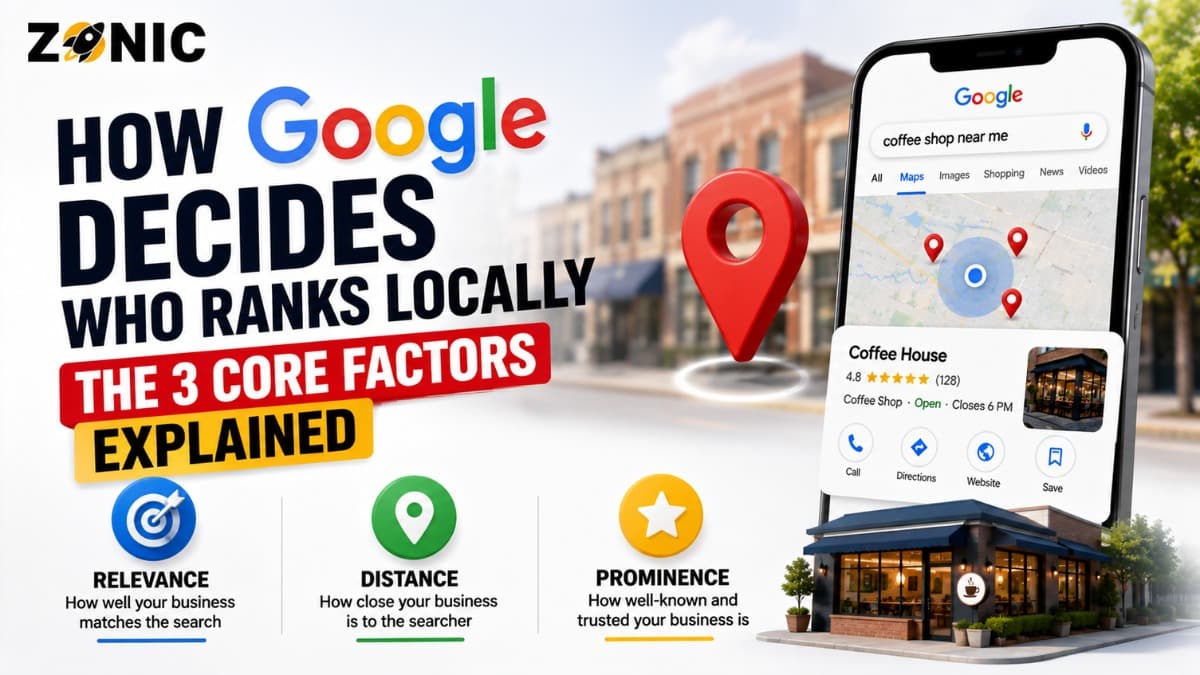
Google does not share every detail of its local ranking algorithm. It does, however, explain the three core factors it uses for local results: relevance, distance, and prominence.
Relevance is about how well your business matches what the customer is searching for. Distance is about how close your business is to the searcher or searched location. Prominence is about how trusted, known, reviewed, and established your business appears to be.
Understanding these three factors helps business owners stop chasing random SEO tricks and start improving the signals that matter. Local rankings are not controlled by one field, one keyword, one photo, or one review. They are shaped by how clearly Google understands your business, where your business operates, and how much trust your business has earned.
This guide explains Google local ranking factors in plain English and shows what businesses can actually improve.
Google’s Local Ranking System Is Built Around User Intent
Local search is different from general search because the user usually wants something nearby. A person looking for “how to repair a pipe” may want information. A person searching “emergency plumber near me” usually wants help fast.
Google’s job is to show businesses that match that local need.
That means local rankings can change based on the search term, the searcher’s location, the device being used, the time of day, the business category, and the strength of competing profiles. A business may rank well for “roof replacement” but not “flat roof repair.” A dentist may rank in one part of town but not across the entire city. A restaurant may rank higher when it is open and nearby.
This is why local SEO cannot be reduced to one simple checklist. The profile, website, reviews, location, service areas, business category, citations, and overall online presence all work together. Google uses these signals to decide which business is the best match for the searcher at that moment.
Local Results Are Not the Same for Every Customer
Two people in the same city may see different local results. If one person is closer to your business and another is farther away, distance can change the ranking order. If one person searches for a specific service and another searches a broad category, relevance can change the results.
This is why checking rankings from one location does not tell the whole story.
A business should look at visibility across its real service area, not just from one device or one office computer. Local rankings are dynamic because local search is based on context.
The First Core Factor: Relevance
Relevance means how well your Business Profile matches what someone is searching for. If Google cannot clearly understand what your business does, it may not show your profile for the right searches.
For example, if someone searches for “emergency AC repair,” Google needs to understand that your HVAC company provides that service. If someone searches for “dental implants,” Google needs signals that the dental office offers implant treatment. If someone searches for “roof leak repair,” the roofing profile and website should support that service clearly.
Relevance starts with your Google Business Profile, but it does not stop there.
Your category, services, business description, website pages, reviews, photos, and business information all help shape how Google understands the business. When these signals are aligned, your profile has a stronger chance of appearing for the right searches.
Complete Business Information Improves Relevance
Google recommends providing complete and detailed business information because it helps Google better understand the business and match the profile to relevant searches.
That includes your business name, category, address or service area, phone number, website, hours, services, attributes, photos, and other profile details.
A thin or incomplete profile creates uncertainty. A complete profile gives Google and customers more context.
A pest control company should list real services such as termite treatment, rodent control, bed bug treatment, mosquito control, and commercial pest service if those are truly offered. A plumber should support emergency plumbing, drain cleaning, water heater repair, sewer repair, and leak detection if those services are real. A med spa should clearly describe the treatments it actually provides.
The goal is not to stuff keywords. The goal is to make the business easy to understand.
The Right Primary Category Is Critical
The primary category is one of the strongest relevance signals in a Google Business Profile. It tells Google what type of business you are.
A roofing contractor should not use a broad contractor category if a roofing category better describes the business. A dentist should use a dental category, not a generic medical label. A restaurant should choose the category that best reflects the type of restaurant when a specific option fits.
Secondary categories can support additional real services, but they should not confuse the profile.
The category setup should match the real business, website, reviews, and customer expectations. If the category is wrong, the profile may struggle even when other signals look strong.
How Website Content Supports Local Relevance
Your website plays an important role in helping Google understand your business. The website connected to your business profile should support the same services, locations, and business identity shown on the profile.
If your profile says you are an HVAC company, your website should have strong HVAC service content. If your profile says you provide legal services, your website should explain your practice areas. If your profile says you are a roofing contractor, your website should clearly support roofing services.
For example, a business may list “emergency roof repair” on its profile, but the website only has a thin homepage with no emergency service page. That makes it harder for customers and search engines to understand the service deeply.
Service Pages and Location Pages Should Be Specific
Strong local SEO usually needs dedicated pages for important services and locations. A plumbing company should not rely on one homepage to rank for emergency plumbing, drain cleaning, water heater repair, sewer repair, and leak detection.
Location pages also help when they are written with real local detail. A city page should not simply swap one city name for another. It should explain the service area, local customer needs, property types, common problems, and the way the business serves that market.
Useful website content strengthens relevance because it confirms what the business profile says.
The Second Core Factor: Distance
Distance means how far each business is from the searcher or from the location used in the search. This is one of the most important local ranking factors, and it is also one of the hardest to control.
If someone searches “coffee shop near me,” Google will usually prefer nearby options because convenience matters. If someone searches “dentist in Dover,” Google will look at businesses connected to that area. If someone searches “roof repair Brooklyn,” Google evaluates businesses based on how they relate to that location.
Distance does not mean the closest business always wins. Google may decide that a business farther away is a better match if it has stronger relevance or prominence.
Still, location matters. A business cannot expect to rank equally in every city simply because it wants customers there.
Service-Area Businesses Still Have Distance Limits
Many service businesses travel to customers. Roofers, plumbers, HVAC companies, pest control companies, cleaners, landscapers, and mobile service providers may serve several towns or counties.
Google allows service-area businesses, but service areas should reflect where the business truly operates.
Adding a long list of cities does not guarantee strong rankings in every one of them. Google still considers distance and local relevance. A plumber based on one side of a metro area may not rank as strongly across the entire region as a closer competitor.
This is why fake locations, rented mailboxes, and duplicate city profiles are risky. They try to manipulate distance instead of building real local trust.
You Cannot Safely Fake Proximity
Some businesses try to rank in more places by creating listings at virtual offices, coworking spaces, mailboxes, residential addresses, or fake branch locations. That approach can create suspension risk and duplicate listing problems.
A better strategy is to build a strong real profile, create useful location pages for legitimate service areas, earn reviews from customers across those areas, and keep business information consistent.
Distance is a real factor, but it should not be manipulated with fake locations.
A business that wants stronger local reach should build stronger relevance and prominence around the places it actually serves.
The Third Core Factor: Prominence
Prominence means how well known or trusted a business appears to be. Google explains that prominence is based on information it has about a business from across the web, including links, articles, directories, and reviews.
In plain language, prominence is about reputation.
A business with strong reviews, a trusted website, local mentions, quality links, directory consistency, media coverage, and real-world brand recognition may appear more prominent than a business with little online presence.
Prominence is especially important in competitive markets. When several businesses are relevant and located near the searcher, trust signals can help separate them.
Reviews Are a Major Prominence Signal
Google says review count and review score can affect local ranking. Reviews also influence whether customers choose your business after seeing it.
A strong review profile can help both visibility and conversion. Customers look at rating, number of reviews, review recency, review details, and how the business responds. A business with recent, detailed reviews may feel more trustworthy than one with old or vague feedback.
For service businesses, reviews that mention real services can be especially useful. A review about “same-day AC repair,” “roof leak inspection,” “dental implant consultation,” or “bed bug treatment” helps future customers understand what the business does.
Responses matter too. A professional response shows that the business is active and accountable.
Links, Mentions, and Local Authority Support Prominence
Prominence is not only about reviews. Google also considers information from across the web.
That means your website authority, local citations, backlinks, articles, business directories, local chamber listings, industry associations, sponsorships, and local mentions can support trust.
For example, a roofing company mentioned by local property associations, listed on contractor directories, and linked from relevant local sources may build stronger prominence. A dental office with provider pages, healthcare listings, local mentions, and strong reviews may look more established. A restaurant with reviews, media mentions, menu listings, and active local coverage may appear more trusted.
How the Three Factors Work Together
Relevance, distance, and prominence are not separate boxes. They work together. A nearby business may rank because it is close. A farther business may rank because it is more relevant or more prominent. A business with many reviews may still struggle if its category is wrong. A business with a great website may still struggle in an area far outside its realistic service range.
Google’s local ranking system tries to find the best match, not simply the closest or most reviewed business.
This is why local SEO requires balance.
A business should not focus only on reviews and ignore category accuracy. It should not build city pages while leaving the profile incomplete. It should not chase links while using a fake address. It should not focus only on ranking while ignoring calls, bookings, and lead quality.
The strongest local visibility usually comes from improving all three core factors over time.
Practical Local Ranking Factor Table
Core Factor | What It Means | What You Can Improve |
Relevance | How well your business matches the search | Categories, services, profile details, service pages, location pages, business description |
Distance | How close your business is to the searcher or searched area | Accurate address, realistic service areas, real location strategy, local pages |
Prominence | How trusted and well known your business appears | Reviews, ratings, links, citations, directories, mentions, website authority |
Conversion support | How likely customers are to contact you after seeing the profile | Photos, hours, calls, website experience, review responses, clear CTAs |
Consistency | How clearly your business information matches across the web | NAP cleanup, website alignment, profile accuracy, duplicate listing fixes |
This table is not a secret ranking formula. It is a practical way to understand what Google is trying to evaluate and what your business can actually improve.
Common Mistakes That Hurt Local Rankings
Many businesses struggle locally because they chase shortcuts instead of building clear trust signals.
A common mistake is using the wrong category. If Google does not understand the business type, the profile may not appear for the right searches.
Another mistake is adding keywords to the business name. A business name should match real-world branding, not act like a keyword list.
Fake locations are also risky. A service business does not need a public office in every city it serves. It needs an accurate profile and real service-area support.
Thin location pages can also hurt. If every city page says the same thing with only the location swapped, the content does not build strong local relevance.
Poor review management is another issue. Ignoring reviews, failing to request feedback, or responding defensively can hurt customer trust. Local rankings improve when the business becomes easier to understand, verify, and trust.
What Actually Helps Google Rank Your Business Locally
If you want to improve local rankings, start with the foundation. Make sure your Google Business Profile is verified, accurate, complete, and aligned with your real business. Choose the correct primary category. Add real services. Keep business hours updated. Use a phone number and website that match your website and citations.
Then strengthen the website. Build service pages that explain what you do. Build location pages for areas you truly serve. Make the website fast, mobile-friendly, and easy to contact from.
Next, build prominence. Ask satisfied customers for honest reviews. Respond professionally. Fix major citation issues. Earn relevant local links and mentions. Keep your business information consistent across trusted platforms.
Finally, measure real outcomes. Rankings matter, but calls, bookings, forms, direction requests, and qualified leads matter more. A business that ranks but does not convert still has a local SEO problem.
How Zonic Helps Businesses Improve Local Rankings
Zonic helps businesses understand which of Google’s three core local ranking factors may be holding them back.
The process starts with a Google Business Profile review. This includes category accuracy, business name, address or service-area setup, services, hours, photos, reviews, manager access, and duplicate listing risks.
Then the website is reviewed for local relevance. Zonic looks at service pages, location pages, content depth, internal structure, mobile experience, conversion paths, and whether the website supports the same services shown on the profile.
Prominence is also reviewed. This includes reviews, citations, links, local mentions, directory consistency, and competitor comparison.
The goal is not random SEO activity. The goal is to identify whether the business needs stronger relevance, better service-area support, more prominence, cleaner business information, or better conversion flow.
Local SEO works best when the right problem is fixed first.
Conclusion
Google decides who ranks locally by looking at three core factors: relevance, distance, and prominence.
Relevance tells Google whether your business matches the search. Distance tells Google whether your business is close enough or connected to the searched area. Prominence tells Google whether your business appears trusted, known, and established.
These factors work together. A nearby business may win because it is close. A farther business may compete if it is more relevant and prominent. A highly reviewed business may still struggle if its category, website, or service-area setup is wrong.
The best local SEO strategy is built on accuracy, consistency, and trust.
Complete your Google Business Profile. Choose the right category. Build useful service and location pages. Keep business information consistent. Earn real reviews. Respond professionally. Avoid fake locations, keyword-stuffed names, and duplicate profiles.
If you want to understand how Google ranks local businesses and what may be holding your company back, you can reach out to Zonic for a local SEO review.
Call Zonic Media at (302) 726-9736 or visit 8 The Green, Suite B, Dover, DE 19901 to discuss Google local ranking opportunities for your business in New York City or anywhere across the United States.