
Google Maps Ranking Factors in 2026: What Actually Moves the Needle
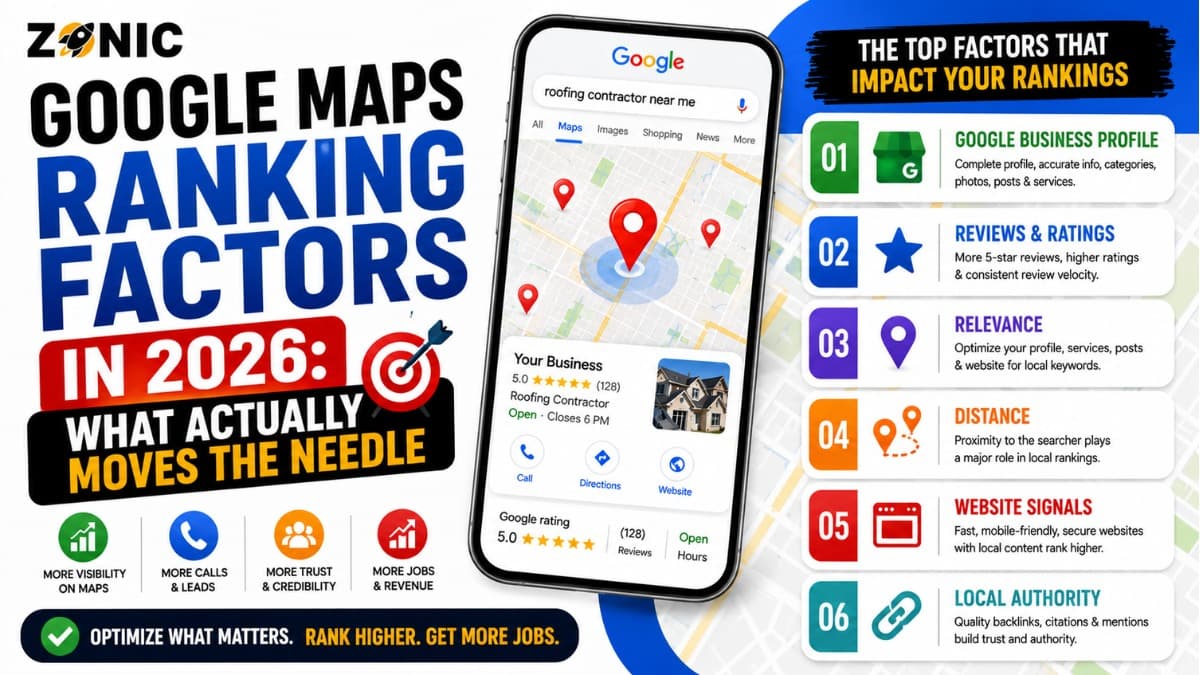
For a local business, showing up on Google Maps can be more valuable than ranking for a broad informational keyword. A homeowner looking for an emergency roofer, a patient searching for a nearby dentist, or someone trying to find an HVAC company is usually much closer to taking action than someone casually reading a blog.
That is why map visibility matters. It can turn into calls, direction requests, bookings, website visits, quote forms, and appointments without the customer needing to scroll through pages of search results.
Google does not publish a secret scorecard showing that reviews are worth one percentage, photos another, and backlinks another. What it does explain is that local results are mainly determined by relevance, distance, and prominence. Most practical Google Maps SEO work sits somewhere inside those three areas.
So rather than treating every profile feature as an equal ranking factor, it makes more sense to understand what Google is trying to determine: Is this business relevant to the search? Is it reasonably located for the person searching? Does it appear established and trustworthy?
Start With the Three Factors Google Actually Talks About
A surprising amount of local SEO advice becomes easier to understand once relevance, distance, and prominence are separated.
Relevance is about matching. If someone searches for roof repair, Google needs enough information to understand that a business actually provides roof repair rather than general construction. Categories, services, website content, and profile information all help make that connection clearer.
Distance is more straightforward but often more frustrating for business owners. Someone searching from three miles away may see a different set of businesses than someone making the same search from ten miles away. A company can improve many parts of its local presence, but it cannot completely optimize away physical proximity.
Prominence is broader. This is where Google looks beyond the basic profile and considers how established the business appears. Reviews, web presence, links, mentions, directories, organic visibility, and overall reputation can all contribute to that picture.
These factors also explain why rankings are never perfectly uniform. A business can perform well for one service but poorly for another. It may dominate close to its location and become much less visible across town. Another company may rank farther away because Google sees it as significantly stronger in relevance or prominence.
Your Primary Category Can Shape What You Compete For
Category selection is one of the first things worth checking on a Google Business Profile because it tells Google what the business fundamentally is.
A roofer using a broad construction category may be putting itself at a disadvantage when a more specific roofing category is available. The same issue can happen with dentists, attorneys, pest control companies, electricians, plumbers, and other businesses that operate within broader industries.
The primary category should represent the core business, not the keyword with the highest search volume and not the category a competitor happens to be using.
Secondary categories can support other legitimate parts of the company, but more is not automatically better. If a business starts adding categories simply because they are loosely related, the profile can become less focused.
A useful way to review categories is to ask whether each one represents something customers can genuinely hire the company for. If the answer is no, it probably does not belong there.
The category setup should also make sense when compared with the website. If the profile presents the company as a specialist in several services that are barely mentioned online, there is a disconnect worth fixing.
Complete Profiles Work Better When the Information Is Useful
There is a difference between completing a Google Business Profile and filling every available field because someone said profile completeness matters.
The purpose of adding information is to make the business easier for Google and customers to understand.
A customer should be able to determine what the company does, how to contact it, when it is available, where it operates, and where to find more information. Those details become particularly important for businesses where availability influences the decision.
An HVAC contractor showing incorrect weekend hours could lose an emergency call. A dental office with outdated appointment information creates unnecessary friction. A restaurant with old opening hours may lose a customer before the person ever reaches its website.
The same principle applies to services. If the business stopped offering a service six months ago, leaving it on the profile does not create useful relevance. It creates inaccurate information.
Keeping the profile current is not exciting SEO work, but it is part of building a local presence Google and customers can rely on.
Distance Is Real, and a Bigger Service Area Does Not Remove It
One of the most common frustrations in Google Maps SEO comes from service-area businesses.
A roofer may serve an entire metro area. A plumber might travel across several cities every day. An HVAC company could have customers throughout a county. From the business owner’s perspective, it makes sense to want strong Maps rankings everywhere the company is willing to work.
A service area tells customers where a business provides service. It should not be viewed as a switch that makes the company equally close to every searcher inside that area.
If a contractor is based on one side of a city, it may rank strongly around that area and become less competitive as searches move farther away. That can happen even when the company genuinely serves the distant neighborhoods.
This is why local rank tracking needs geographic context. Searching a keyword once from the office does not tell you what customers are seeing throughout the market.
Fake Locations Are Not a Sustainable Solution
Once businesses discover how much proximity matters, some try to solve the problem with virtual offices, mailboxes, duplicate city listings, or addresses where no legitimate operation exists.
A fake location may appear to solve a geographic weakness temporarily, but it can expose the profile to reports, verification problems, duplication, or suspension. It also builds the entire strategy around information that does not accurately represent the business.
If a company genuinely operates multiple eligible locations, those locations can be represented appropriately. If it does not, creating the appearance of multiple locations is not a substitute for building stronger relevance and prominence.
For most service businesses, the safer strategy is to accept that distance creates limits and strengthen the areas that can actually be improved.
Reviews Matter, but the Goal Should Not Be a Review Counter
Google has stated that review count and review score can influence local ranking. At the same time, customers use those reviews to decide whether a business deserves a call.
That makes reviews important for two reasons, but it does not mean the strategy should become “get as many as possible.”
A profile with a steady flow of genuine feedback often gives customers a better picture of the business than a profile where almost every review arrived years ago. Detailed experiences can also answer questions that a star rating alone cannot.
For example, a homeowner may mention that a roofer identified the source of a leak, explained the repair clearly, and completed the work on schedule. Someone reading that review learns far more than they would from a one-line “great company” comment.
Businesses should not script those details for customers. The value comes from real people describing real experiences in their own words.
Responses deserve similar common sense. Reply because customers are reading, not because every response needs a service keyword squeezed into it. A professional answer to praise or criticism shows that the company pays attention to the people it serves.
Buying reviews, offering rewards for positive ratings, or creating fake feedback works against that credibility and can create policy issues as well.
Your Website and Google Business Profile Should Tell the Same Story
A business can have a beautifully completed Google Business Profile and still have a weak local presence if the website behind it says very little.
Google does not evaluate local businesses in isolation from the wider web. The website helps establish what the company does, where it works, how much expertise it demonstrates, and how strong its broader search presence is.
If an HVAC company lists furnace repair, AC repair, heat pumps, and maintenance as major services, those topics should be properly covered on the website. If a roofing contractor serves several important markets, the site should make those legitimate service areas understandable without producing dozens of nearly identical pages.
Local Pages Need More Than a Different City Name
Imagine two roofing pages. One targets Brooklyn, and the other targets a suburban community in Delaware. If every paragraph is identical except for the place name, neither page says much about why the service matters in that particular market.
Useful local content can reflect building types, service expectations, property conditions, neighborhoods, weather exposure, access challenges, common customer concerns, or other differences that actually exist.
That does not mean every paragraph needs a location keyword. In fact, forcing the city name repeatedly usually makes the page feel less natural.
A local page should make sense even if someone ignores the SEO reason it was created. A customer from that area should feel that the business understands the market.
Prominence Is Built Across the Web, Not Inside One Dashboard
Google Business Profile optimization gets a lot of attention because it is visible and easy to edit. Prominence often requires work outside the profile.
A company that has been operating for years, earning legitimate reviews, getting mentioned by local organizations, attracting relevant backlinks, ranking organically, and maintaining consistent business information has a stronger digital footprint than a company that exists almost nowhere outside Google Maps.
Links from reputable industry organizations, suppliers, local associations, publications, business groups, and relevant websites can strengthen online authority. The value is not in collecting as many links as possible. It is in building connections that make sense for the business.
A few outdated listings do not automatically destroy local rankings, but major inconsistencies should not be ignored. If the phone number on the website differs from the number on major directories, or an old address continues to appear across important sources, customers can easily become confused.
Start with the places that matter most: the website, Google Business Profile, established directories, industry platforms, licensing sources, and active business profiles.
Photos, Hours, and Profile Maintenance Support the Customer Journey
Not everything worth doing on a Google Business Profile needs to be sold as a direct ranking factor.
A roofing company showing recent completed projects, crews, branded vehicles, and materials gives potential customers something tangible to evaluate. A dental office can show its entrance, reception area, team, and treatment environment. Restaurants can give people a realistic view of the food and atmosphere before they decide where to go.
Uploading twenty random photographs simply to create “activity” is a different strategy, and there is no reason to assume a certain upload frequency automatically creates better rankings.
Hours deserve similar attention. Customers often act directly from Maps, especially on mobile devices. If holiday hours or regular business hours are wrong, the listing can create a bad experience at the exact moment someone is ready to visit or call.
Services, appointment links, contact details, and other visible information should be maintained with the same goal: make the profile genuinely useful.
Calls and Clicks Are Outcomes, Not Just SEO Metrics
Business owners understandably pay attention to calls, direction requests, website visits, bookings, and other profile interactions.
The mistake is assuming that every extra click or direction request is automatically a confirmed ranking lever. Google does not publish a simple formula showing that a specific number of interactions will move a business several positions higher.
Ranking number one while generating poor leads is not necessarily better than ranking slightly lower and attracting customers who are ready to buy.
Do Not Turn the Business Name Into a Keyword Field
Business-name keyword stuffing continues to show up in competitive local results, which makes it tempting to copy.
Suppose a legitimate business is called “Smith Roofing.” Changing the profile to “Smith Roofing Emergency Roof Repair Replacement Brooklyn” may make the services more obvious, but it no longer represents the normal business name.
The profile name should reflect the name customers recognize in the real world.
There are already appropriate places to explain services and locations: categories, service fields, website pages, business descriptions, products, posts, and other profile information.
Building a local strategy around an exaggerated business name may provide a short-term advantage in some cases, but it also creates unnecessary risk and weakens the accuracy of the profile.
Which Areas Should a Business Fix First?
Not every Google Maps issue deserves the same priority. A company with the wrong primary category and an incomplete website should not spend its first month debating how often to upload photos.
A practical order looks more like this:
Area | What to Check First |
Primary category | Does it accurately describe the core business? |
Business information | Are name, location, phone, hours, website, and services accurate? |
Reviews | Is there a healthy flow of genuine recent feedback? |
Website | Does it properly support the services and locations on the profile? |
Distance | Are ranking expectations realistic for the actual business location? |
Prominence | Does the business have meaningful links, mentions, reviews, and organic presence? |
Citations | Are major directories and trusted sources showing the correct information? |
Profile media | Do photos and visible details help customers understand the business? |
Duplicate listings | Are old or conflicting profiles creating confusion? |
The order can change depending on the business. If there is a duplicate profile creating a major problem, fix that first. If reviews are strong but the website consists of five thin pages, the site may deserve more attention.
This is why local SEO audits are more useful than generic checklists. Two businesses competing in the same market can have completely different reasons for weak Maps visibility.
Google Maps Mistakes That Usually Create More Problems
Some local SEO tactics remain attractive because they appear faster than building real authority. Most are not worth building a long-term strategy around.
Businesses should be particularly careful with:
Keyword stuffing the Google Business Profile name
Selecting categories that do not reflect actual services
Creating multiple profiles for the same legitimate location
Using fake offices, rented mailboxes, or ineligible locations
Showing a public address where customers cannot genuinely visit
Purchasing or incentivizing reviews
Leaving important business information outdated
Publishing location pages that differ only by city name
Ignoring obvious conflicts between the website and business profile
Measuring success only by a single ranking screenshot
Google Maps optimization works better when the business becomes easier to understand and verify, not harder.
What Actually Moves the Needle in 2026
There is no one setting that turns an average Google Business Profile into the top result across an entire city.
The correct category helps Google understand what the company is. Accurate profile information removes ambiguity. Real reviews establish customer trust. Good service pages strengthen relevance. Quality links and mentions improve authority. A legitimate location creates realistic geographic reach.
When those pieces support each other, the business presents a much stronger local search presence.
Competition should also be judged realistically. If another company consistently outranks you, compare the differences that can actually matter. Is it closer to the search area? Does it have a much stronger review profile? Are its service pages significantly better? Does it have stronger organic rankings or local authority?
The purpose of competitor analysis is not to copy every visible tactic. It is to understand why Google may have more confidence in one result than another.
How Zonic Approaches Google Maps SEO
Zonic looks at Google Maps visibility as part of the complete local search picture rather than treating the business profile as an isolated asset.
That starts with the basics: category selection, business-name accuracy, location setup, service areas, services, reviews, duplicates, photos, hours, and profile completeness.
From there, the website matters. Service-page quality, local landing pages, technical SEO, business information, backlinks, citations, and conversion paths can reveal why the profile is struggling even when it appears properly configured.
Competitor research can then show whether the real gap is proximity, review strength, content, authority, profile relevance, or a combination of several factors.
The goal is to identify what should be fixed first rather than making random profile changes and hoping rankings move.
Conclusion
The Google Maps ranking factors that matter in 2026 still come back to a fairly understandable framework: relevance, distance, and prominence.
A business needs to clearly match the search, be geographically reasonable for the person searching, and demonstrate enough authority and trust to compete with other local options.
That makes the priorities clearer. Use accurate categories. Keep the Business Profile current. Earn genuine reviews. Build useful service and location pages. Strengthen the business across the wider web. Keep major business information consistent. Show customers real proof through photos and a professional profile.
At the same time, avoid trying to manufacture proximity or relevance through fake locations, stuffed business names, unrelated categories, or duplicated city pages.
Good Google Maps SEO is not a collection of tricks. It is the process of making a legitimate local business easier for Google to understand and easier for customers to choose.
If your business is appearing inconsistently in Maps or struggling to compete in important local searches, Zonic can review the Google Business Profile, website, local competitors, and broader SEO footprint to identify the areas most likely to be holding it back.
Call Zonic Media at (302) 726-9736 or visit 8. The Green, Suite B, Dover, DE 19901, to discuss your local SEO opportunities.