Why Your Website Gets Traffic but No Leads (Local Business Fix)
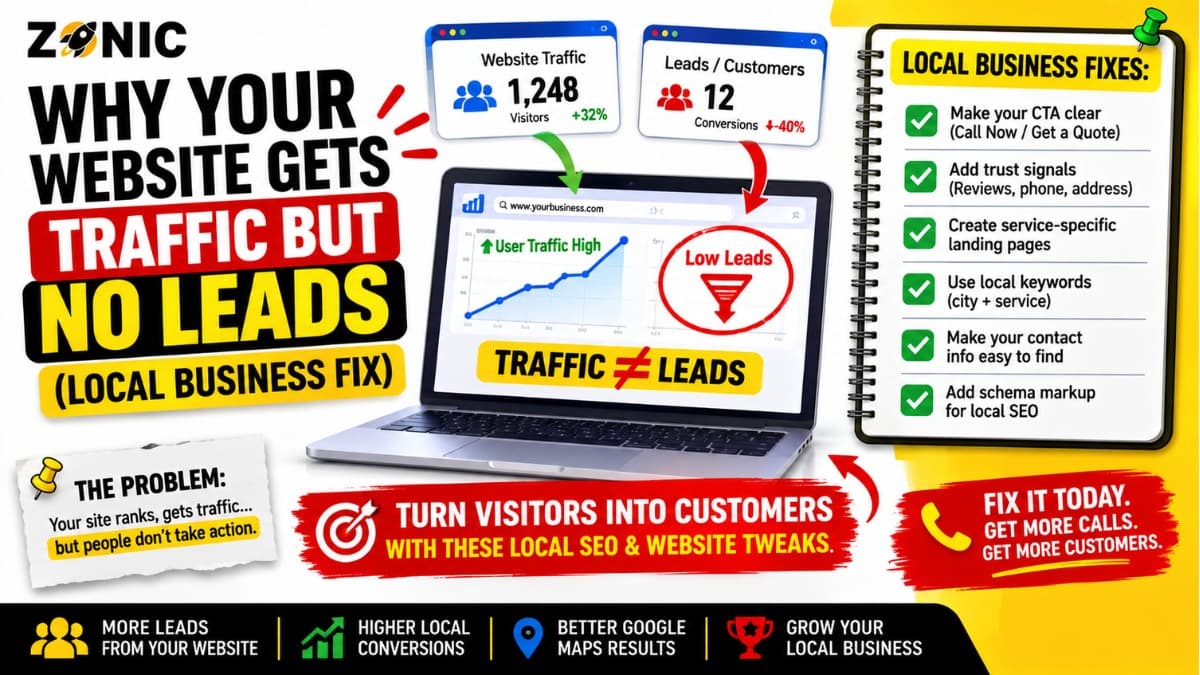
Getting website traffic should feel like progress. People are finding your business on Google, clicking your pages, reading your content, and visiting your site. But if the phone is not ringing, forms are not coming in, and appointments are not getting booked, traffic alone is not solving the real problem.
A roofer needs inspection requests. A dentist needs appointment bookings. An HVAC company needs service calls. A lawyer needs consultations. A remodeler needs estimate requests. A med spa needs booked treatments. If visitors come and leave without contacting you, something in the customer journey is broken.
Many local businesses focus only on rankings. They publish blogs, build service pages, optimize their Google Business Profile, and check traffic reports. That work can bring visitors, but it does not automatically create leads. A customer still needs trust, clarity, urgency, and an easy way to contact you.
Your local business conversion rate depends on what happens after the click. The page must match the search, answer the customer’s real concern, prove your business is credible, and make the next step simple.
Traffic Is Not the Same as Local Leads
A website visitor is not automatically a lead. A lead is someone who takes action, such as calling, filling out a form, booking an appointment, requesting an estimate, or asking for service.
Your Traffic May Not Have Buying Intent
Some visitors are only researching. They may be reading a blog, comparing ideas, checking prices, or looking for general information. That kind of traffic can be useful, but it may not convert right away.
For example, someone searching “how long does a roof last” may not be ready to hire a roofer today. Someone searching “roof leak repair near me” has stronger intent and is much closer to calling.
If most of your traffic comes from broad informational topics, lead volume may stay low.
Your Pages May Attract the Wrong Audience
A local business can get traffic from outside its service area, from unrelated searches, or from keywords that do not match what it sells.
A contractor in New York City does not benefit much from traffic coming from another state. A dental office does not need visitors searching for dental school information. A local SEO agency does not need traffic from people looking for free tools only. Good traffic is targeted, local, and relevant to the service you want to sell.
The Page Does Not Match the Search Intent
Search intent means what the visitor actually wanted when they clicked. If your page does not match that need, the visitor leaves.
Service Searches Need Service Pages
If someone searches for a local service, they usually want a page that explains that service clearly. A search for “emergency plumber near me” should land on a page about emergency plumbing, not a generic homepage or blog.
The page should quickly answer what you do, where you serve, how fast you can help, and how to contact you. A mismatch between search and page is one of the most common reasons traffic does not become leads.
Blog Traffic Needs a Clear Next Step
Blogs can bring useful traffic, but many blogs do not guide readers toward a service. For example, a blog about “signs you need roof repair” should naturally guide readers to a roof inspection or roof repair page. A blog about “how to know if your AC needs repair” should lead to AC service booking. If the article gives information but never connects to the next step, the visitor may leave after reading.
Your Website Does Not Build Enough Trust
Local customers need confidence before they contact a business. If the page looks generic, outdated, or thin, the visitor may not feel safe calling.
Visitors Look for Proof
Customers want to know whether your business is real and reliable. They look for reviews, photos, licensing, insurance, project examples, team details, service process, address or service area, and clear contact information. A page that only says “we provide quality service” does not prove much. Trust is built through specific details. Show real work. Explain real experience. Make your business feel active and accountable.
Generic Content Hurts Confidence
Many local business websites sound the same. They use lines like “we are committed to quality,” “customer satisfaction is our priority,” and “we provide reliable service.” Those phrases are not wrong, but they are weak when used alone. A better page explains what problems you solve, how your process works, what customers can expect, and why your local experience matters.
Your Calls to Action Are Weak or Missing
A visitor should never have to guess what to do next. Every important page needs a clear call to action.
Make the Next Step Obvious
If you want calls, show the phone number clearly. If you want forms, place the form where visitors can find it. If you want bookings, use a simple appointment path.
Strong calls to action include:
“Call for a Free Estimate”
“Schedule Your Inspection”
“Book an Appointment”
“Request Service Today”
“Get a Local SEO Audit”
These phrases work because they tell the visitor what happens next.
Use CTAs Based on Service Intent
A roof repair page should not use the same CTA as a general blog. An emergency service page should push calls. A consultation page may push booking. A pricing guide may push estimate requests. The CTA should match the customer’s urgency. A visitor with an active leak, no heat, or legal emergency needs a faster path than someone reading a general guide.
Your Website Is Hard to Use on Mobile
Most local searches happen on phones, especially when customers need fast help. If your site is slow, crowded, or hard to navigate, leads can drop.
Mobile Visitors Need Speed and Clarity
A mobile visitor should be able to see your service, location, phone number, and next step quickly.
If the page loads slowly, the phone number is hidden, or the form is hard to use, many visitors will leave.
Google has shared research showing that slower mobile pages can increase bounce behavior, and mobile speed can affect conversion performance.
Forms Should Be Simple
Long forms can reduce leads. Local customers usually do not want to answer too many questions before speaking with a business. A simple form may ask for name, phone number, service needed, location, and message. You can collect more details after the first contact.
Your Offer Is Not Clear Enough
A local business page should make the offer easy to understand. Visitors should know what they get when they contact you.
Explain the Service Outcome.
Do not only list the service name. Explain what the service helps the customer solve. A roof repair page should explain leak detection, damaged shingles, flashing problems, storm damage, emergency repair, and inspection steps.
An HVAC repair page should explain no-cooling, no-heat, thermostat issues, airflow problems, and emergency response. When customers understand the outcome, they are more likely to contact you.
Show What Happens After They Reach Out
Many visitors hesitate because they do not know what happens next. Tell them clearly. Do you call back? Do you schedule an inspection? Do you provide a quote? Do you offer same-day appointments? Do you send a technician? Do you review the website first? A simple process section can increase trust and reduce friction.
Your Google Business Profile and Website Do Not Match
A customer may find you on Google Maps, then click your website. If the details do not match, trust can fall.
Keep Business Information Consistent
Your business name, phone number, address or service area, hours, services, and website should match across your Google Business Profile and website.
Google says complete and detailed business information helps it understand your business and match your listing to relevant local searches.
If your profile says you offer emergency service but your website does not mention it, the journey feels unclear. If your profile shows one phone number and the site shows another, customers may hesitate.
Match Location and Service Promises
A local page should support the same service areas shown on your profile. Do not claim dozens of cities on the website if your profile and real service range do not support them.
Consistency helps both Google and customers understand your business.
Your Pages Are Ranking, but Not the Right Pages
Sometimes the website gets traffic, but the pages bringing traffic are not the pages that convert.
Informational Pages May Need Internal Links
A blog can rank well, but it may not generate leads unless it connects to service pages.
For example, a blog about “why your roof leaks after rain” should link naturally to roof leak repair, roof inspection, and emergency roof repair. A blog about “how much HVAC repair costs” should link to HVAC repair and maintenance pages.
Internal links help visitors move from research to action.
Service Pages Need Better Conversion Elements
If a service page gets traffic but no leads, check the page itself.
Does it have a visible phone number? Does it explain the service clearly? Does it show trust signals? Does it have local proof? Does it include reviews or project examples? Does it have a form? Does it load fast?
A ranking page still needs to sell the next step.
Your Reviews Are Not Visible Enough
Reviews help visitors trust your business. If reviews are only on Google and not visible on the website, you may miss a conversion opportunity.
Add Review Proof to Key Pages
Add selected review snippets or review badges near important calls to action. Use real customer feedback where allowed.
A visitor should not need to leave the page to understand that other people trust your business.
For local service businesses, reviews that mention the service and location can be especially useful.
Respond to Reviews on Google
Your review activity also matters on Google Business Profile. Google says more reviews and positive ratings can improve local ranking, and reviews help customers evaluate businesses.
Responding professionally shows that your business is active and cares about customer experience.
Your Local Business Conversion Rate Is Not Being Tracked
Many businesses say they have no leads, but they are not tracking properly. Without tracking, you may not know which pages, keywords, or sources are working.
Track Calls, Forms, and Bookings
Track phone calls, contact forms, appointment bookings, quote requests, email clicks, and chat messages.
Do not rely only on traffic. Traffic shows attention. Leads show action.
Use tracking to see which pages bring real opportunities.
Measure Lead Quality
Not every lead is equal. Some calls are spam. Some forms are outside your service area. Some visitors are looking for jobs, free advice, or unrelated services.
Track which leads become appointments, estimates, sales, or booked jobs.
That is the real conversion picture.
Quick Diagnostic Table: Traffic but No Leads
Use this table to find the likely issue faster.
What You See | Likely Problem | Fix |
Lots of blog traffic, few calls | Informational intent | Add service CTAs and internal links. |
Service page traffic, no forms | Weak conversion path | Improve CTA, form, trust, and offer. |
Google Maps clicks, no calls | The website does not match the profile. | Align services, phone, hours, and location. |
High mobile traffic, low leads | Poor mobile experience | Improve speed, layout, click-to-call, and forms. |
Traffic from wrong cities | Poor targeting | Improve local pages and keyword focus. |
Many visitors leave fast. | Search intent mismatch | Rewrite the page to match the query. |
Calls are low despite rankings. | Weak trust signals | Add reviews, photos, proof, and process. |
Leads are low quality. | Wrong keyword focus | Target higher-intent service searches. |
How to Fix a Local Website That Gets Traffic but No Leads
A traffic problem needs SEO. A no-leads problem needs conversion work. Most local businesses need both.
Start With Your Highest-Traffic Pages
Open your analytics and find the pages with traffic but low conversions. These are your biggest opportunities.
Review each page from a customer’s point of view.
Does the page answer the search? Does it show the service clearly? Does it prove the business is local and trustworthy? Is the phone number easy to tap? Is there a clear next step?
Fix these pages before creating more content.
Improve the Above-the-Fold Section
The first screen matters. A visitor should quickly understand what you offer, where you serve, and how to contact you.
A strong top section should include a clear headline, service area, trust proof, phone number, and primary call to action.
Do not make visitors scroll too far to understand the offer.
Add Stronger Local Proof
Local proof can include reviews, project photos, neighborhood references, service area details, case studies, before-and-after examples, licenses, certifications, and team photos.
The more real your business feels, the easier it is for customers to contact you.
Build Better Service-to-CTA Flow
Each page should move naturally from problem to solution to proof to action.
Explain the customer’s problem. Show how your service solves it. Add trust signals. Then ask for the call, form, appointment, or estimate.
This is what turns content into a lead path.
Common Reasons Local Websites Fail to Convert
Most conversion issues are simple, but they are easy to overlook.
Avoid these problems:
Phone number is hard to find
The contact form is too long
The page headline is too vague
Content does not match the search intent
No reviews or proof near the CTA
Website loads slowly on mobile
Service area is unclear
The offer is not specific
Blog posts do not link to service pages
Google Business Profile and website details do not match
Fixing these basics can improve both visibility and lead quality.
Practical Conversion Checklist for Local Businesses
Use this checklist on every important service and location page.
Put a clear phone number near the top
Add a strong CTA above the fold
Mention the service area naturally
Explain the service in plain English
Add reviews or trust proof near the CTA
Use real photos instead of stock images
Keep forms short and mobile-friendly
Link blogs to relevant service pages
Match website details with Google Business Profile
Track calls, forms, bookings, and sales
A better conversion path helps you get more value from the traffic you already have.
How Zonic Helps Local Businesses Turn Traffic Into Leads
Zonic helps local businesses find why website traffic is not becoming calls, forms, appointments, or booked jobs.
Conversion and Local SEO Audit
Zonic reviews your highest-traffic pages, Google Business Profile, service pages, location pages, calls to action, forms, mobile layout, trust signals, and tracking setup.
The goal is to find where visitors are dropping off.
Website Content and CTA Improvements
Zonic helps rewrite weak pages so they match search intent, explain services clearly, and guide visitors toward action.
This includes improving headlines, service sections, local proof, internal links, reviews, and conversion flow.
Lead Tracking and Growth Plan
Zonic helps businesses focus on leads, not just traffic. That means tracking calls, forms, bookings, estimates, and sales opportunities so your marketing decisions are based on real outcomes.
Conclusion
If your local business website gets traffic but no leads, the problem is not always SEO. The problem may be search intent, weak trust signals, poor mobile experience, unclear calls to action, mismatched Google Business Profile details, or pages that do not guide visitors toward the next step.
Traffic is only the first part of local marketing. Conversion is what turns that traffic into revenue.
Start by reviewing your highest-traffic pages. Make sure each page matches the search, explains the service clearly, proves your business is trustworthy, and makes it easy to call, book, or request a quote.
If your website traffic has no leads, the local business issue is costing you opportunities. Zonic can help identify what is blocking conversions and build a better lead path.
Call Zonic Media at (302) 726-9736 or visit 8 The Green, Suite B, Dover, DE 19901 to request a local website conversion and Google visibility audit for your business in New York City or anywhere across the United States.